

![MultipartFile resource [file_data]](/assets/img/articles/vashki-1.jpg)
The multiplication of aphids in winter cereals in spring is a real danger for a massive attack in the autumn. Newly planted autumn crops become a “target” for barley yellow dwarf disease. Due to the favourable climatic conditions during the year, this pest managed in a short time to spread massively and to form colonies on the leaves and ears of wheat and barley, and on the panicles of oats.
The development cycle of the species occurring in our country has a similar character. From the overwintered eggs, larvae hatch at the end of March – beginning of April, which pass through 4 instars and turn into wingless parthenogenetic females, called fundatrices. Without fertilization they give birth to larvae, from which wingless and winged viviparous females develop, giving rise to 10 – 15 generations. At the beginning of the vegetation period, the aphids colonize the cereal crops. Their mass multiplication covers the phenophases heading – flowering – milk ripeness. With the onset of wax ripeness, the density of aphids decreases due to the coarsening of the vegetative mass of cereal plants and its unsuitability for feeding. As a result, winged individuals appear massively in the aphid populations. Later they migrate to developing crops and wild cereal grasses.
In autumn, from volunteer cereals and wild cereal grasses, the aphids fly into the winter crops. Depending on the climatic conditions, they can be found there until the end of November or the second half of December. With the decrease in temperature, oviparous individuals appear in the aphid populations. The migrating aphids fly to their primary hosts and there give birth to male and female individuals. After fertilization, the females lay eggs, which remain to overwinter. Non-migrating species lay their eggs in the winter cereal crops. Of the studied species, under our climatic conditions only Rhopalosiphum maidis cannot overwinter.
During feeding, aphids suck sap from plant tissues and adversely affect vital functions, causing curling and drying of the leaves and the vegetative apex, and slowing the growth and development of the plants. The injured tissues and the “honeydew” secreted by aphids favour the development of numerous pathogens – sooty mould fungi of the genera Capnodium u Cladosporium, which hinders the normal course of photosynthesis.
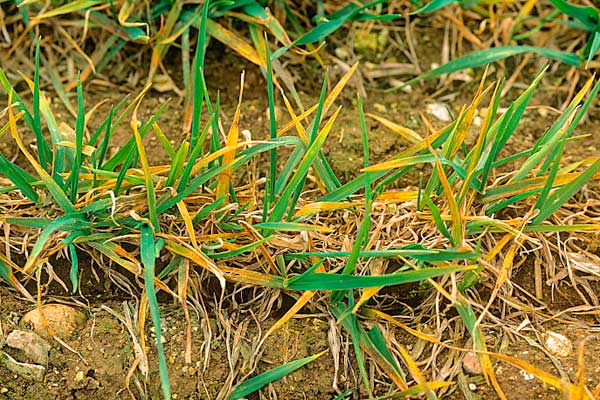
Damage caused by Barley Yellow Dwarf Virus – BYDV
The greatest danger from aphids arises from the fact that they transmit viral diseases and mainly Barley Yellow Dwarf Virus – Barley Yellow Dwarf Virus – BYDV. This disease causes great damage not only in Bulgaria but also worldwide. Infection of cereal plants occurs mainly in autumn, when aphids migrate from volunteer cereals and cereal grasses to the newly emerged crops.
Barley Yellow Dwarf Virus is transmitted persistently by aphids. The viruses are taken up by the pests when they suck sap from infected plants for 10 – 15 minutes. The latent period is from half a day to 14 days. The retention period of the virus continues until the death of the aphids and covers all larval instars, without reducing its infective capacity during their moulting. In infectious individuals, the pest is detected in the haemolymph and other organs of the aphid.
When aphids have multiplied to a high degree, it is mandatory to control them. The aim of this control is not so much to reduce their density below the economic threshold of harmfulness, as to prevent infection with Barley Yellow Dwarf Virus, which they transmit as soon as they first colonize the crops. It is necessary to use fast-acting insecticides whose lethal effect precedes the period of effective transmission of the virus from the pests to the plant. Considering the high risk of infection this autumn, one option for avoiding it is later sowing of the winter crops.