

![MultipartFile resource [file_data]](/assets/img/articles/kuerbis-traegt-keine-fruechte.jpg)
The family Cucurbitaceae (Cucurbitacea) includes the cultivated species of the genus Cucurbita – C. maxima (winter squash), C. moschata (musky pumpkin, butternut squash) and C. pepo (common pumpkin and summer squash); the genus Citrullus – watermelon, and the genus Cucumis – C. sativus (cucumber) and C. melo (melon). In recent years, scientific efforts have been focused on identifying and characterising drought-tolerant plant forms that can be used directly in production and in breeding programmes for the development of new cultivars possessing this trait. The current national programme implemented at the Institute of Plant Genetic Resources – Sadovo, where collections of local genetic resources are maintained, is concentrated on the study of pumpkin populations and melon accessions.
On a local, regional and global scale, pumpkins are characterised by a rich diversity of subspecies, varieties, types, cultivars and populations. They differ in morphological characteristics: habit; stems; leaves; petioles; ovaries; corollas; stamens; fruit size; flesh; shape, size and colour of the seeds. The fruits of non-cultivated plants vary greatly in shape, size, colouration and surface texture. For use in different directions in breeding, the following traits are of interest: bushy habit; red / orange fruit colour, increased dry matter and carotene content – suitability for use in the processing industry; yield potential; long-term storability – for fodder purposes; market suitability – taste, appearance, shelf life, transportability; suitability for intensive technologies – response to fertilisation, irrigation, increased planting density in crops and plantations; physiological properties – earliness, resistance to diseases, pests and adverse meteorological events. Under current conditions, specialised breeding and concentration of priorities in the development of final breeding products are required, focusing not only on the main economically valuable traits, but also on the introduction of an adaptive orientation when developing models of future cultivars. Drought stress associated with climate change is one of the main environmental factors causing a reduction in plant growth, development and productivity. Therefore, future breeding efforts will continue to be directed towards obtaining genotypes that are highly adaptable to dry and semi-arid conditions.
In the region of Sadovo, where the accessions were studied, no significant deviations from the climatic norm were found in terms of the average total amount of precipitation. Differences were observed in their distribution during the vegetation period and in the occurrence of extreme events in their character. At the beginning of the vegetation period, soil moisture is optimal for crop development. As a result of abundant rainfall, physiological deformations were even observed in the plants – stem cracking and changes in flower structure. Drought begins in July with the increase in temperatures and reaches critical levels in September, when rainfall is 80% below the multiannual norm.
A total of 43 local populations and cultivars from the family Cucurbitaceae with origin from 21 different locations in Bulgaria and botanical affiliation to 4 species, 6 varieties and 7 groups by cultivar type were studied. Accessions with irreversible damage and unsatisfactory results were gradually excluded from the sowing scheme. For the remaining ones, evaluation data were collected and physiological, biochemical and phytopathological analyses were carried out. In most accessions, drought had a negative effect on productivity, with yield reductions in fruits and seeds reaching up to 90% in some populations. One of the reasons for this is that nutrient uptake decreases under water deficit conditions. Water limitation causes a reduction in the number of fruits per plant and the number of seeds per fruit by disrupting nutrition and shortening the growth period of the plants. Another reason is that under long-day conditions and high temperatures, the formation of female flowers is reduced. When these conditions are combined with drought, pollen may rapidly lose viability. Also, the occurrence of drought stress during the reproductive stages causes a decrease in chlorophyll content and a shortening of the photosynthesis period.
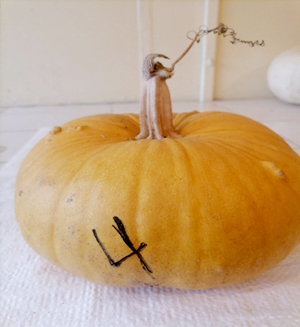
BGR6545 – Cucurbita pepo var. saccharata, Local population from the village of Beslen, Blagoevgrad
From the populations studied in field drought experiments, compared with the average yields from conventional production under irrigated conditions, four accessions were identified as promising with good yield potential. Two of them were collected during expeditions within the framework of the present project – No. B9E0057 and No. B9E0092, and the other two are part of the basic national collection for long-term conservation in the gene bank at the Institute of Plant Genetic Resources – Sadovo – BGR6545 and BGR6547. Physiological studies show the most stable response to environmental conditions in terms of growth intensity and water exchange in the accessions with catalogue numbers B9E0020 and B9E0043, and BGR3329, BGR6545 and BGR6547.
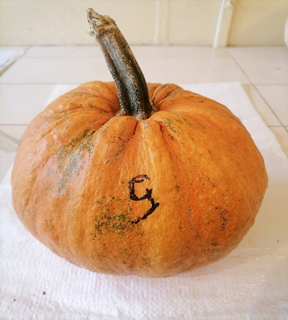
BGR6547 – Cucurbita pepo var. saccharata, Local population from the village of Skart, Blagoevgrad
Therefore, as a result of the comprehensive study, the following local populations with the best results in terms of both botanical and agronomic drought tolerance were identified: BGR6545 and BGR6547. Both accessions belong to the botanical species Cucurbita pepo var. saccharata, to different types according to the morphological characteristics of the fruits. Both accessions represent local populations collected in 1981 from different villages located in south-western Bulgaria. They showed higher values of fresh and dry mass, leaf water content, chlorophyll index and at the same time higher fruit yields. They are characterised by accelerated onset of flowering, which does not affect earliness and the fruiting period. Both accessions are medium-early, with BGR6547 standing out with compact fruit ripening, and BGR6545 – with the longest fruiting period, as at the time of harvest in mid-October 50% of the fruits were still unripe.
As with pumpkins, a great genetic diversity has been identified in melons preserved in the national collection. The main breeding objectives for melons in Bulgaria are: earliness, good organoleptic properties (taste qualities depending on the sugar content of the fruit), resistance to transport damage (thickness, elasticity and netted structure of the rind), productivity (average fruit weight and number of fruits per plant). The identification of accessions with a good complex of agronomic traits is a factor that maximally meets the requirements of breeding programmes and shortens the period of the improvement process. On the basis of the agrobiological study of the local populations from the collection, the following genotypes are of interest in this respect:
Cat. No. B4E0112 – Melon accession of local origin from the village of Malo Konare, Plovdiv province. According to the fruit index, it is characterised by an ovoid shape. According to the qualitative assessment – the rind is creamy, finely wrinkled, with light yellow stripes and well-expressed ribbing. The flesh is yellow-green in colour, aromatic and with very good taste qualities.
Cat. No. B4E0133 – Accession from a local melon population from the village of Chernogorovo, Pazardzhik province. Its fruits are ovoid in shape. The predominant colour of the rind is creamy, with light green stripes and slightly expressed ribbing. The flesh is light pink, aromatic, very sweet.
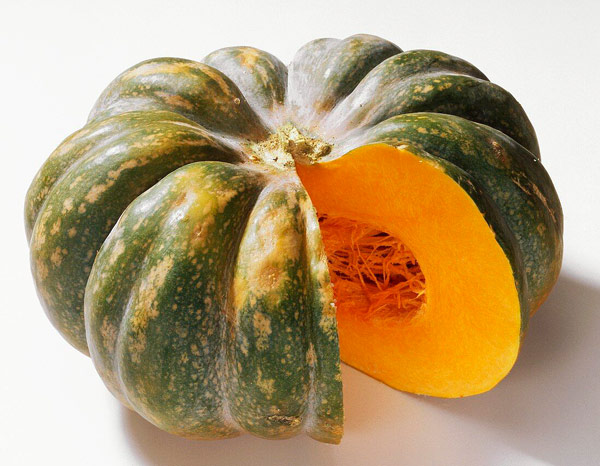
Cucurbita moschata
In conclusion, based on the conducted study of local populations, it can be summarised that the Bulgarian national gene bank preserves accessions suitable for use both directly in production and as a genetic basis for the development of new melon cultivars with a good complex of agronomic traits and high fruit mass: B4E0112 and B4E0133 (Cucumis melo); and drought-tolerant cultivars of the genus Cucurbita: BGR3329 (C. maxima), BGR6545 and BGR6547 (C. pepo). New accessions with good botanical drought tolerance – B9E0020 and B9E0043 (C. moschata) and agronomic drought tolerance – B9E0057 (C. maxima) and B9E0092 (C. moschata) have been added to the Cucurbitaceae collection through expeditions. Two local populations of the species Cucurbita pepo var. saccharata with good yield potential under drought conditions and stable response to environmental conditions in terms of growth intensity and water exchange have been identified: BGR6545 and BGR6547. The populations BGR6545, BGR6547, BGR3329, B9E0020 and B9E0043 have the highest values of morphometric indicators for drought tolerance. The highest yields under natural non-irrigated conditions were recorded for the accessions BGR6545, BGR6547, B9E0057 and B9E0092. The national collection of cucurbit crops is constantly being enriched with new accessions collected during expeditions in the country, provided by local producers, as well as through non-monetary exchange with various foreign organisations.