

![MultipartFile resource [file_data]](/assets/img/articles/заглавна-млада-рапица.jpg)
The use of effective and selective herbicides is an integral part of the agronomic practices for winter cereal crops (wheat, barley, oats, rye, triticale) and oilseed rape. In this regard, we present the results of our trials from recent years concerning the choice of timing and conditions for herbicide use in these crops.
Recently, we have witnessed changes in agro-meteorological conditions, which specialists claim are long-term trends in the climate of Bulgaria. If we accept the ongoing changes as consistent patterns, it becomes necessary to reconsider the strategy for chemical weed control.
In practice, two trends are evident. The first is related to earlier sowing of rape and wheat. When these earlier sowing dates coincide with a prolonged, warm and humid autumn, a mild and very often snowless winter, the conditions for weed germination, growth and development change significantly. The second trend is the sowing of new foreign wheat varieties and hybrids, with a low seeding rate – below 20 kg/da (below 400-450 plants/sq.m). This implies that already in autumn, before the wheat in these stands has entered the tillering stage, the weeds quickly occupy the free space.
In each specific case, we must take into account the phytotoxicity, selectivity and persistence of the herbicides used. Very often we observe manifestations of compensatory processes in weed infestation and a strong increase in the abundance of species that were until recently relatively insignificant. The reasons for this phenomenon are most often the long-underestimated low density of certain weed species, the systematic incorrect choice of herbicides, or the very long-term use of the same and insufficiently effective herbicides.
Some particularities in weed biology also contribute to failures in weed control – their high reproductive potential, the long-term preservation of seed viability in the soil, and the similarity in the life cycle between some weeds and the crops in which they spread.
It is well known to everyone that herbicides are plant poisons. Very often, there is only one step between them being an invaluable aid to farmers and becoming a means leading to major losses and failure.
The agro-meteorological conditions of each year are unique and unrepeatable. All those engaged in agriculture are constantly faced with a complex, dynamically changing and never climatically repeating environment. This is an objective reality that requires specialists to know the specific requirements and reactions of agricultural crops, especially to herbicides. In this sense, there is no more creative activity in agricultural practice than the correct selection and use of herbicides.
Above all, one must not forget the rule that crops should not be treated with herbicides if they are under the influence of any stress factor, such as freezing, high temperatures, large diurnal temperature amplitudes, severe drought or waterlogging, heavy attack by diseases and pests, insufficient or unbalanced mineral nutrition, etc.
Our observations show that in a normal autumn, with warm and humid October and November, and with early sowing, more than 90% of the weeds emerge simultaneously with the wheat and barley.

corn poppy
Under the conditions of Southern Bulgaria, fields are massively infested with corn poppy, field larkspur, speedwell species, chamomile, cleavers, charlock, wild radish, volunteer rape, coriander, herbicide-tolerant sunflower volunteers and the full diversity of winter-annual grass weeds.
Only if the following conditions are simultaneously met: normally emerged and well-established cereal stand, which has reached the beginning of the tillering stage and is in good physiological condition, without stress from the above-mentioned abiotic and biotic factors, with daytime temperatures above 12 degrees and night temperatures at least 2-3 degrees above zero, as well as with a forecast that no negative temperatures are expected in the next few days, the herbicides registered in our country may be used already in autumn. If even one of these conditions is not present, problems are possible and we do not recommend autumn herbicide application in winter cereals.
When all favourable conditions are present, we strongly recommend that the most heavily infested fields be treated with herbicides already in autumn, so that the crops are freed in time from weed competition. Through autumn herbicide application, higher efficacy is ensured, as weeds are in earlier growth stages and can be controlled even with lower doses. A disadvantage of this treatment is the risk of phytotoxicity to cereals in the event of unexpectedly low night temperatures after herbicide application, as well as the possibility of partial secondary weed infestation in spring.
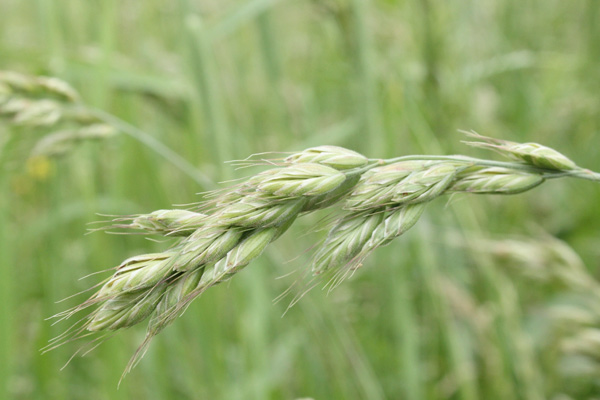
brome grass
We consider autumn treatment to be most imperative in those wheat stands that are infested with grass weeds, especially with ryegrass species, brome grass, fescue, as well as with volunteers from Clearfield rape hybrids and volunteers from herbicide-tolerant sunflowers (Express and Clearfield), and others. Autumn treatment of wheat is appropriate only on areas free from perennial root-suckering weeds – field bindweed and creeping thistle, since reinfestation with them in spring is guaranteed. Fields infested with these species must be treated with glyphosate-containing herbicides (Roundup and others) during the non-vegetation period.
The results of many of our trials show that, against volunteers from Clearfield rape in subsequent crops in the rotation, the most effective active substance so far is 2,4-D. In a subsequent wheat crop, when volunteer rape of this type is present, it is recommended to add at least 50 ml/da of products containing 2,4-D to the spray solution. It is unacceptable to reduce the herbicide dose of 2,4-D below this limit, as a reverse, stimulating effect of the hormone-type herbicide on Clearfield rape volunteers is observed. Another possibility for controlling herbicide-tolerant rape up to the rosette stage is the use of MCPA-based herbicides, such as Agroxon 500 SL (200 ml/da), EMCE (100 ml/da) and U 46 M Fluid (200 ml/da). Of course, these herbicides must be applied at their full registered doses in order to achieve a high herbicidal effect against volunteers. Some of the more widely used herbicides containing the active substances florasulam (Derby Super WG – 3.3 g/da) or tritosulfuron + florasulam (Biathlon 4 D – 5.5 g/da), obligatorily applied with an adjuvant, can control herbicide-tolerant rape well, but only up to the cotyledon stage.
After sowing and before emergence of wheat and barley, herbicides based on pendimethalin can be used – Stomp Aqua, Sharpen 330 EC – 250-300 ml/da, Pendinova, Pendigan 330 EC – 400-600 ml/da; based on diflufenican + chlorotoluron – Constel – 450 ml/da; based on diflufenican + flufenacet – Battle Delta – 60 ml/da and others. These products can also be used early post-emergence in the crops and have a mixed spectrum of action. They affect weeds such as blackgrass, loose silky-bent, annual meadow grass, speedwell, cornflower fumitory, corn poppy, wild radish, chickweed, chamomile, cleavers, field pansy, charlock, shepherd’s needle, red dead-nettle, couch grass and others. Wild oat is moderately sensitive. Against annual ryegrass species, the use of the herbicide Constel is recommended, but only in wheat. For control of annual ryegrass, meadow fescue, brome grass and rape volunteers (Clearfield), in autumn 2020 and 2021 we tested the newly registered product in wheat Mateno Forte (450 g/l aclonifen + 75 g/l flufenacet + 60 g/l diflufenican) at doses of 160 ml/da and 200 ml/da. These are in fact its already registered doses. The herbicide Mateno Forte, applied after sowing and before crop emergence at a dose of 200 ml/da, has satisfactory herbicidal effect against brome grass, meadow fescue and annual ryegrass. Only against Clearfield rape volunteers is the efficacy slightly lower (75–80%). At the lower tested dose of 160 ml/da, the trend is almost preserved, with herbicidal control of rape volunteers decreasing to 50–60%. With early post-emergence treatment with Mateno Forte, herbicidal efficacy increases both against the existing weeds in the trial and against Clearfield rape volunteers, reaching 90–95% control, regardless of the treatment dose. To achieve such high efficacy, it is essential to have optimal soil moisture.
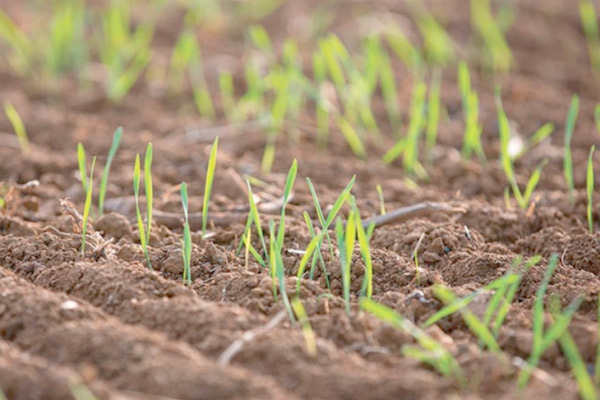
Before emergence, as well as after the 3rd leaf stage of wheat and barley, it is possible to use the chlorosulfuron-containing product Eagle 75 WG (Glean 75 WG) at doses of 2–2.5 g/da and 1–1.5 g/da, respectively. Weeds sensitive to the chlorosulfuron-based herbicide are speedwell species, coriander, black mustard, shepherd’s purse, field pansy, chamomile, corn poppy, common couch grass, charlock, chickweed, common field speedwell, dead-nettle species, wild radish, cornflower, summer adonis, greater celandine, sunflower volunteers, field bindweed, ivy-leaved speedwell, cleavers, field pansy, cornflower fumitory, blackgrass species, annual ryegrass species and others. Eagle should be applied only on areas intended for monoculture cultivation of wheat and barley. In case of crop failure of wheat or barley treated with the product, only wheat or barley may be sown afterwards. In the crop rotation, as an exception and only in suitable years with favourable meteorological conditions, mainly in terms of rainfall, field crops such as rape and sunflower may be sown, which in other cases are extremely sensitive to chlorosulfuron. In addition, these soils must have a higher humus content and active microbiological activity contributing to faster herbicide degradation in the soil. Therefore, ultimately, these exceptions are risky in agriculture.
During warm autumn days, after the 3rd leaf stage of wheat, herbicidal products can be successfully used for control of major grass weeds: Axial 050 EC (pinoxaden) – 60–90 ml/da, Traxos 50 EC (clodinafop + pinoxaden) – 120 ml/da, Puma Super 7.5 EW (fenoxaprop-P-ethyl) – 100–120 ml/da and Scorpio Super 7.5 EW – 100 ml/da. These products are effective against wild oat species, cornflower fumitory, blackgrass, annual meadow grass and others. Of the herbicides listed, only Axial 050 and Traxos control annual ryegrass species. None of the products mentioned are effective against brome grass species.
Against broadleaf weeds in wheat and barley after the beginning of tillering, the following are recommended: Derby Super (florasulam + aminopyralid) – 2.5–3.3 g/da, Cameo Max (tribenuron + thifensulfuron) – 4 g/da, Arat (tritosulfuron + dicamba) – 10 g/da, Biathlon 4 D (florasulam + tritosulfuron) – 4–5.5 g/da, Ally Max (metsulfuron + tribenuron) – 3.5 g/da, Sekator OD (amidosulfuron + iodosulfuron) – 10–15 ml/da, Buctril Universal (2,4-D + bromoxynil) – 100 ml/da, Mustang 306.25 SC (2,4-D + florasulam) – 60–80 ml/da, Ergon WG (metsulfuron + thifensulfuron) – 5–9 g/da, Accurate Extra WG (metsulfuron) – 5 g/da, Bellure T (tribenuron) – 2 g/da, Beflex (beflubutamid) – 50–63 ml/da, Omnera OD (fluroxypyr + metsulfuron + thifensulfuron) – 75–100 ml/da, Tripali WG (tribenuron + metsulfuron + florasulam) – 5 g/da and others. The listed herbicides successfully control weeds such as cleavers, corn cockle, field speedwell, corn poppy, coriander, red dead-nettle, charlock, shepherd’s purse, common vetch, larkspur species, summer adonis, field speedwell, stem-clasping dead-nettle, field pansy, chamomile species, wild radish, common couch grass, chickweed, common field speedwell, dead-nettle species and others. Moderately sensitive weeds are ivy-leaved speedwell, cornflower and creeping thistle.
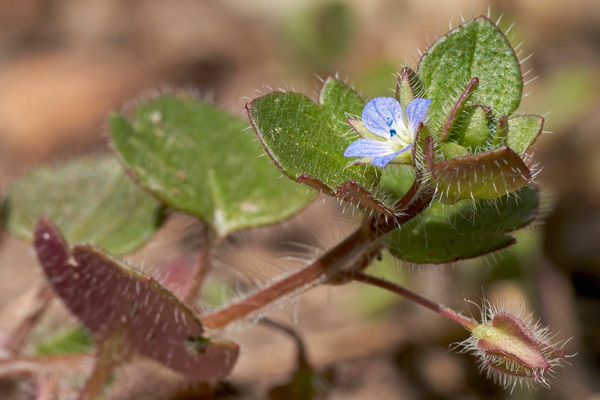
ivy-leaved speedwell
On the market, most registered herbicides from the sulfonylurea group control speedwell species with difficulty or very weakly. The newly registered product Pontos, which contains two active substances (flufenacet + picolinafen), has high efficacy in the range of 90–95% against this weed. To achieve this high level of control, optimal soil moisture is required at the time of treatment and for at least 5–6 days thereafter. Picolinafen belongs to the group of CBI inhibitors, and flufenacet to the group of VLSFA inhibitors, and they have different modes of action. The product is registered for control of annual grass and broadleaf weeds, including Italian ryegrass, blackgrass, loose silky-bent, annual meadow grass, violet, speedwell species, volunteers from Clearfield rape and others, in soft and durum wheat, winter barley and triticale. It can be applied both after sowing and before emergence of winter cereals, as well as early post-emergence up to the tillering stage. The application rates vary from 50 to 100 ml/da.
Under conditions of mixed weed infestation, at the beginning of wheat tillering, the following herbicides are recommended: Palas 75 WG (pyroxsulam) – 20–25 g/da, Corello Duo (pyroxsulam + florasulam) – 26.5 g/da, Hussar Max OD (iodosulfuron + mesosulfuron) – 100 ml/da, Pacifica Expert (amidosulfuron + iodosulfuron + mesosulfuron) – 30–50 g/da, Zerrate (pyroxsulam + clodinafop) – 25 g/da, Atlantis Flex 20.25 WG (propoxycarbazone + mesosulfuron) – 20–33 g/da, Axial One EC (florasulam + pinoxaden) – 100 ml/da and others. The latter product is also registered for use in barley. The listed herbicides can also be applied at the stem elongation stage (first–second node), provided that the sensitive weeds have not overgrown. Broadleaf weeds are most sensitive at the 3rd–5th leaf stage, and grass weeds up to the beginning of tillering. Of all the herbicides listed above, those with high efficacy against winter-annual weeds such as brome grass and meadow fescue are Palas 75 WG, Corello Duo and Zerrate. All listed herbicides are highly effective against the following weed species: cornflower fumitory, wild oat, blackgrass, annual ryegrass, shepherd’s purse, cleavers, coriander, corn poppy, chickweed, field speedwell, charlock, dead-nettle species, chamomile species, wild radish, dead-nettle species and others. Since most of these herbicides belong to the sulfonylurea group, complete weed death occurs four to six weeks after treatment. Nevertheless, once they reach the sensitive weeds, the products are rapidly absorbed by the leaves and immediately stop their growth and development.
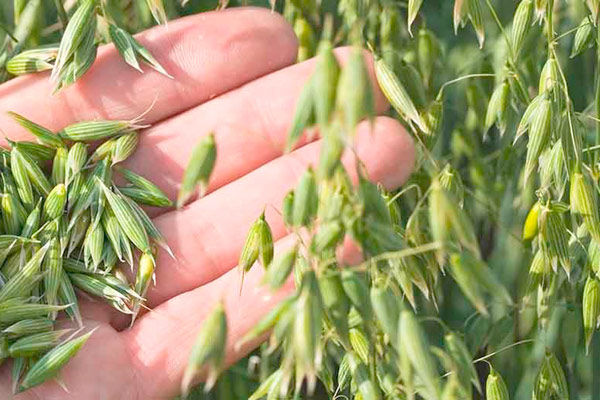
Oats is a plant with a well-developed root system, and under favourable soil conditions and optimal fertilisation, it forms a well-established stand early in spring that successfully suppresses weeds. Against broadleaf weeds in oats, MCPA-based herbicides can be used, which are more tolerant to the crop compared to 2,4-D. Other registered products include: Biathlon 4 D, Buctril Universal, Lontrel, Omnera, Refine Extra, Starane Gold, Tripali, Flurostar and others. The results of our trials show that the crop tolerates very well the action of Derby Super, Mustang SC and Defender SL. Of the herbicides registered in our country, none can be used against wild oat in cultivated oats. Control of this weed must be carried out by agronomic measures or by using herbicides in the preceding crop.
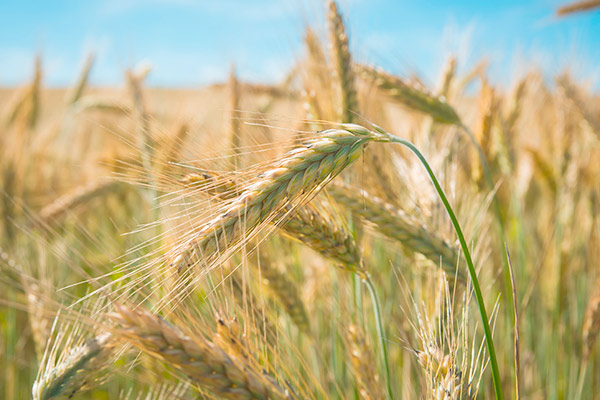
rye
In rye and triticale, all herbicides for control of grass and broadleaf weeds listed for wheat and barley can be successfully used.
In many winter cereal varieties, differences in their reaction to individual herbicides have been established, which must also be taken into account for correct selection.
The undeniable advantage of autumn treatment is that the crop is freed in time from weed competition and the effectiveness against weeds is guaranteed to be higher.
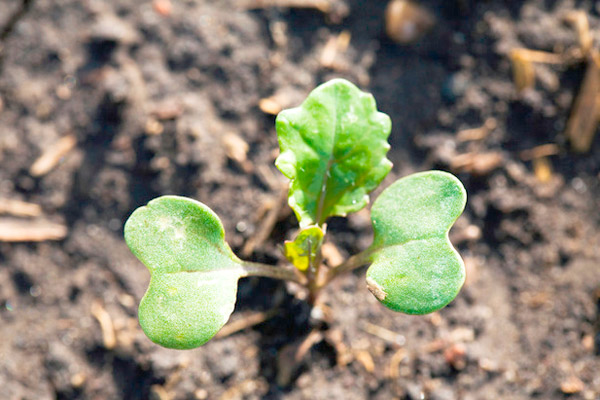
Winter oilseed rape in our country is increasingly sown in August and early September. If this excessively early sowing coincides with sufficient rainfall for crop emergence and initial development, highly effective herbicides must unconditionally be used for weed control. The long period of active weed vegetation in rape stands (September – November) requires the herbicide campaign to be carried out in autumn. In this way, the crop is freed in time from weed competition regarding the main life factors – light, water and nutrients. In addition, autumn treatment results in higher efficacy against weeds, as well as higher selectivity towards rape.
In conventional rape hybrids, weed control must necessarily be carried out in autumn mainly with soil-applied and post-emergence herbicides up to the “rosette” stage of the crop.
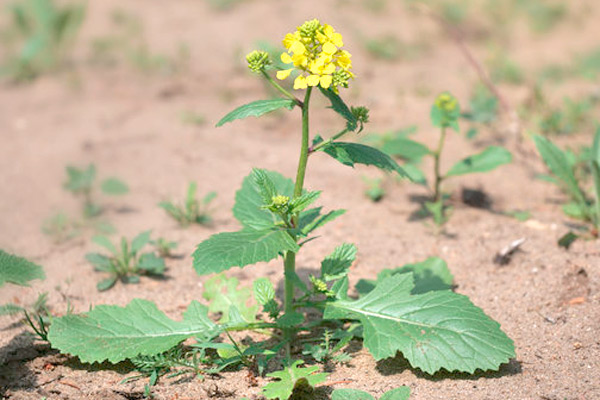
For control of annual grass and some broadleaf weeds (excluding cruciferous species such as charlock and wild radish) in rape, the following soil-applied herbicides can be used after sowing and before emergence of the crop and weeds: Devrinol 4 F (napropamide) at 300–350 ml/da; Kalif 360 SC, Reactor 36 SC and Sirtaki (clomazone) at 33 ml/da; Kalif 480 EC at 20 ml/da; Kalif Mega 3K (clomazone + metazachlor) at 250 ml/da; Teridox 500 EC (dimethachlor) at 200 ml/da. Brasan 540 EC (dimethachlor + clomazone) is another product for rape. It is a selective, systemic, soil-applied herbicide for control of annual broadleaf and some grass weeds. It is applied at 200 ml/da, after sowing and before crop emergence. Another newly registered product in rape is the herbicide Nero EC (pethoxamid + clomazone). It is registered at 300 ml/da and is used for control of annual broadleaf and grass weeds. It must be applied after sowing and before emergence (up to the fifth day after sowing) and should not be used more than once every three years on the same field.
For control of grass and broadleaf weeds (excluding cruciferous species) before emergence of the crop and weeds, as well as early post-emergence, the following are registered: Butisan 400 SC, Butisan S, Sultan 500 SC (Brother 500 SC), all containing the active substance metazachlor at 200 or 250 ml/da of the products. The use of products based on the active substance metazachlor is permissible no more often than once every third year on the same arable area. It is worth noting that if rainfall exceeds 40–50 l/sq.m in the period from sowing to emergence, this may cause thinning of the rape stand.
Other soil-applied herbicides that can be used in rape are Butisan Max SL (metazachlor + dimethenamid-P + quinmerac) at 200–250 ml/da; Electron 500 SC (metazachlor + quinmerac) at 200 ml/da; Springbok EC (dimethenamid-P + metazachlor) at 250 ml/da; Bismark SC (clomazone + pendimethalin) at 120–150 ml/da; Colzor Trio EC (dimethachlor + clomazone + napropamide) at 400 ml/da.
For control of some broadleaf weeds (speedwell, chamomile, cleavers, creeping thistle, coriander, corn cockle, couch grass, field bindweed and others) in rape (from the 2nd leaf to the 9th or more leaves of the crop), the following are successfully used: Lontrel 72 SG (clopyralid) at 17–21 g/da, Cliofar 600 SL (clopyralid) at 25 ml/da.
The herbicide Galera Super SL (clopyralid + picloram + aminopyralid) is registered at 20 ml/da from the 2nd leaf stage up to 9 or more formed internodes of the crop. The product shows high selectivity to rape even when applied at increased doses and in later growth stages of the crop. With its three active substances, Galera Super is a broad-spectrum herbicide. It is effective against chamomile, speedwell, corn poppy, larkspur, cleavers, chickweed, field pansy, field bindweed, creeping thistle and others. The results of all our trials over the past 7–8 years show excellent tank-mix compatibility of Galera Super with the main grass-control herbicides registered in rape.
For control of cruciferous weeds such as charlock and wild radish in conventional rape hybrids, Modown 4 F (bifenox) is recommended at 100 ml/da. The product has satisfactory herbicidal effect (70–80%) against these two weeds and good selectivity to the crop. Herbicides Belkar (halauxifen + picloram) and Korveto (halauxifen + clopyralid), which are registered in conventional rape for very good control of major broadleaf weeds including charlock and wild radish, can also be included here. For high selectivity, Belkar must be applied no earlier than the unfolded second leaf stage of the crop at 25 ml/da. At a more advanced stage (unfolded sixth leaf to the beginning of stem elongation), a higher registered dose of 50 ml/da can be used, especially when cruciferous weeds such as charlock and wild radish are present. The herbicide Korveto is registered at 100 ml/da. It is applied at more advanced stages of rape development – at the beginning of stem elongation (presence of flower buds) in spring.
During rape vegetation in autumn, the use of some post-emergence grass-control herbicides is also recommended, such as: Agil 100 EC /Shogun 100 EC/ (propaquizafop) at 50–80 ml/da; Zetrova 100 EC (propaquizafop) at 50–200 ml/da; Targa Super 5 EC, Leopard 5 EC (quizalofop-P-ethyl); Pantera 40 EC /Panarex or Rango 40 EC/ (quizalofop-P-tefuryl) at 80 ml/da; Stratos Ultra (Focus Ultra) (cycloxydim) at 100 ml/da; Select Super 120 EC, Shadow (clethodim); Fusilade Forte 150 EC (fluazifop-P-butyl) at 130 ml/da and Frequent (fluazifop-P-butyl) at 200 ml/da. It is recommended that these herbicides be applied at the 2nd–5th leaf stage of the sensitive grass weeds and volunteers, regardless of the rape growth stage. They are effective against wild oat, brome grass, blackgrass, cornflower fumitory and cereal volunteers. None of the above-mentioned post-emergence grass herbicides are effective against fescue.
The Clearfield® technology in rape is used only with imazamox-tolerant hybrids. The product Cleranda (metazachlor + imazamox) is applied, registered at 150–200 ml/da alone or with the addition of the adjuvant Dash. Against some weed species, the addition of Dash increases the efficacy of Cleranda by more than 20%. Cleranda is used for control of grass and broadleaf weeds and cereal volunteers. It is applied in autumn post-emergence in the crop at the 2nd–6th leaf stage, at the 2nd–6th leaf stage of broadleaf weeds and before tillering of grass weeds and cereal volunteers. Thanks to its simultaneous soil and foliar action, Cleranda also controls later (secondary) emerging weeds. The addition of Dash ensures better adhesion and penetration of the active substances into the weeds. In addition, this increases herbicide efficacy in cold weather. Cleranda may be applied on the same field no more often than once every third year. When used at its registered doses and application timings, Cleranda is extremely selective to oilseed rape – Clearfield hybrids. The higher registered dose (200 ml/da) is recommended where ryegrass density is higher and broadleaf weeds are at more advanced growth stages. The main advantage of this technology is that a single treatment destroys all existing weeds in rape stands. It is important to note that delayed treatment with Cleranda reduces efficacy against speedwell and ryegrass. Cleranda is the only post-emergence herbicide that successfully controls the root parasite broomrape in rape stands (through spring application) and fescue, which is not affected by post-emergence grass herbicides.
Another product containing the active substance imazamox for Clearfield rape hybrids is Cleravo (quinmerac + imazamox). The herbicide is applied from full cotyledon formation up to the 8th leaf stage of the crop at 100 ml/da for control of annual broadleaf and grass weeds.
Clearfield rape volunteers often occur as a significant and difficult-to-eradicate weed in arable land within the crop rotation.
In over 90% of cases, rape treatment with herbicides must be carried out in autumn and, by exception, in spring, but at the very beginning of crop vegetation and strictly before the onset of stem elongation. Delayed herbicide use leads to a sharp reduction in yields due to strong weed competition and the limited selectivity of herbicides in these late growth stages.
Modern chemical weed control is an immense field that requires continuous, complex research and improvement, in order to bring our knowledge as close as possible to the full potential of each product, to make maximum use of its benefits and to avoid its shortcomings.
For chemical weed control to be maximally effective, it must not be schematic, but carried out on the basis of correct diagnosis and forecast of weed infestation. On this basis, the type, dose, timing and conditions of herbicide application must be determined in order to achieve an optimal agronomic, environmental and economic effect.