

![MultipartFile resource [file_data]](/assets/img/articles/заглавна-волфия.jpg)
To stop climate change, we must also change our eating habits and make an environmentally responsible choice.
When it comes to addressing climate change, the focus is mainly on clean energy solutions. But the global chain related to the production and distribution of food is also a significant source of carbon emissions, for which there is still no lasting solution. Changing the diet, including by cultivating and consuming “novel foods”, is part of a possible solution to the problem. An example of such a “novel food” is Wolffia, which was approved on 10 December 2021 by an Implementing Regulation for the territory of the EU.
In tackling climate change, the focus is often on clean energy solutions – the deployment of renewable sources, improving energy efficiency, or switching to low-carbon transport. In fact, energy, whether electricity, heat, transport or industrial processes, accounts for the largest share – 74% of greenhouse gas emissions. But the global food system, which includes the production, processing and distribution of food, is also a key source of emissions. Globally, food production is the source of about 26% of them. And this is a problem for which there are still no effective technological solutions in the world.
Food, energy and water are the resources that the UN calls the “nexus link” for sustainable development. As the world’s population grows and becomes wealthier, demand for all three is also increasing rapidly. Besides their rising demand, they are also highly intertwined: food requires water and energy, conventional energy production requires water resources, agriculture is a potential source of energy.
What are the environmental impacts of food production and agriculture?
Some of the main global impacts are as follows:
- Food production is the source of more than 1/4 (26%) of global greenhouse gas emissions;
- 50% of the world’s habitable land (excluding ice and deserts) is used for agriculture;
- 70% of the world’s freshwater is used for agriculture;
- 78% of global organic pollution of the oceans is caused by agriculture;
- 94% of the biomass of mammals (excluding humans) is livestock. This means that farm animals are 15 times more numerous than wild mammals. Of the 28,000 threatened animal species on the Red List of the International Union for Conservation of Nature (IUCN), 24,000 are listed as being threatened by agriculture and aquaculture.
Thus, food proves to be at the centre of efforts to combat climate change, reduce water scarcity, reduce pollution, convert land into forests or pastures and conserve wildlife worldwide. To be able to calculate how the production of different types of food affects the climate, an indicator of their ecological footprint is used. The ecological footprint of foods is measured in square metres of land needed to produce 1 kg of food. Here is what it is for some of the most commonly consumed foods:
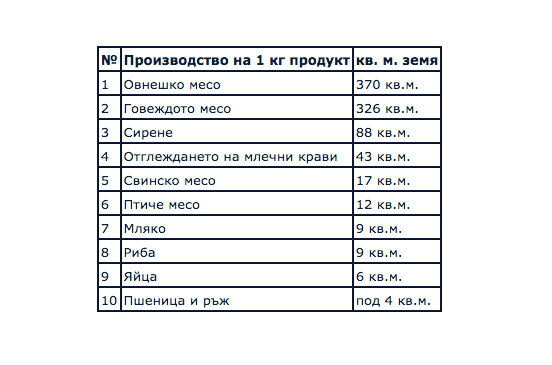
Ecological footprint of foods. Data source: Global Footprint Network
“Novel food” is one possible solution to the problem
What are the possible ways to solve this problem? We need a set of solutions: changing diets, reducing food waste, increasing the efficiency of agriculture, and technologies that make low-carbon food alternatives scalable and affordable. Part of the solution are the so-called “novel foods”. Since 1 January 2018, the new Regulation (EU) 2015/2283 on “novel foods” has been applicable in the territory of the EU.
“Novel food” is defined as food that has not been consumed to a significant degree by humans in the EU before 15 May 1997, when the first regulation on novel foods entered into force.
“Novel food” may be newly developed, innovative food, food produced using new technologies and production processes, as well as foods that are (traditionally) consumed outside the EU.
Examples include the larvae of the yellow mealworm (Tenebrio molitor) and the house cricket (Acheta domesticus), which have been authorised for human consumption by the European Food Safety Authority. With the new regulation from December, the placing on the market of fresh plants of Wolffia was officially authorised. Compared with those listed above, Wolffia is a food whose production has a minimal ecological footprint and minimal greenhouse gas emissions.
Wolffia is authorised as a “novel food” in the territory of the EU
Wolffia, also known as Wolffia arrhiza, Wolffia globosa and water meal, is a small floating aquatic plant. It is a monocotyledonous species from the botanical subfamily Lemnaceae – duckweeds, and belongs to the so-called macrophytes. Wolffia species are found in Europe, Asia, America and other parts of the world; they are adapted to variations in geographical and climatic zones. It is a fast-growing angiosperm plant and can cover a lake or other water body within a few days under favourable environmental conditions. The optimal temperature for its growth and development is 15 – 22 °C, and it develops on the surface of the water in natural or artificial water bodies. Wolffia requires sufficient and bright natural or artificial light, without being exposed to direct sunlight. In nature, Wolffia prefers stagnant water, such as small lakes or old river beds (oxbow lakes); under unsuitable conditions it does not reproduce. Flowing water is destructive for it and it does not survive there. Under favourable conditions the plant grows very rapidly and reproduces by simple division. It is important to control the very process of reproduction so that it does not fill the entire surface area of the basin. It should not be grown in ponds with herbivorous fish species, because otherwise the fish will consume the entire amount of the plant.
Description
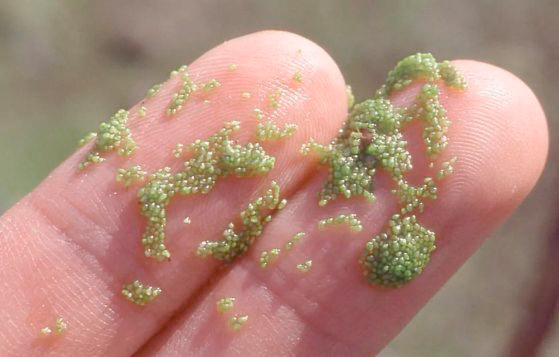
Wolffia close up. Photo source: Personal archive
Wolffia is considered to be the smallest flowering plant on the planet, living in various water bodies on Earth, and is also classified as a type of duckweed. Its size does not exceed 1 mm. As mentioned above, this millimetre-sized plant lives on the surface of water bodies; it lacks a root system and has no leaves. The leaf-like body is called a scutellum or frond. This frond is round, with a diameter of up to 1.3 mm. Stem: thin, up to 9 mm long and 1.5 mm wide. Thanks to their stalks they form star-shaped clusters. While other plants have flowers and bloom 1–2 times per season, Wolffia almost never flowers. From a botanical point of view, the fruit of Wolffia is single-seeded and resembles a bladder. The spherical fruit contains a small, smooth seed measuring 0.5 mm.
Cultivation
The plant develops throughout the year and is undemanding with regard to environmental conditions. It does not require a special temperature regime – water temperatures of 14 — 16 °C are sufficient, and the pH level is not critical. It is optimal if the plant grows in soft, slightly acidic water, with regular water changes. It is advisable to aerate the water with an aquarium pump in order to prevent the formation of a bacterial film, which would be fatal for the plant itself. Under artificial lighting it should be shaded, because it cannot tolerate direct ultraviolet light. Under good conditions, Wolffia reproduces very quickly and covers the entire vessel in which it is grown. For its cultivation, a container or aquarium with a volume of 30 litres of water is sufficient. A water pump is attached to the bottom of the container to create a water flow. The container should not be exposed to direct sunlight, as this may burn the plant. The temperature should be room temperature. The species grow in water of any depth, but they do not survive in water that moves at a speed of more than 0.3 m/sec. or water that is also exposed to wind.
Use
Wolffia arrhiza is an extremely useful aquatic plant. It is a rich source of plant proteins (20% of dry matter); up to 44% are carbohydrates, and therefore it is an excellent fresh food for humans or feed in the rearing of farm animals and in aquaculture. Interestingly, Wolffia contains as much plant protein as soybeans. The plant is rich in vitamins A, B2, PP and B6. Its easy cultivation in urban conditions in rooftop or vertical farms and its low carbon and ecological footprint make it an excellent alternative for inclusion in the human food chain and a tool for limiting the negative impact of food production on climate change.
Environmental benefits
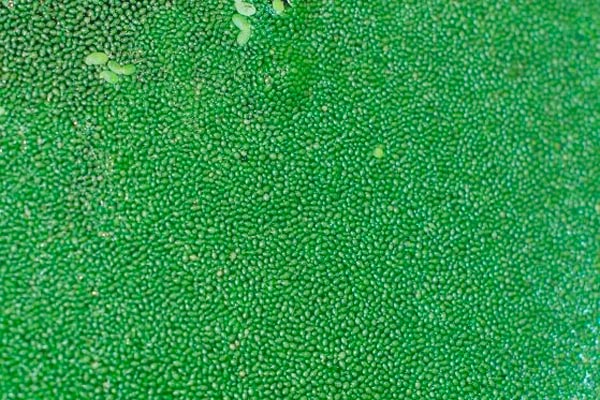
Wolffia can be used for wastewater treatment. Photo source: Personal archive.
Wolffia acts as a bioremediator of excess phosphorus and nitrogen due to its rapid growth and uptake of these elements. It can accumulate toxic heavy metals such as lead, cadmium, chromium and arsenic, as well as cyanotoxins such as microcystin. Wolffia accumulates sex steroids and corticosteroids that are found in wastewater. Thanks to its rapid growth rate, Wolffia is capable of absorbing a large amount of pollutants, thereby purifying the water from them. Due to its rapid growth and ability to absorb a significant amount of nutrients, it can successfully be used for bioremediation of wastewater from poultry and pig farms. The plant is also a very good CO2 sink from the atmosphere. It has been established that one hectare of water surface covered with Wolffia is capable of capturing 21,266 kg of CO2 (C) per year. As a key factor in climate change, humanity today must change its habits, including its eating habits, and make its environmentally responsible choice for the future of our planet.
Diseases and pests
Wolffia reproduces at a very fast rate and begins to dominate the water body, so there is no information about pests and diseases affecting it. Even if part of it is damaged, it dies, which does not affect the total amount of plant biomass.
Propagation
Under optimal conditions Wolffia grows rapidly and propagates by division of the mother culture, filling the surface of the water. How does the process of division and propagation occur? The daughter plant separates from the parent plant and then grows and develops independently, detaching from it. After the separation, the mother plant dies.
Today, humanity still does not have an easy solution that would make agriculture more sustainable and climate-friendly, but those at the forefront of change prove that solutions do exist. The combination of technological innovations, new ways of farming and changing consumer demand will bring about a significant change in the global food footprint. These are the tools, technologies and practices that could completely transform food production from an environmental burden into an environmental solution. Whether we use them effectively depends on us.
The following materials were used in this publication:
- Regulation (EU) 2015/2283 of the European Parliament and of the Council of 25 November 2015 on novel foods, amending Regulation (EU) No 1169/2011 of the European Parliament and of the Council and repealing Regulation (EC) No 258/97 of the European Parliament and of the Council and Commission Regulation (EC) No 1852/2001
- Commission Implementing Regulation (EU) 2021/2191 of 10 December 2021 authorising the placing on the market of fresh plants of Wolffia arrhiza and/or Wolffia globosa as a traditional food from a third country under Regulation (EU) 2015/2283 of the European Parliament and of the Council and amending Commission Implementing Regulation (EU) 2017/2470
- Water lentils Delicious and healthy, Cees Gauw & Yvonne Derksen, A publication of ABC Kroos BV and Hogeschool VHL; May 2015
- Duckweed as human food. The influence of meal context and information on duckweed acceptability of Dutch consumers. de Beukelaar, M. F. A., Zeinstra, G. G., Mes, J. J., & Fischer, A. R. H. (2018). Duckweed as human food. The influence of meal context and information on duckweed acceptability of Dutch consumers. Food Quality and Preference, 71, 76–86. https://doi.org/10.1016/j.foodqual.2018.06.005
- Hamdan, H.Z., Houri, A.F. CO2 sequestration by propagation of the fast-growing Azolla spp.. Environ Sci Pollut Res (2021). https://doi.org/10.1007/s11356-021-16986-6
Source: Wolffia – a “novel food”, but also an opportunity to combat climate change, Klimeteka
The author, Roman Rachkov, is part of the Klimeteka editorial team. He is an agronomist, a specialist in tropical and subtropical agriculture, and a long-standing expert in integrated and organic plant protection. He is Chair of the Bulgarian Association for Organic Plant Protection and has interests in the field of invasive insect species in Europe.