

![MultipartFile resource [file_data]](/assets/img/articles/3_Drechslera_graminea-1.jpg)
Seed-borne diseases are a major limiting factor for barley production. The most important pathogens are Ustilago nuda, causing loose smut, and Helminthosporium graminea, causing stripe disease.
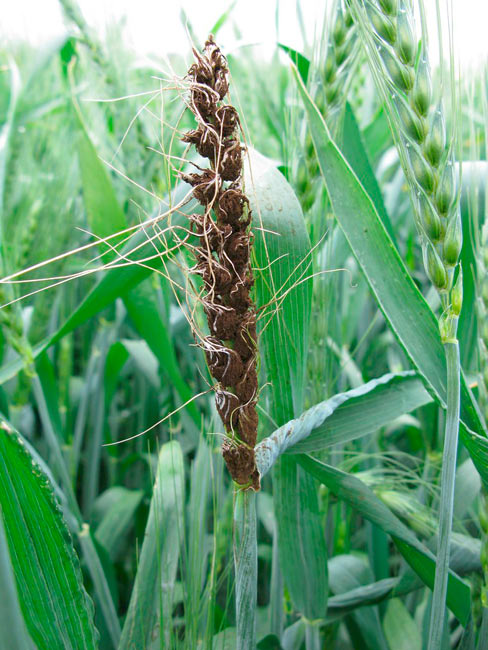
Loose smut is of great economic importance for barley. The characteristic symptoms of the disease appear during heading. In the infected ear, instead of grains, a black mass of smut spores is formed, into which it is transformed. As a rule, all parts of the ear are destroyed. Only the rachis and sometimes a small part of the awns remain unaffected. Control of this disease is carried out mainly through pre-sowing seed treatment and by breeding. The winter malting variety Perun possesses resistance to the causal agent of loose smut.
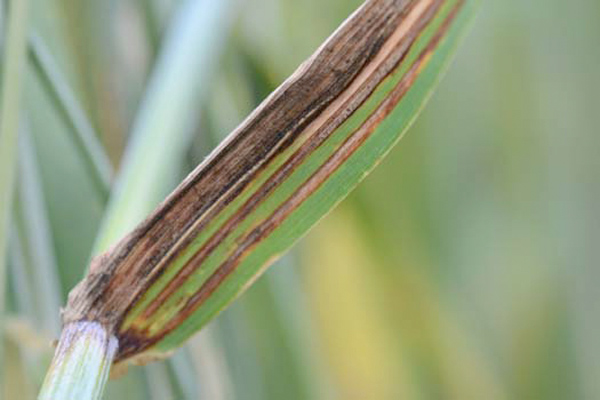
Stripe disease is of decisive economic importance for barley. The symptoms of the disease are observed from seedling emergence to ripening, but the most characteristic are the symptoms in the period after heading. Light yellow spots develop on the leaves, which gradually elongate between the veins. Subsequently, the spots darken and split lengthwise into 2–3 stripes. Gradually, the infected leaves dry out completely. The attacked plants do not head or remain sterile. In rare cases, when they form grains, these are shrivelled and poorly developed. The limitation of the spread of the disease is carried out mainly through seed disinfection.
Seeds, as a form of new life, are fragile and weak and need care. And this care begins with disinfection. Treating the seeds with an appropriate product protects not only them, but also the sprouts, roots and young plants in the initial stages of their development. It is known that the available seed treatment products also have a stimulating effect on germination and on the development of young plants. Uniform germination and emergence, even development and a secure yield are ensured. The choice of a seed treatment product depends on many conditions. It is necessary to know the level of seed contamination with the causal agents of seed-borne pathogens. This information is obtained by performing a phytopathological analysis. On this basis, a suitable fungicide is selected. The crop stand is in optimal condition when no contamination has been established. Treatment of seed material in elite seed production is mandatory. The choice of product also depends on the seed treatment equipment. Treatment with properly functioning equipment, which doses the product accurately, ensures high-quality and uniform coverage of the seeds. The spectrum of activity of seed treatment products is related to the ability of the active substances to penetrate into the host tissues. Contact fungicides cannot suppress the development of pathogens inside the seed, but only on the surface. They provide protection against infection from the soil and on the seed surface. The active substances of systemic fungicides provide reliable protection against smuts caused by surface or internal infection, suppress the development of root rots, and inhibit the development of septorioses in the early stages of ontogenesis. The use of systemic fungicides is recommended – they provide more reliable protection.
When treating seeds with chemical means, it is mandatory to observe certain conditions:
- Proper selection of seed treatment equipment.
- Strict adherence to the instructions for application of the respective product.
- Strict observance of the specified dose.
The quality of seed disinfection determines the effect of the fungicide. It is necessary for the product to reach every grain and to ensure uniform coverage of its surface.
Disease control is effective when it is carried out in an integrated manner, with the necessary preventive, economic and environmental orientation. Observance of the main agrotechnical practices will not completely eliminate diseases, but will significantly limit the degree of their development and, accordingly, the losses.
Preventive measures:
- Observance of an appropriate crop rotation.
- Shredding and ploughing-in of plant residues.
- Use of healthy seed material.
Chemical control:
For seed treatment against smuts and stripe disease, the following are recommended: Bariton Super 97.5 FS – 100 ml, Lamador 400 FS – 20 ml, Lamador Pro – 50 ml, Kinto Trio – 120–150 ml, Rancona 15 E, Rancona i-Mix, Rancona Royal – 100 ml, Orius 5 FS/Savage 5 FS – 150 ml, Tesoro 250 – 100 ml, etc. They are applied by the semi-wet method, with the recommended dose dissolved in 4 l of water, and the resulting solution is for 100 kg of seed.