

![MultipartFile resource [file_data]](/assets/img/articles/заглавна-ягодов-разсад.jpg)
By the end of September, autumn planting of seedlings may be carried out in the new strawberry plantations. Well-rooted runners are used. Do not plant poorly developed strawberry seedlings with strongly elongated petioles, because they take root poorly and, when planted in hot and dry weather, they perish. Strawberry cultivars must be resistant to autumn-winter frosts, late spring frosts and drought.
Before planting, you must:
- Trim the roots of the plants back to fresh, vital tissue, without shortening them excessively;
- Clean the plants from runners, dry and old leaves;
- Remove damaged leaves, runners or plants affected by diseases and pests;
- Check the planting material for diseases and pests that are transmitted with it, such as - common leaf spot, angular leaf spot, root weevils, strawberry foliar nematode, strawberry mite, viral diseases of strawberry.
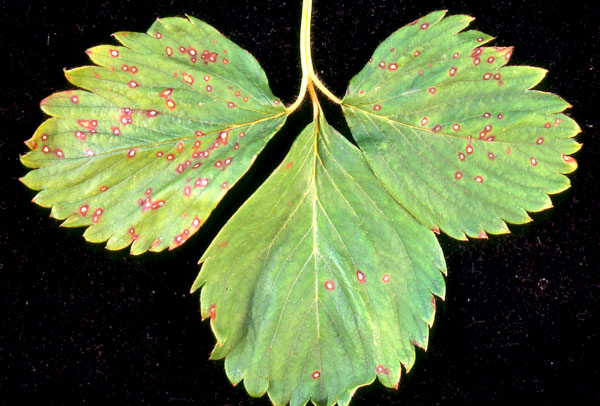
Common leaf spot
The fungus overwinters as mycelium in the green leaves and as winter fruiting bodies in the dried leaves. During winter the fruiting bodies – perithecia – are filled with numerous winter spores. When sufficient moisture is present and after they have completed their development, the spores are discharged into the air and thus cause primary infections. In the spots from the primary infections, summer spores – conidia – are formed, which serve for the mass spread of the disease. The symptoms are most clearly expressed on the leaves – white round spots with a reddish margin. On the petioles, flower stalks and runners, the spots are elongated and brown.
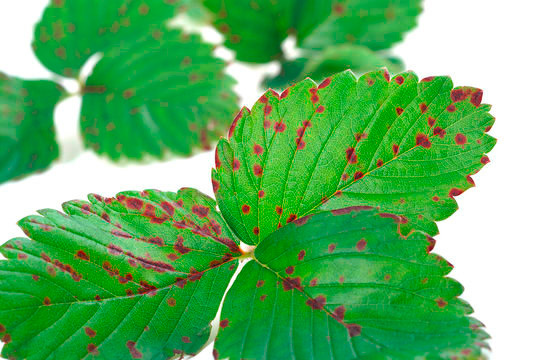
Purple-brown leaf spot
The fungus overwinters both in the dried and in the green leaves. Winter spores are formed in them, which cause primary infections during the following spring. On the leaves the spots are angular, and on the petioles – elliptical with a purple-brown colour. On the underside of the leaves the spots are speckled with small black bodies. In these bodies the summer spores of the pathogen are formed, which cause mass infection. Infected fruits dry out and become mummified.
Among the root weevils you must monitor for strawberry root weevil and black vine weevil.
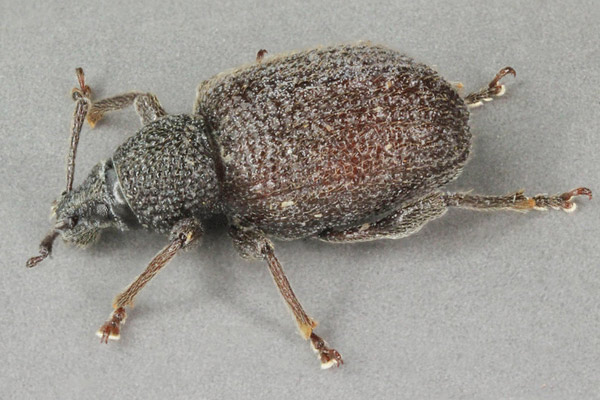
Strawberry root weevil
The strawberry root weevil overwinters as a larva in the roots of infested plants and less frequently as an adult insect in the soil. The larva is dirty white, pale yellow to pale pink, arched, with a brown head and without legs. It reaches 10-12 mm in length. At a young stage it gnaws the lateral roots, and later bores a tunnel in the central root of the strawberry plant and disrupts the uptake of water and mineral salts.
The black vine weevil is a similar species in its biological characteristics and in the pattern of damage to the strawberry root weevil.
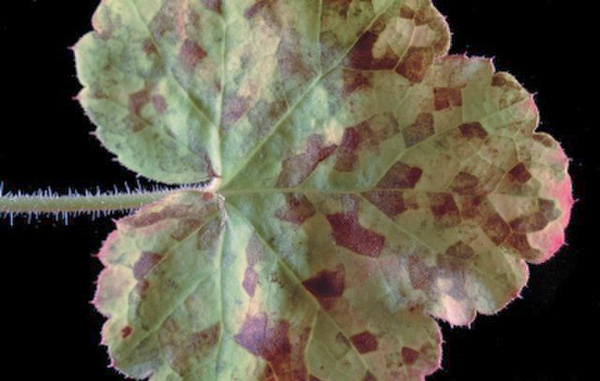
Strawberry foliar nematode
It occurs in mixed populations with the chrysanthemum foliar nematode. Both nematode species are widespread throughout the country. Their damage and biological characteristics are identical. Under optimal conditions, the strawberry and chrysanthemum nematodes develop one generation in about 13-17 days, and during the vegetation period of the strawberry they may have many generations.
Droughts during this period have an adverse effect on the development of nematodes, although they are able to survive in a state of anabiosis in dry leaves for several months. On strawberry they develop and feed on the surface of the plant tissue. They are preserved in the soil and in infected plant parts. Their movement and feeding on the plants is possible only in the presence of water droplets or when the surface of the plant organs is covered with a very thin water film.
Strawberry mite
The females are glassy, whitish-yellow, elongate-oval, 0.2-0.25 mm long. The fourth pair of legs does not end in claws but in two bristles, one of which is considerably longer. The males have an oval-ovoid body shape. They reach 0.15 mm in length. Their last pair of legs is very strongly developed. The eggs are white, oval, measuring 0.1 – 0.12 mm. The larvae are white with three pairs of legs, and there are no nymphs.
The strawberry mite overwinters as a fertilised female in the surface soil layer, under plant residues, in the leaf axils and buds of strawberry plants. The pest multiplies massively at relatively low temperatures (16-220C) and high humidity (85-90%). The presence of young leaves with tender consistency is also of great importance. Depending on temperature conditions, one generation develops in 15 to 65 days. At harvest time, all stages – eggs, larvae and adults – can be observed on infested plants.
Depending on the degree of infestation, the yield of the stands may be reduced by 20 to 70-80%.
Leaf size reduction leads to a decrease in nutrients in the rhizome and to weak bud initiation for the following year. The fruits obtained are of reduced quality – small and with low sugar content, and in very severe infestations they may dry out.
Viral diseases of strawberry
A number of viruses infect the seedlings – transmitted by aphids that are specialised on strawberry (Strawberry mottle virus, Strawberry crinkle virus, Strawberry yellow edge virus); transmitted by nematodes, leafhoppers and fungi, which are characterised by a wider range of hosts (Arabis mosaic virus, Strawberry latent ringspot virus, Tomato black ring virus, Strawberry green petal disease).
Mosaic curl of strawberry - Strawberry mottle virus
The virus is transmitted by the strawberry aphid, which is widespread in our country. The mosaic curl of strawberry is caused by strains of the virus differing in pathogenicity, which determines the great diversity of symptoms. Vein clearing is observed, followed by the appearance of small chlorotic spots. Uneven growth of the parenchyma in the area of the spots causes the formation of depressions and swellings that deform the leaves. The leaf blade has slightly upward-curved margins. Plants infected with this virus lag in growth, runner formation is weak and the resulting runners are anaemic. Many cultivars are latent carriers of this virus, which leads to reduced growth and smaller leaves.
Strawberry crinkle - Strawberry crinkle virus
The virus is transmitted by aphids – Pentatrichopus fragaefolii and P. jacobi, with the former being of greater importance. On the leaves of infected plants, chlorotic and necrotic spots are observed near the veins, which leads to deformation and reduction in leaf size. Similar spots are observed on the runners, but with a violet-red halo, as a result of which the tissue becomes necrotic and deformed. The petioles are strongly shortened. The plants form single rosettes located close to the mother plant.
Strawberry yellow edge virus – Strawberry yellow edge virus
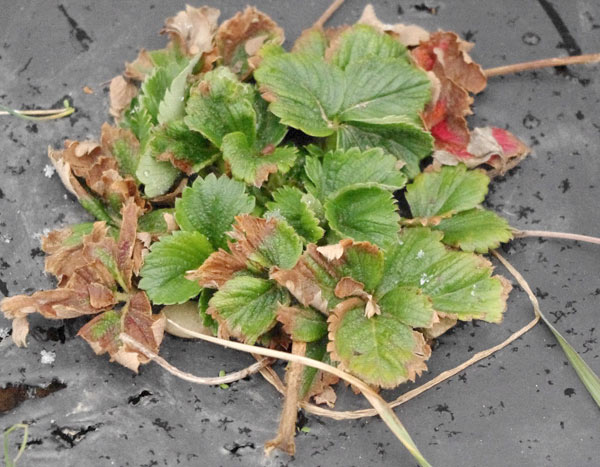
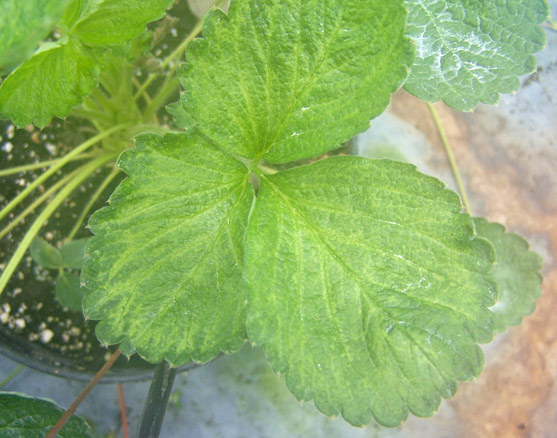
Infected leaves acquire a yellow-green colour, with intensity increasing towards the margins, which leads to scorching and drying. Infected plants form few and short runners. The limited number of rosettes are located close to the mother plant and exhibit the same symptoms as the mother plants.
Arabis mosaic virus of strawberry – Arabis mosaic virus
The virus is transmitted by the nematode Xiphinema diverasicaudatum and causes diffuse chlorotic spots on the leaves, which lead to twisting, wrinkling and deformation. The growth of the whole plant is weakened and results in dwarfing.
Strawberry latent ringspot virus – Strawberry latent ringspot virus
The virus is transmitted by the nematode Xiphinema diversicaudatum. It causes the appearance of small yellow spots. Young leaves cease growth and fruiting is weak.
Tomato black ring virus - Tomato black ring virus
The virus is transmitted by the nematode Longidorus elongatus. Isolated chlorotic spots and diffuse chlorosis between the veins are observed. The leaves are strongly deformed. Infected plants progressively become stunted, weakened and die.
Strawberry green petal disease – Strawberry green pet
The disease is caused by a mycoplasma, which is transmitted by grafting and by leafhoppers. It occurs in plantations located near clover crops. Infected plants are poorly developed, and the leaves have a matt shade. During flowering the sepals enlarge, the petals are small and pale green. These flowers do not form fruits, and when fruits are formed they are small and gradually dry out.
Disinfection of seedlings
In the presence of strawberry foliar nematode or strawberry mite, the seedlings are disinfected by immersing them for 13-15 minutes in water at a temperature of 45-50 oC.