

![MultipartFile resource [file_data]](/assets/img/articles/apfelwickler-schadbild.jpg)
The foliage of the trees in September photosynthesizes actively, providing assimilates for fruit nutrition, differentiation of fruit buds and deposition of reserve nutrients.
Late-hatched larvae of the second generation of the codling moth continue to cause fruit worminess. The larvae also cause worminess of the fruits of other fruit tree species. The serpentine leafminer moth is still harmful, and the European red mite has laid its winter eggs. Therefore, sprayings are required up to the first half of the month.
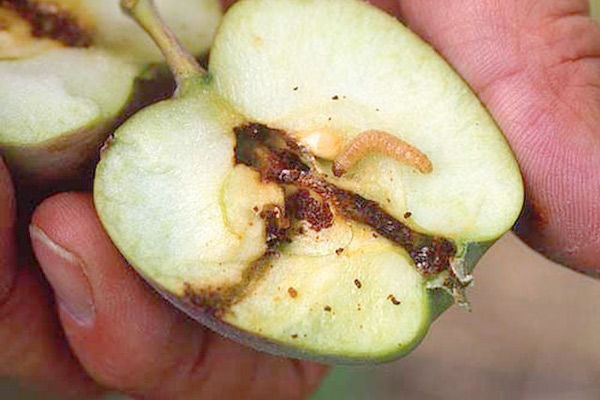
Codling moth
It is widespread throughout the country and occurs every year at high population density. It attacks all fruit tree species, causing the greatest damage to apple, pear, quince, apricot and walnut. It can cause fruit worminess of over 80–90%.
The codling moth develops two generations per year. In some years it may also develop a partial third generation, but its density is extremely low.
It overwinters as a fully fed larva in a dense dirty-white cocoon under the old cracked bark of trunks and scaffold branches, in borings of wood-boring insects, in the soil, in packaging, in fruit storages and in other suitable protected places.
In older apple orchards more than 90% of the overwintering larvae are found on the trunks and scaffold branches. In young orchards, due to the lack of cracked bark, more than 50% of the larvae hide in the soil, most often attached to the underground part of the trunk and the roots.
The moths emerging from the pupae of the first generation fly from the end of June – beginning of July until the end of September, when they can be found together with the moths of the partial third generation. They live for a shorter period than the moths of the previous generation – from 3 to 12 days, but the fecundity of the females is significantly higher – on average 150 eggs. The eggs are laid mainly on the fruits, as they are already without hairs. At the end of August – beginning of September oviposition gradually ceases.
The hatched larvae crawl over leaves and fruits in search of a suitable place to penetrate into the fruits. Since the boring-in lasts for several hours, they choose hidden places – where two fruits touch each other, a fruit and a leaf or a twig, in the calyx between the dried petals or in the stem cavity. Sometimes the entry hole is difficult to detect because the larvae cover it with a small heap of frass and excreta, wrapped with silken threads, and sometimes a dark secretion is also exuded.
In pome fruits the larvae almost always penetrate into the seed chamber. One fruit may contain two or more larvae, especially the larger fruits. Damaged fruits may not drop, but they are deformed and/or have large exit holes and galleries filled with brown frass and excreta. Various phytopathogens often develop on them – mainly brown rot.
In stone fruit species, the larvae feed on the fleshy part around the stone.
In walnuts they more often feed in the green pericarp, causing partial blackening without causing damage, but during this period there is also penetration into the kernel, which occurs at the point of attachment to the stem, and sometimes the level of worminess is significant.
Although one fruit is sufficient to feed a single larva, since the fruits are larger, damage is usually significantly higher due to the increased fecundity of the females.
Part of the moths migrate and lay eggs on other hosts – pears, peaches, walnuts, quinces, etc.
The duration of the larval stage is from 18 to 35 days, depending on the meteorological conditions and the host plant used for feeding.
The harmful activity of the larvae of the second generation may continue until the end of September – beginning of October and may be completed in fruit storages.
After completing its development the larva leaves the fruit and descends on a silken thread to the overwintering sites, where it spins a cocoon and remains in it until the following spring.
A small part of the population – about 1–2% – may pupate and in August–September moths emerge, which lay eggs and give rise to a third generation. The eggs and the larvae hatched from them are very few in number, since oviposition ceases during the first ten days of September. These larvae usually do not manage to complete their development before harvest and continue feeding in fruit storages, where they hide and overwinter together with the larvae of the second generation.
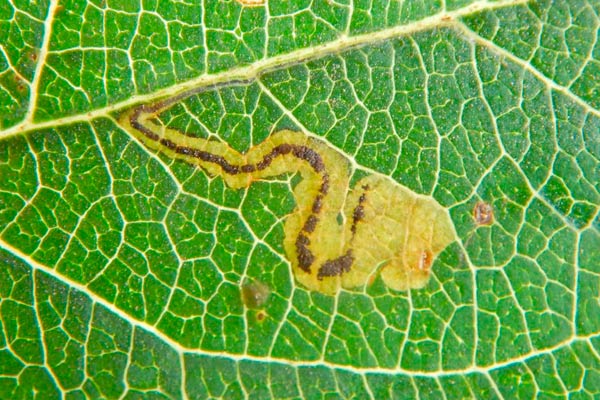
The larvae of the serpentine leafminer moth mine the leaves, gnawing serpentine-shaped tunnels immediately under the upper epidermis, which gradually widen
Serpentine leafminer moth
This pest occurs in all fruit-growing regions of the country and sometimes reaches significant population density. It attacks only apple, developing three to four generations per year. Its flight lasts for more than one month. The moths are active during the day. In cool weather they are found on the trunk, and when the temperature rises, they move onto the leaves. Males and females emerge sexually mature and immediately start to copulate.
The eggs are laid on the underside of the leaves, near the veins. One female lays an average of 50 eggs. Embryonic development lasts from 6 to 11–12 days.
The hatched larvae pierce the chorion at the point of its attachment to the substrate and enter the leaves without moving over the surface. The entry hole is covered by the eggshell (chorion). The larvae mine the leaves, gnawing serpentine-shaped tunnels immediately under the upper epidermis, which gradually widen. The length of the mines in which the larvae have completed their development is from 2.7 to 5 cm. The excreta are arranged in the middle of the mine, forming one broad or two longitudinal lines.
Feeding of the larvae lasts from 12 to 26 days. After completing its development, the larva gnaws a heart-shaped opening in the widened part of the mine, descends on a silken thread and pupates (overwinters) in the soil at a depth of 5 to 7 cm in a light-brown cocoon. The pupal stage lasts from 6 to 13 days.
Control
Against the larvae of the codling moth you may use one of the following products – Carpovirusine (100 ml/da), Madex Top (10 ml/da), Dipel DF (50–150 g/da), Sineis 480 SC (20–37.5 ml/da), Delegate 250 WG (30 g/da), Avant 150 EC (33.3 ml/da), Deka EC (30 ml/da), Decline 2.5 EC (30 ml/da), Lamdex Extra (60–100 g/da).
The economic injury level (EIL) is 1.5–2% fresh penetrations per fruit.
Against the young larvae of the serpentine leafminer moth, before they have formed a large mine, treat with one of the insecticides – Mospilan 20 SG (25 g/da), Delegate 250 WG (30 g/da), Sineis 480 EC (20–37.5 ml/da), NeemAzal T/S (300 ml/da).
The EIL is 3 fresh mines per leaf.
To reduce the winter stock of eggs of the European red mite, add to the spray solution one of the acaricides – Apollo 50 SC (40 ml/da), Nissorun 5 EC (0.05%), Naturalis (100–150 ml/da).