

![MultipartFile resource [file_data]](/assets/img/articles/himbeeren-schneiden-bild.jpg)
After harvesting the fruits, the plantations are treated with a contact insecticide – Decis 100 EC (7.5–12.5 ml/da), Karate Zeon 5 CS (15 ml/da), Coragen 20 SC (18–30 ml/da), etc., against the raspberry beetle, the raspberry gall midge and the raspberry agrilus. In November–March the attacked shoots are cut out and burned. After harvest, by means of soil cultivation, part of the pupae and adult insects are destroyed.
In case of damage caused by the two-spotted spider mite and the Atlantic mite, one of the following products is added to the spray solution – Voliam Targo 063 SC (80 ml/da), Laota, Bermektin, Valmec (15–100 ml/da), Sulfur WG (500–700 g/da), Heliosulfur C (150–750 ml/da). Economic injury threshold – 5–7 specimens per leaf. Using a strong magnifying glass or a binocular microscope, the lower side of the leaves is examined and all developmental stages of the pest are counted. It is necessary to count the mites on an average sample of 50–100 leaves taken evenly from the entire plantation.
For biological control, when pest density is significantly below the economic threshold, the predatory mite Phytoseiulus persimilis is used, through double seasonal colonization, at a predator:prey ratio of 1:25 to 1:50. The following can also be used – the mite Amblyseius californicus, the gall midge Feltiella acarisuga, the mirid bug Macrolophus caliginosus, etc.
The choice of plant protection product must comply with the pre-harvest intervals and upcoming harvests.
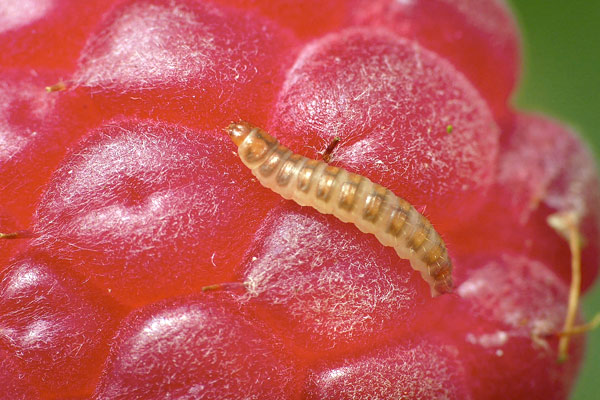
Common raspberry beetle – Byturus tomentosus
It develops one generation per year.
The female individuals are already sexually mature, have mated and completed oviposition. The eggs are laid singly, at the base of half-opened flower buds, in the flowers and on the green fruits.
The larvae feed inside the fruits, causing them to become wormy. They cause greater damage. The damaged fruits remain smaller, underdeveloped, deformed, with strongly deteriorated quality and often rot. In cases of mass infestation, yields are very low.
The larvae develop within 40–45 days. Usually, during raspberry harvest, some of them have not completed their development and are harvested together with the fruits. The fully fed larvae leave the fruits and the containers in which the raspberries are picked and pupate in the soil at a depth of 5 to 20 cm. The beetles emerge as adults in the same autumn, but do not come to the surface and remain to overwinter.
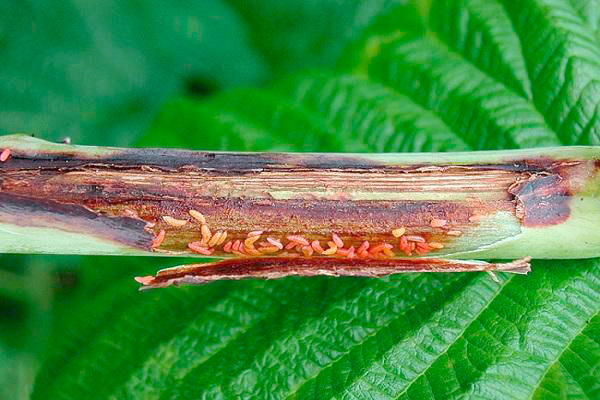
Raspberry gall midge – Resseliella (Thomasiniana) theobaldi
Depending on the region and meteorological conditions during the year, the pest develops three to four generations annually. The flight of the separate generations overlaps and continues until October.
The gall midges are active in warm and calm weather. The females lay their eggs under the bark of one-year-old shoots or in the cracked bark of two-year-old shoots.
The hatched larvae penetrate deeply under the bark and feed on the cambial layer. The damage occurs mainly at 30–40 cm above the soil surface, rarely higher. At the damaged site the tissue turns brown and a small depression forms under the larva. A small anthocyanin spot appears on the bark, which gradually becomes brown. When larval density is high – mostly in the third–fourth generation – 5–10 or more larvae live in one depression. Then the dark blue spot sinks into the wood.
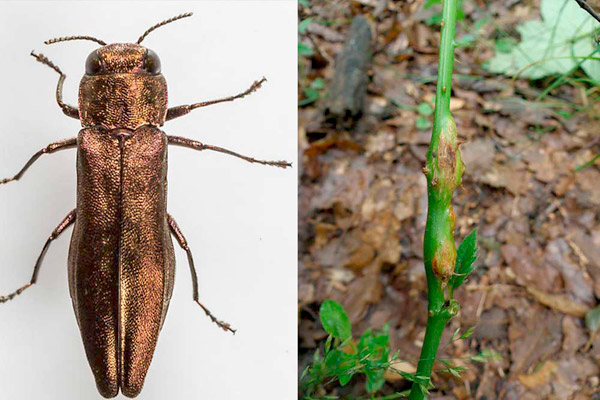
Raspberry agrilus – Agrilus rubicola
It develops one generation per year.
The beetles are already sexually mature and have laid eggs. The fertilized females lay their eggs singly on the bark of the shoots or in the cracks on them. Therefore, in fruit-bearing plantations, stems and twigs must be monitored for damage.
The larvae bore through the bark and enter beneath it, where they excavate spiral galleries. At the damaged sites the stem swells and swellings can be observed on it. Initially the galleries are very thin and difficult to detect. As the larva grows, the galleries widen and the stem acquires a spindle-shaped form. The bark at the damaged site cracks.
The grown larvae enter the pith of the stem and make deep vertical galleries in an upward direction. By the beginning of September the larvae complete their development and remain to overwinter at the end of the gallery.
The damaged plants develop more weakly or dry out completely. Yields from them decrease by 30–50%. In case of consecutive infestation over several years, the pest is capable of severely thinning the infested plantations.
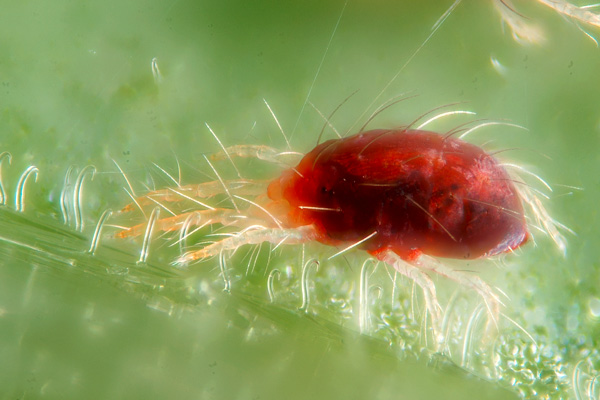
Two-spotted spider mite – Tetranychus urticae
Under field conditions it develops 12–15 to 20 generations per year. The attacked plants lag severely in their development, and yields are reduced by 20–30 up to 60%.
Initially, the damage may be grouped only in certain interveinal areas, but gradually it covers the entire leaf blade. The attacked leaves acquire a mottled, marbled appearance and subsequently become yellow-brown, dry up and fall. The mites entangle the trichomes of the leaves with web threads, where they inhabit and use them as shelter under which they feed. At high density, the web threads also entangle the leaves, actively growing shoot tips, lateral branches and twigs, and shoots. The mites suck sap from the buds, flowers and young ovaries, which then drop off.
The female mites lay their eggs on the underside of the leaves between the threads.
Simultaneously with the common two-spotted spider mite, the Atlantic mite – Tetranychus atlanticus – is also found. The two species usually occur together, in mixed populations, have a similar appearance and cause identical damage.
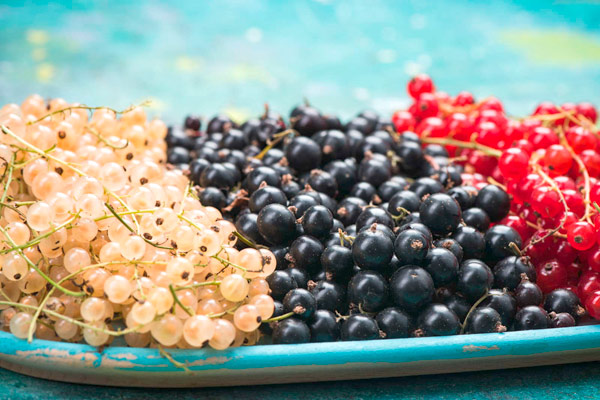
In shrubs – black currant, white and red currant, etc.
After harvesting the fruits, the plantations are sprayed with one of the following products – Voliam Targo 063 SC (80 ml/da), Laota, Bermektin, Valmec (15–100 ml/da), Sulfur WG (500–700 g/da), Heliosulfur C (150–750 ml/da) against the two-spotted spider mite, the Atlantic mite and the currant bud mite.
The weeds in the inter-rows are mapped and, in case of mixed weed infestation, they are sprayed (wearing a mask is mandatory) with a glyphosate-based herbicide – Nasa 360 SL (400–1200 ml/da), Satellite 360 SL (300–450 ml/da).
Currant bud mite – Eriophyes (Phytoptus) ribis
The currant bud mite develops 5 generations per year on black currant. It attacks the buds.
The females start laying eggs and leaving their winter shelters in March, moving along the stems and branches towards the new buds. Migration continues until late autumn. Mortality among migrating individuals is very high and only 0.01% manage to reach the new buds, but this is sometimes sufficient for a severe infestation to occur. The attacked plants have weak growth and yields are very low. With 10% damaged buds, yield decreases by 50%.