

![MultipartFile resource [file_data]](/assets/img/articles/ливадна-пеперуда-1.jpg)
In recent weeks, a mass multiplication of the meadow moth (Loxostege sticticalis) on sunflower and maize has been observed in Northern Bulgaria. Some regions of Dobrich Province, such as the Krushari area towards Silistra, Zhitnitsa, around Vladimirovo, Minkovo and Medovo are significantly affected by the pest. The Minister of Agriculture has declared a calamity of the meadow moth on the territory of the country and has authorized the implementation of control measures against this pest.
Calamity outbreaks in the development of the moth occur during certain periods, especially when there are favourable conditions for the development of the pest, such as a prolonged hot autumn followed by a warm winter. During periods of population increase and mass multiplication, the meadow moth can lead to a yield reduction of up to 60%, and sometimes to its complete loss.
The pest is widely distributed throughout Bulgaria. The larvae damage plants from 35 families, primarily attacking sunflower, but also damaging maize, beet, legumes, peas, cereals, hemp, grasses and millet, sorghum and potatoes. This pest also harms more than 200 species of wild-growing plants.
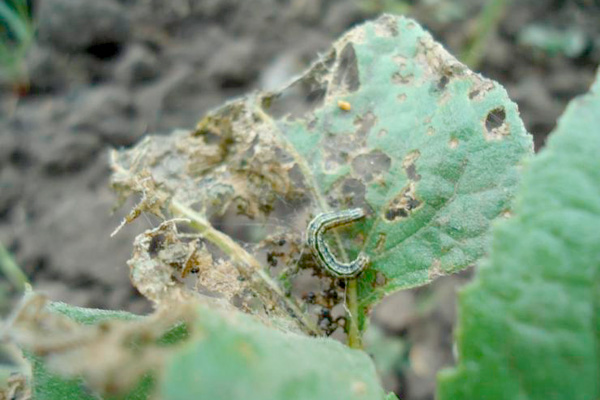
The larvae of the meadow moth feed on the above-ground parts of the plants – leaves, flowers and fruit sets, entangling them in web-like threads.
The damage caused by the pest is first noticeable on the leaves, which turn brown. Larvae of the first, second and third instar feed on the mesophyll of the leaves, leaving only the main veins. When large populations are present, the leaves and stems of entire plants are destroyed, especially of host crops such as soybean, sunflower and oats.
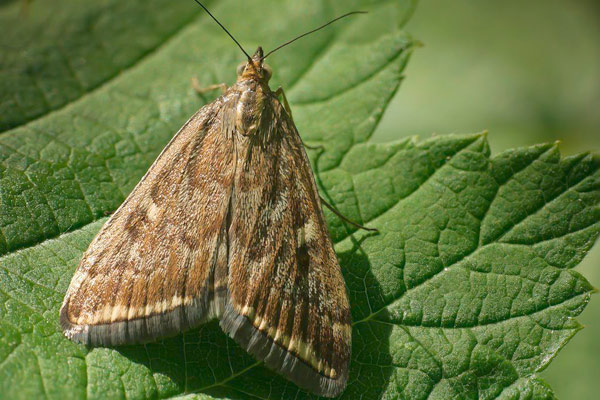
The meadow moth usually develops between 3 and 4 generations per year, with the flight of the first generation occurring mainly in April, May and June, the flight of the second generation in July – August, and the third (fourth) in August – September, October. The most massive flight occurs in June-July. Adults are active mainly at night. Females lay their eggs (150-160 eggs) on the underside of the leaves.
Strategy for pest control
The economic injury threshold is about 5-10 larvae/m2. The larvae perform mass migration. Pupation takes place in the soil and they overwinter as larvae in cocoons in the soil.
Periodic mass multiplication is characteristic of the meadow moth.
Authorised plant protection products
By order of the Minister of Agriculture of 21 July of this year, a deadline until 30 July was imposed for the application of immediate measures on the areas attacked by the meadow moth. If it is established that the period for dealing with the danger is insufficient, it will be extended immediately. A list of products with restricted and controlled use for protection against the meadow moth has also been attached.
In the presence of larvae in instars II-III and III-IV, as well as during the vegetation period, Sumi Alpha 5 EC, Sumicidin 5 EC, Oasis 5 EC are used – plant protection products containing 50 g/l esfenvalerate, applied with ground equipment while observing the specified measures for the protection of bees.
Authorisations for aerial spraying with aviation equipment are only for treatments with biological plant protection products with the active substance Bacillus thuringiensis. These are: Dipel DF, Dipel 2X, Rapax, Rapax – AS and Foray 48 B.
Before starting the spraying of damaged and affected crops, farmers must notify beekeepers of the forthcoming activities. The beekeepers must close or cover the hives on the days and at the hours of treatment.