

![MultipartFile resource [file_data]](/assets/img/articles/miomente-erdbeeren-strawberry-pflanzen-do-it-yourself.jpg)
In July, strawberry plantations in non-infested areas are inspected to detect strawberry mite. When present, treatment is carried out with the following products – Voliam Targo 063 SC (80 ml/da), Laota, Bermektin, Valmec (15–100 ml/da), Sulfur WG (500–700 g/da), Heliosulph C (150–750 ml/da). Biological control can be implemented using predatory mites of the genus Typhlodromus and the six-spotted thrips.
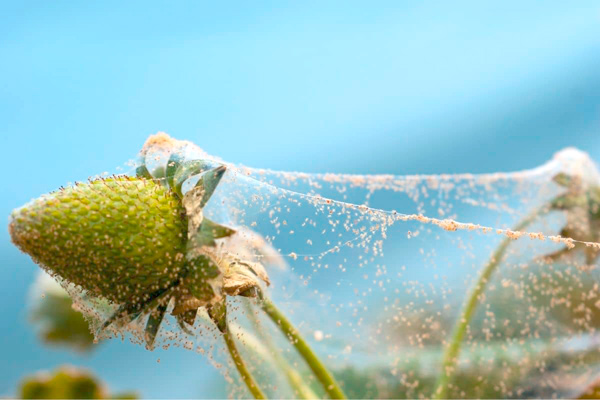
Strawberry mite - Tarsonemus pallidus
The strawberry mite develops about seven overlapping generations per year and, at harvest time, when maximum density is reached, all stages – eggs, larvae and adults – can be observed on the infested plants.
It prefers young leaves with tender tissue. Sometimes it remains hidden in the plant rosette and causes damage only there. Newly hatched larvae also suck sap and are most dangerous at this time.
Depending on the degree of infestation, yield reduction in the crop can range from 20 to 70–80%. The harvested fruits are of reduced quality – small and with low sugar content, and in cases of very heavy infestation they may dry out. Damaged leaves remain small and deformed, turn yellow and dry out in dry weather or rot in wet conditions. Leaf dwarfing leads to a reduction of nutrients in the rhizome and to poor bud formation for the following year. Symptoms resemble damage caused by stem nematodes and some viral diseases. The developed leaves are damaged, but no mites can be detected on them, which hinders timely identification of the causal agent.
Weevils
Strawberry plantations are inspected for infestation by root weevils. The appearance of adults can be detected using soil traps evenly distributed between the rows in the plantation.
Spraying is carried out against the adult insects during their additional feeding period with one of the insecticides – Decis 100 EC (17.5 ml/da) or another deltamethrin-based product, Mospilan 20 SP (30 g/da), Naturalis (100 ml/da) – applied by irrigation beforehand. For biological control, entomopathogenic nematodes of the genus Heterorhabditis can be used.
Spraying must be carried out in the evening, as the beetles are active and feed on the above-ground parts of the plants at night. A single treatment is usually not sufficient.
If the weevils have laid eggs, soil treatment is carried out against the larvae. The products are the same; only the dose of Naturalis is increased to 300 ml/da.
Serious damage is caused by the strawberry root weevil and the black vine weevil. Damage is also caused by three other species - Turkish vine weevil, small vine weevil and alfalfa root weevil.
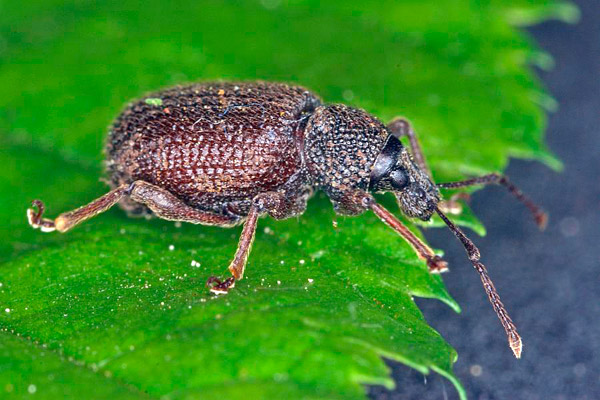
Strawberry root weevil - Otiorhynchus rugosostriatus
Emergence of the beetles continues until the second half of July. They are active at night. After remaining in the soil for 4–5 days, the weevils come to the surface and begin to feed on the leaves. Feeding continues for 10–15 days, until they reach sexual maturity. After maturation, they begin to lay eggs without fertilisation – parthenogenetic reproduction. Egg laying also takes place at night, in the soil at the base of the strawberry plants, and to a limited extent on plant residues and on the leaves of the plants. Females place them in rounded patches – clusters.
The larvae move towards the roots and rhizomes of the strawberry plants, where they feed until late autumn. When temperatures drop permanently, feeding ceases and the larvae remain to overwinter at these sites. The main damage is caused by the larva, which in its early stages gnaws the lateral roots, and later bores a tunnel into the central root of the strawberry plant, disrupting the uptake of water and mineral salts. In cases of low infestation, plants lag in development, flower and bear fruit, but the fruits are small, tasteless and often dry out during ripening. In cases of heavy infestation, the older leaves dry out first, and later the entire plant.
The black vine weevil - Otiorhynchus ovatus is a species similar to the strawberry root weevil in its biological characteristics and in the pattern of damage. It is most often found in low and moist areas.
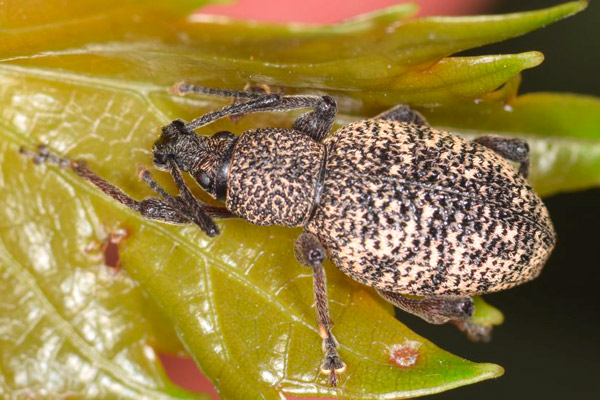
Turkish vine weevil - Otiorhynchus turca
The Turkish vine weevil develops one generation per year. It develops best in structured, humus-carbonate and chernozem soils. In unstructured, heavily compacted and sandy soils its development is hindered. The annual cycle of the pest does not have strictly fixed boundaries, therefore larvae and adults can be found throughout the year.
The beetles feed for about 2 months, after which the females begin to lay eggs parthenogenetically.
They feed at night, gnawing the buds, thereby greatly reducing yields. During the day they hide under soil clods, in soil cracks, under plant residues and elsewhere. Damaged buds appear as if cut with a saw. A single beetle damages from 8 to 12 buds. Later they skeletonise the leaves. The egg-laying period continues until September. Eggs are laid singly on the surface or shallowly in the soil.
Young larvae initially feed on dead organic matter, and later on the roots. They completely consume the young roots and superficially gnaw the thicker ones. Depending on the time of egg laying and the temperature, larval development lasts from 3 to 10 months. Larvae also require high soil moisture and die en masse during drought.
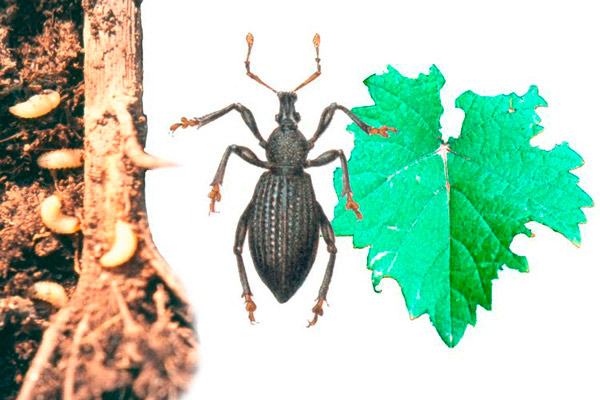
Small vine weevil - Otiorhynchus sulcatus
The small vine weevil develops one generation in one or two years. Beetles live for 17–23 months. They are active mainly at night and very rarely emerge during the day in cloudy weather or move while hiding under plants. Reproduction is predominantly parthenogenetic – males are rarely encountered.
Adults feed on the buds and later on the leaves, gnawing them from the sides. Feeding lasts from 1.5 to 4 months.
Overwintered larvae pupate in April and May, and adults appear in May and June. They feed in the same way.
The egg-laying period lasts from the second half of May to September. Eggs are laid on the surface and shallowly in the soil around the plant.
Newly hatched larvae initially feed on dead organic matter and later on young and old roots. At high population density they can cause growth retardation and even death of young plants. Damaged roots are easily attacked by fungal phytopathogens.
Larvae that hatch in July–August overwinter and continue to develop the following spring until May–June, after which they pupate in soil chambers.
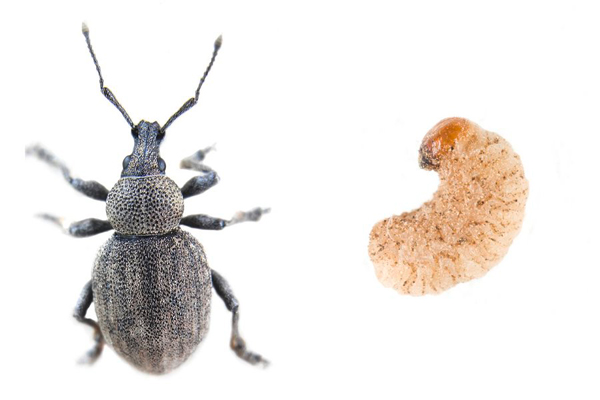
Alfalfa root weevil - Otiorhynchus ligustici
The alfalfa root weevil develops one generation in two years.
At the end of May, after about one month of feeding, the beetles reach sexual maturity. Reproduction is mainly parthenogenetic, but reproduction with fertilisation is also observed. Male individuals are rarely encountered. Females lay their eggs in the soil, singly or in small groups, around the roots of their host plants. The egg-laying period lasts one to two months.
Newly hatched larvae are very mobile and burrow into the soil. There they feed on the roots, gnawing groove-like pits and tunnels inside them, with a length from 5–6 up to more than 25 cm. At high population density, plants die within 1–2 years and the stands thin out. Damage usually appears in patches.
Initially, wilting and yellowing of plants is observed in the centre of the area – where larval density is highest. Later the plants partially or completely dry out.
After fruit harvest, strawberry plantations are sprayed with a copper-based product – Funguran OH 50 WP (200–300 g/da), Kocide 2000 WG (125 g/da) against common leaf spot and purple leaf blotch. Dried leaves are collected and burned.
Diseases
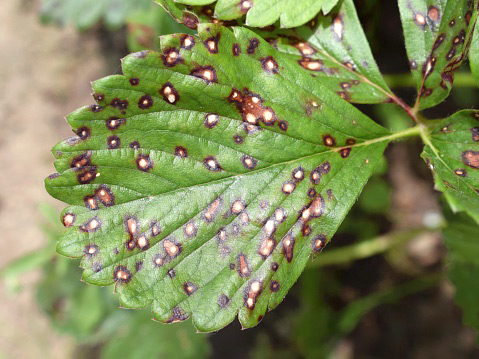
Common leaf spot - Mycosphaerella fragariae
The disease infects leaves, petioles, runners, flower stalks, sepals, petals, but rarely the fruits. Under strong development of the pathogen, assimilation is reduced and, consequently, yields decrease.
The fungus overwinters as mycelium in green leaves and as winter fruiting bodies in dried leaves. During winter, the fruiting bodies – perithecia – are filled with many winter spores. After completing their development, under sufficient moisture, the spores are ejected into the air and thus cause primary infections. In the spots from the primary infections, summer spores – conidia – are formed. They serve for the mass spread of the disease.
Symptoms are most clearly expressed on the leaves – white circular spots with a reddish border. On leaf petioles, flower stalks and runners, the spots are elongated and brown.
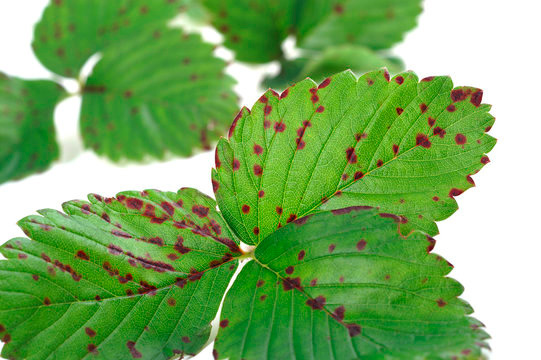
Purple leaf blotch – Diplocarpon earliana
Leaves, petioles, flower stalks, sepals, runners and fruits are attacked.
The fungus overwinters both in dried and in green leaves. Winter spores are formed in them, which cause primary infections in the following spring.
On the leaves, the spots are angular, and on their petioles – elliptical with a purple-brown colour. On the underside of the leaves, the spots are mottled with small black bodies. In these bodies the summer spores of the pathogen are formed, which cause mass infection. Infected fruits dry out and mummify.