

![MultipartFile resource [file_data]](/assets/img/articles/I-Saltari-web.jpg)
During this period, the vines are in the phenological stages from “end of flowering” to “beginning of berry ripening” in the early cultivars.
Downy mildew of grapevine
Infection of the still tender berries by the disease occurs directly through the epidermis, the so-called form “grey rot”. In wet weather the berries become covered with a sporulating growth and rot rapidly. With the increase in berry size, the disease spreads from the pedicels, the so-called form “brown rot”. In this case, the skin around the berry stalk turns pale brown, the berries turn brown, wilt, mummify and fall off, but no white growth appears.
Strategy for pest control
During the month, preventive treatments against downy mildew of grapevine (before sporulation of the pathogen and before rainfall) must be continued. The determination of sprayings is carried out on the basis of incubation periods. The calculation of each subsequent incubation period starts in the presence of rain or dew lasting at least two hours. This is the time required for germination of conidiospores, which cause the mass vegetative infections. For preventive sprayings contact fungicides are used (with spray intervals of 3-7 days). Under conditions favourable for the development of the disease, locally systemic fungicides are applied (with spray intervals of 7-10 days) and systemic fungicides (with spray intervals of 10-14 days).
Authorised plant protection products: Alial 80 WG - 75-330 g/ha; Bordeaux Mix 20 WP – 0.5-0.6%; Winker WG – 200 g/ha; Vitene Triplo R - 400-450 g/ha; Vitra 50 WP, Quadris 25 SC - 0.075-0.1% (75-100 ml/ha with 100 l/ha spray solution); Cuprohy 50 WP – 0.15%; Delan 700 WG – 0.05%; Dimix 500 SC - 30 ml/ha (in combination with a product containing mancozeb) or 34 ml/ha (in combination with a product containing folpet); Cabrio Top – 0.15% – treatment interval 7-10 days - 0.2% every 10-14 days; Mikal Flash – 0.3%; Momentum Extra WG - 300 g/ha; Pergado Med 27 WG - 500 g/ha; Pergado F – 0.2%; Profiler 71.1 WG - 200-225 g/ha; Sphinx Extra, Vinostar - 180 g/ha; Follow 80 WG, Friller 80 WG, Flowet 80 WG - 187.5 g/ha; Folpan 80 WG - 0.15%; Funguran OH 50 WP – 0.15%; Champion WP / Macc 50 WP / Champ WP – 0.15%; Delan Pro - 300 ml/ha; Equation Pro - 40 g/ha; Kocide 2000 WG - 0.12%; Leimai - 37.5 ml/ha; Metomor F - 100-150 ml/ha; Orvego - 80 ml/ha; Pergado F - 200 ml/ha; Ridomil Gold R - 500 g/ha; Solofol - 188 g/ha; Ceraxel - 250 ml/ha; Cuprocin 35 WP - 220-300 g/ha; Lieto - 220-300 g/ha; Zorvec-Vinabel - 50 ml/ha; Topaz - 30 ml/100 l spray solution.
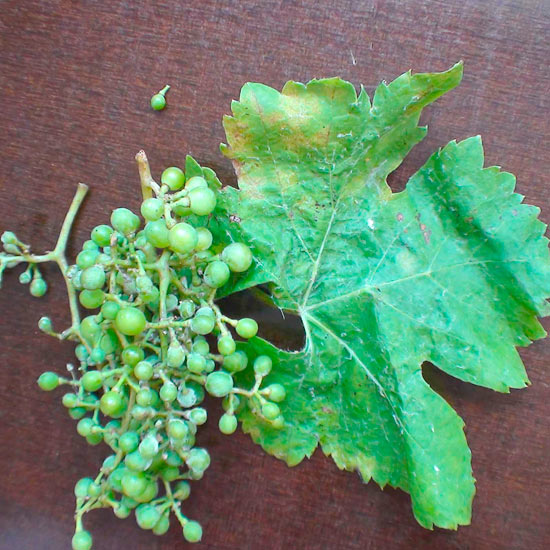
Powdery mildew – Odium tuckeri
Powdery mildew
The attacked young berries are covered with a greyish-white coating under which the skin is blackened. On enlarged berries, dark brown spots also appear, which are clearly visible after the coating is wiped off. Since oidium develops superficially, the interior of the berry remains healthy and continues to grow. Therefore, the attacked berries that have not completed their growth are deformed, crack deeply and the seeds become exposed.
Strategy for pest control
Treatments against powdery mildew can be combined with those against downy mildew. To avoid the occurrence of resistance, plant protection products with different active substances and different modes of action are alternated.
Authorised plant protection products: Acoidal WG - 0.25%; Vivando - 20 ml/ha; Dynali 090 DC - 50-65 ml/ha; Cabrio Top - 0.2%; Orius 25 EW, Dynasty 25 EW, Tebumax 25 EW - 0.04%; Solfoliquid 800 SC – 400 ml/ha at a 7-day treatment interval; 1210 ml/ha at a 10-day treatment interval; Talendo 20 EC - 20-25 ml/ha; Talendo Extra - 7.5-25 ml/ha; Thiovit Jet 80 WG – 0.3% (before flowering); 0.2% (after flowering); Flint Max 75 WG - 0.016%; Folicur 250 EW, Horizon - 0.04%; Folpan 80 WG - 0.15%, Sercadis - 15 ml/ha.
Grey mould
The pathogen does not attack green berries because of the high acidity of their juice. Fruit rot develops from veraison to consumption. Initially, light brown spots appear on the skin of the infected berries, which peels off easily when touched. In wet weather the attacked berries are covered with abundant grey growth, and in dry weather the berries shrivel and dry out.
Strategy for pest control
To protect vineyards from grey mould, it is necessary to: create well-ventilated conditions in the plantation - remove leaves in the cluster zone during the period of bunch loosening and veraison; protect the grapes from mechanical damage and injury caused by other harmful organisms (downy mildew, oidium and moths); carry out chemical treatment at the phenological stage “veraison of the grapes”. Chemical treatments are completed two to three weeks before harvest.
Authorised plant protection products: Cabrio Top – 0.2%; Cantus - 100 g/ha; Prolectus 50 WG - 120 g/ha; SWITCH 62.5 WG - 0.08; Follow 80 WG, Friller 80 WG, Flowet 80 WG - 187.5 g/ha; Folpan 80 WG - 0.15%; Avalon - 250 ml/ha, Banjo - 100-150 ml/ha.
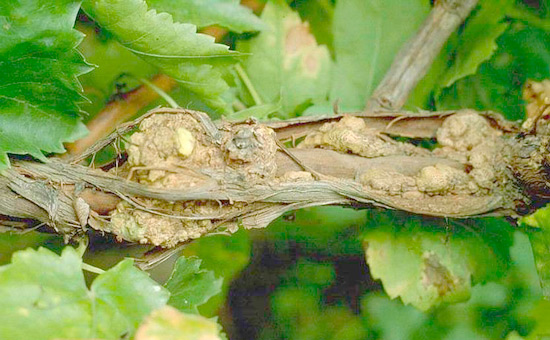
Bacterial crown gall of grapevine – Agrobacterium vitis
Bacterial crown gall
In infected plants on the woody parts, close to the soil surface or immediately below the soil surface, swellings (tumours) with a granular structure are observed, ranging in size from 0.5 to 10 or more centimetres. Diseased plants have depressed growth, chlorotic leaves and are easily winter-killed during cold winters. The disease is particularly harmful in nurseries and young vineyards.
Strategy for pest control
In July, vines showing symptoms of the disease must be marked.
When attacked plants are detected during the first 3 years after establishment of the vineyard, they must be uprooted and destroyed.
Vines resistant to the causal agent of bacterial crown gall are planted.
Cultivars that show some resistance to the disease: Muscat Ottonel, Pinot Gris, Rhine Riesling, Italian Riesling, Aligoté, Ugni Blanc, Vratsa Muscat, Pinot Noir.
European grapevine moth
In July, the butterflies of the third generation of the pest are in flight. The larvae of this generation damage the ripening and already ripe berries of the grapes by webbing them together with silk threads. Favourable conditions are thus created for the development of fungal diseases, which increases the extent of the damage caused.
Strategy for pest control
Treatment should be carried out at the EPV (economic threshold): for table grape cultivars 7-8 larvae per 100 bunches, and for wine grape cultivars 10-12 larvae per 100 bunches.
Authorised plant protection products: Aphicar 100 EC - 40 ml/ha; Decis 100 EC - 12.5-17.5 ml/ha; Dipel 2 X - 0.1%; Efcymerin 10 EC, Zyper 10 - 40 ml/ha; Karate Zeon 5 CS - 0.02%; Coragen 20 SC, Voliam - 15-27 ml/ha; Mageos - 10 g/ha; Rapax - 75-100 ml/ha; Sumi Alpha 5 EC, Sumicidin 5 EC - 0.025%; Forey 48 B - 0.15%; Cyclon 10 EC - 50 ml/ha; Citrin Max, Ciperkil 500 EC, Cipert 500 EC, Poli 500 EC - 6 ml/ha; Sherpa 100 EC - 40 ml/ha, Delmur - 50 ml/ha, Kedu - 40 ml/ha.
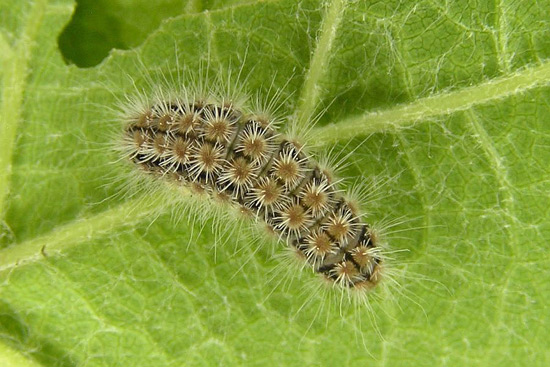
Vine leafroller moth – Yno ampelophaga Bayle
Vine leafroller moth
The harmful activity of the larvae continues; they chew holes or skeletonise the leaves, leaving only the thicker veins undamaged.
Strategy for pest control: To destroy the larvae pupating in the soil, mechanical cultivation is carried out.
Authorised plant protection products: Decis 100 EC - 12.5-17.5 ml/ha;
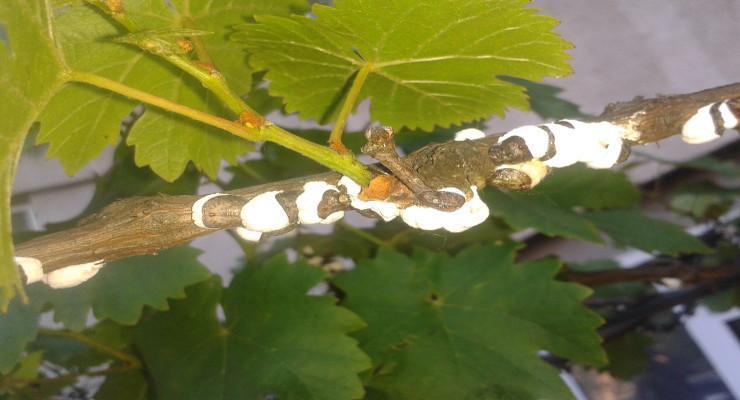
Vine cottony scale – Pulvinaria vitis
Vine cottony scale
Hatching of the larvae continues in July. They cause damage by sucking sap from the leaves, shoots and grape clusters. They moult once, feed for some time, then leave the feeding sites and move to overwintering sites. As a result of the damage, the vines become weakened. Severely damaged vines are exhausted, produce low and poor-quality grape yields and often dry out.
The vine scale transmits three types of viruses that cause diseases in grapevine.
Strategy for pest control
In the second half of June and in July, spraying with registered insecticides should be carried out. Chemical control is conducted against the young larvae.
Authorised plant protection product: Movento 100 SC - 0.075-0.095%;
Yellow grapevine mite
During the summer months, the populations of the different generations of the yellow grapevine mite overlap. As a result of the damage (larvae, protonymphs, deutonymphs and adult mites suck sap from the underside of the leaves), physiological and biochemical disorders occur in the leaves, which affect vine growth and grape quality.
Strategy for pest control
Treatment is carried out against adults and larvae when the EPV is reached - 9-10 individuals/leaf - until the end of August.
Authorised plant protection products: Apollo 50 SC - 30-40 ml/ha; Nissorun 5 EC - 0.05%; Danitron 5 SC - 100 ml/ha; Shyrudo (former Masai WP) - 25 g/ha.