

![MultipartFile resource [file_data]](/assets/img/articles/tomato-diagnostik-недостик-молибден.jpg)
Are we able to “communicate with plants"?
Visual diagnosis
MOLYBDENUM (Mo – Molybdenum – from Greek)
Importance of molybdenum for plants
Molybdenum is required for the assimilation of nitrates absorbed by the plant. It participates together with the enzymes nitrate reductases in the reduction of nitrates (NO3-) to nitrites (NO2-) and ammonia. It is considered that molybdenum is a transient carrier of electrons. There are also other enzymes that require molybdenum in order to perform their activity (oxidation-reduction reactions – xanthine dehydrogenase, aldehyde oxidase and sulfite oxidase).
Molybdenum is necessary for the symbiotic nitrogen-fixing bacteria in leguminous plants in order to fix atmospheric nitrogen. Plants also use it to convert inorganic phosphorus into organic forms within the plant.
Molybdenum also affects the synthesis of chlorophyll and ascorbic acid, as well as carbohydrate metabolism and the metabolism of phosphorus and iron.
Plant requirements for molybdenum
Plant requirements for molybdenum differ among the various plant species. Its average content in plants varies from 0.1 to 1.0 ppm in dry matter. Its content is highest in roots and seeds. A characteristic feature of molybdenum nutrition in most plants is the large variation between the critical deficiency level and toxicity levels. These limits range from 0.1 to 1000 ppm dry matter.
Uptake
Plants take up molybdenum as molybdate (MoO4-2).
MOLYBDENUM DEFICIENCY
General symptoms – the first symptoms occur on older leaves
Molybdenum is mobile in the plant, so deficiency symptoms appear first on the older leaves, but spread upward along the stem and affect the new leaves. Symptoms of molybdenum deficiency are similar to those of nitrogen starvation. The leaves are small and become pale green; a whitish-brown interveinal chlorosis appears, which in severe cases is accompanied by scorching of the leaf margins. The veins remain light green. Later, the leaves wrinkle and their edges curl inward. Silvery spots may appear on the interveinal tissue as a result of the separation of the upper epidermis from the underlying tissue. These spots become necrotic. Necrosis on the margins and in the interveinal zones of older leaves may somewhat resemble damage from salinity or boron toxicity, but these disorders usually cause much more extensive necrosis than is observed in the case of molybdenum deficiency, and are usually not associated with acidic soils.
Reddening of the veins on young leaves is possible.
Plant growth and development are retarded. Flower formation is limited. The growth of the root system is slowed down.
The vegetable crops that are most sensitive to molybdenum deficiency are broccoli, cauliflower, cabbage, beans and peas.
Causes
Since molybdenum is required for the conversion of nitrates into ammonia in the plant, nutrition predominantly with nitrate fertiliser induces molybdenum deficiency earlier than nutrition with ammonium nitrogen. The presence of high levels of sulphates, manganese, copper, zinc and nickel also reduces molybdenum uptake by plants.
The reaction of the nutrient medium has a strong influence on the uptake of this microelement – an acidic reaction of the nutrient medium (pH < 5.5) leads to Mo deficiency.
Recommendation
Correction of pH; foliar feeding with ammonium or sodium molybdate 0.05 – 0.10 %. Foliar feeding provides a rapid effect when properly applied. The dosage must be observed so as not to cross the boundary between the optimum level and the toxicity threshold of Mo.
Identification of molybdenum deficiency symptoms by crops
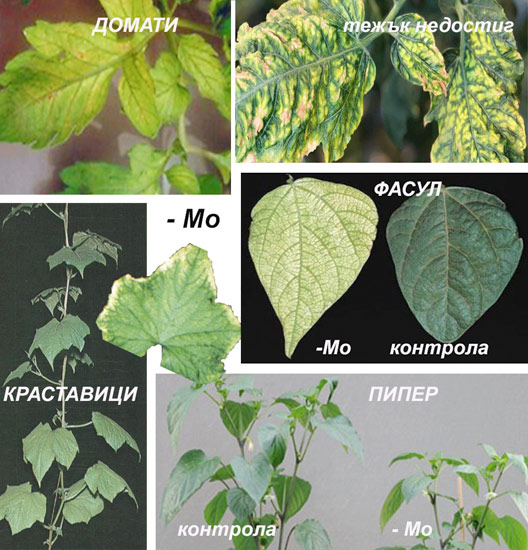
Molybdenum deficiency in fruiting vegetable crops
Symptoms of molybdenum deficiency in fruiting vegetable crops:
- Interveinal chlorosis appears on the older leaves, whose margins curl upwards, forming a channel. Necrosis begins in the yellow sectors of the leaves and spreads over the entire leaf, which becomes wrinkled.
- The symptoms spread to the younger leaves;
- Plant growth and development are retarded;
- Internodes are shortened;
- Fruiting is reduced. Ripening is delayed.
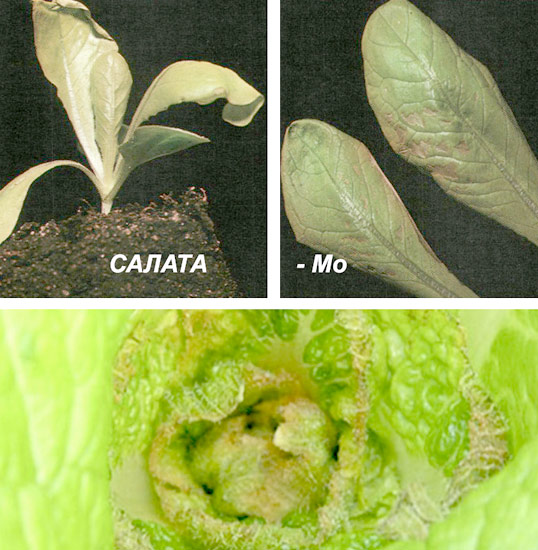
Molybdenum deficiency in leafy vegetable crops
Symptoms of molybdenum deficiency in leafy vegetable crops:
- Chlorosis appears, which progresses to necrosis at the leaf margins and develops inward. The leaves dry from the tip and edges towards the centre. The necrotic tissue becomes brownish-yellow. The spots on the leaves later coalesce;
- Growth of both the above-ground parts and the roots is severely restricted and the plants may die.
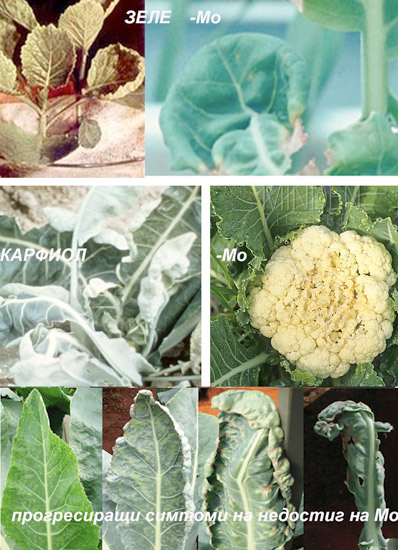
Molybdenum deficiency in leafy-stem vegetable crops
Symptoms of molybdenum deficiency in leafy-stem vegetable crops:
- Leaf growth is severely restricted, which gives the leaves a narrow, cup-shaped form. The leaves are deformed, with reduced area and are brittle. In cauliflower, narrow, distorted leaves are formed – the leaf width is strongly reduced, while the midrib continues to grow, making the leaf like a «whip», i.e. the so-called “whiptail“ is formed;
- Small, deformed or discoloured cauliflower heads may be caused by various factors, among which are boron and/or molybdenum deficiency;
- At advanced stages, plant growth and head formation are restricted.
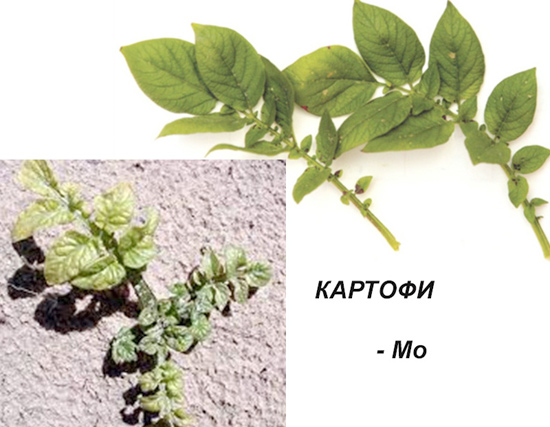
Molybdenum deficiency in tuber vegetable crops
Symptoms of molybdenum deficiency in tuber vegetable crops:
- The visual symptoms of molybdenum deficiency in tuber vegetable crops depend on the level of the microelement in the seed tuber;
- Symptoms include a general pale green colour and slow growth with small leaf size;
- Reddening of the veins on young leaves is possible;
- Silvery spots appear on the interveinal tissue of older leaves as a result of the separation of the upper epidermis from the underlying tissue. The margins and tips of the older leaves are scorched.
EXCESS MOLYBDENUM
Most plants are tolerant to excess molybdenum. Data on toxicity from this microelement are scarce. The problem is observed in an alkaline medium and is almost always associated with copper deficiency.
General symptoms
Symptoms of excess molybdenum are expressed as yellowing and necrosis of the leaves.
Causes
Alkaline nutrient medium.
Recommendations
Correction of pH.