

![MultipartFile resource [file_data]](/assets/img/articles/tomato-diagnostik-недостик-бор.jpg)
Do we know how to “communicate with plants"?
Visual diagnosis
BORON (B – Boron from Arabic buraq and from Persian burah)
Importance of boron for plants
Boron is a micronutrient that plays a specific role in the life of plants. It affects their growth and development. Its functions (physiological and biochemical) are closely related to the formation of plant tissues. It participates in the building of the cell plasma and the cell wall. It stimulates the development of the root system, the formation of flowers and fruit set.
Boron affects carbohydrate metabolism – the synthesis, transformations and translocation of sugars. The importance of boron for root growth is also associated with its influence on the movement of sucrose and the formation of complex organic compounds that contribute to the elongation of root cells.
Boron is not a constituent of any enzyme, but it influences enzymatic reactions. It is also involved in the synthesis of chlorophyll and certain vitamins. It affects the uptake of other nutrients – calcium, nitrogen, potassium.
Boron has an effect on the hydration of cell colloids. Under unfavourable climatic conditions it has the ability to increase the content of chemically bound water in the cells and thus affects the water regime and the activity of enzymes. This also explains the positive influence of boron on plant resistance to adverse growth factors – high salt concentration of the nutrient medium, low temperatures, bacterial and fungal diseases.
Plant requirements for boron
Boron is present in all plant tissues, but it is distributed unevenly. The largest amount is concentrated in the reproductive parts of the plant – stigmas, stamens and pistil, as well as in the young ovaries.
Boron can hardly be reutilised in the plant, since the borate anion forms stable complex compounds. Boron absorbed by the roots is transported to the leaves in the form of inorganic compounds. In the leaves, complex boron-organic molecules with low mobility are synthesised. This necessitates that boron be continuously available to plants, especially to boron-demanding crops (tomato, etc.).
During the vegetation period plants have varying requirements for boron. The need for this element increases during the period of formation of the reproductive organs. Boron affects fertilisation and is particularly important when plants are grown for seed production.
Plant requirements for boron change depending on the ratio between mineral elements in the nutrient medium – nitrogen and potassium increase boron uptake, while magnesium and iron reduce it.
Uptake
Boron is taken up by plants as neutral molecules of boric acid (H3BO3) or as an anion (H3BO2 -).
BORON DEFICIENCY
General symptoms – the first symptoms appear on the young leaves
Symptoms of boron deficiency appear very rapidly. In all plants they affect the growing organs and tissues. Growth is retarded and the plant appears stunted. The formation of new organs ceases. Growing points die.
Root growth is more sensitive to boron deficiency than shoot growth. Inhibition of cell division as a result of boron deficiency inhibits root elongation. In cases of severe deficiency, growth stops and root tips die. The shoot:root ratio increases and plants become more susceptible to drought and nutrient imbalance.
Internodes shorten, leaves turn yellow, darken and their petioles become brittle and fragile. The stem becomes deformed – bent, twisted, cracked. The growth of the root system stops. When boron deficiency occurs at flowering stage, normal pollen development is impaired, flowers are not fertilised and drop off.
Yields decrease sharply
Causes
Disturbed nutrient regime: high level of nitrogen, calcium, magnesium and/or phosphorus; low level of boron; calcareous, waterlogged soils; improper liming; high pH.
Recommendation
Lowering the temperature under greenhouse conditions; reduction of phosphorus fertilisation; correction of pH and boron level in the nutrient medium; pre-sowing fertilisation with borax at 1 – 2 kg/da. Foliar feeding with a 0.1% borax solution, strictly observing the concentration and the requirements for foliar feeding, since at higher concentrations boron is toxic to plants. Therefore, foliar or soil fertilisation with boron must necessarily be based on plant or soil agrochemical analysis.
Identification of boron deficiency symptoms by crop type
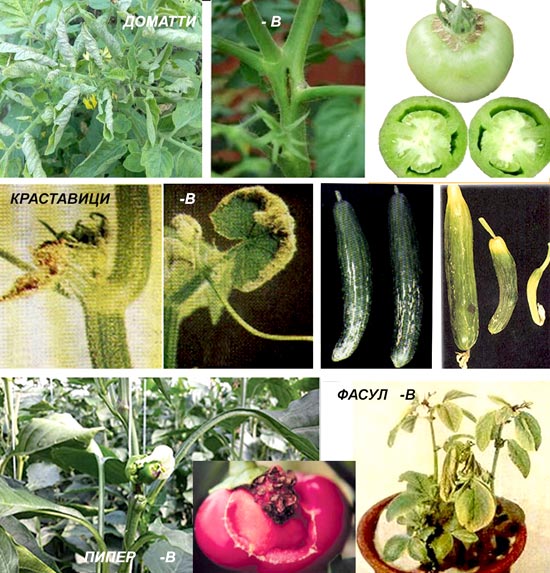
Boron deficiency in fruit vegetable crops
Symptoms of boron deficiency in fruit vegetable crops:
- The shoot tip shrivels and dies, with the dead tissues appearing greyish;
- Growing buds die. Fruit set drops off;
- Stem and branch growth is retarded. The plant appears underdeveloped and stunted;
- Leaves are deformed and brittle. Slightly pronounced necrotic spots appear on the interveinal tissue of young leaves. These leaves remain small and curled inward. Intermediate leaves have a yellow to orange colour, and their veins – purple. With prolonged deficiency, older leaves become yellow-green. Their petioles are very brittle and the leaves easily break off. These symptoms of brittleness and plugging of the vascular tissue are typical of boron deficiency;
- The stem cracks and/or necrotic spots appear on it;
- Roots are brown and grow slowly, and small lateral roots die off;
- Flower formation is limited;
- Quality deteriorates: fruits are deformed; the seed part increases and the ovary may be exposed; they are darker with necrotic spots or appear scratched, with yellow to white stripes that become corky;
- Young fruits drop off;
- Yield is low.
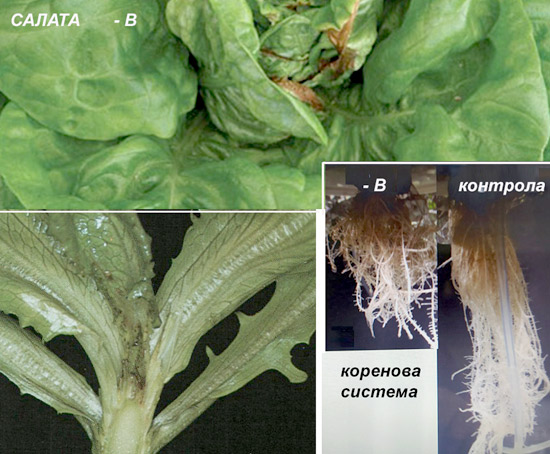
Boron deficiency in leafy vegetable crops
Symptoms of boron deficiency in leafy vegetable crops:
- Leaves exhibit various symptoms – thickening, distortion, wilting. They are small and pale green and/or with chlorotic or necrotic spots;
- Growing points die and growth is retarded or ceases. Plants are stunted;
- The root system is severely affected – it is smaller, with short primary roots, its colour changes to dark and part of it dies.
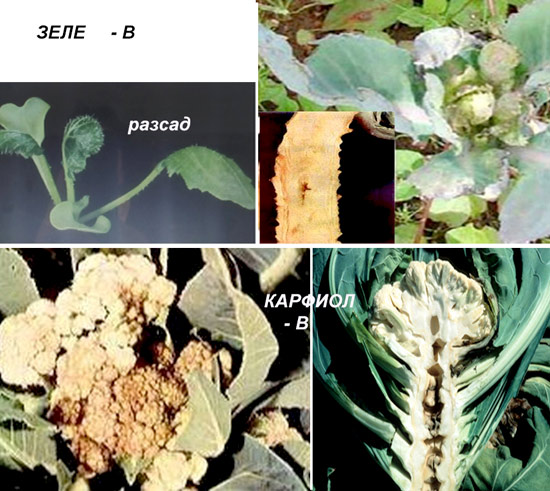
Boron deficiency in leafy-stem vegetable crops
Symptoms of boron deficiency in leafy-stem vegetable crops:
- Leafy-stem vegetable crops have high boron requirements;
- In cauliflower, the curds may turn brown and their formation may even stop. Small, deformed or discoloured cauliflower heads may be caused by various factors, one of which is boron deficiency;
- Young leaves are small, curled, firm and light green. Older leaves are curved downward and may develop a reddish coloration or chlorosis;
- Head formation is delayed or a loose head is formed;
- Stems are cracked and/or corky. Boron deficiency is one of the causes of hollow stems – an empty space known as "hollow heart";
- Yields are poor and heads are small, loose, deformed, with yellow or brown colour.
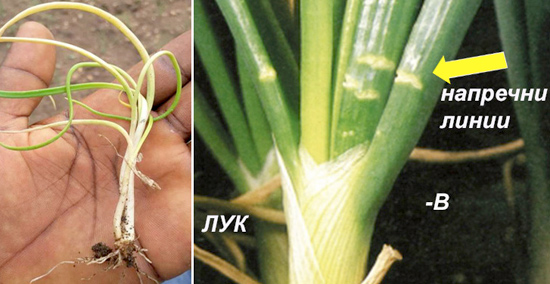
Boron deficiency in bulb vegetable crops
Symptoms of boron deficiency in bulb vegetable crops:
- Leaves are brittle and become grey-green or blue-green, while younger leaves are mottled with distorted, twisted areas and yellow-green spots;
- On the upper surface of the lower leaves, near their base, transverse yellow lines may appear, which develop into cracks. Leaves become rigid, brittle and chlorotic;
- Root development is poor;
- Plants are stunted and deformed;
- Storability deteriorates.
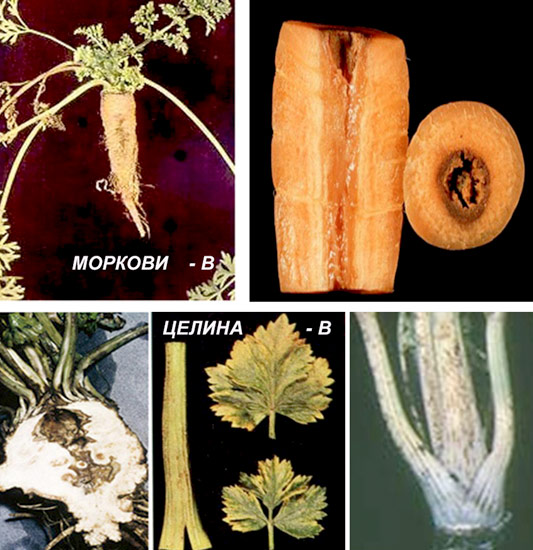
Boron deficiency in root vegetable crops
Symptoms of boron deficiency in root vegetable crops:
- Young leaves are glossy, and old leaves have red margins;
- Leaves are small and curved downward. Necrotic spots may appear on the leaves and their petioles. The plant is brittle;
- Growing points die. The plant becomes deformed;
- The root may split and have a dark and/or hollow central core;
- Yield is low with impaired quality.
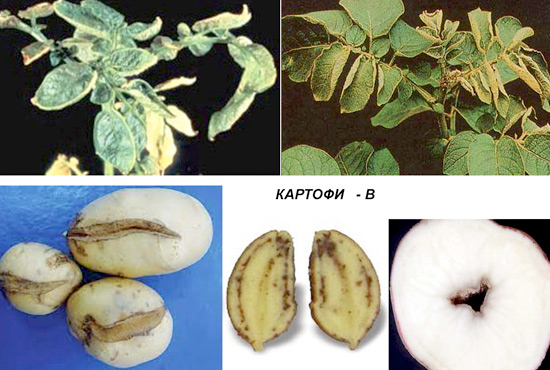
Boron deficiency in tuber vegetable crops
Symptoms of boron deficiency in tuber vegetable crops:
- Emergence is slow. Growing buds on tubers die;
- Leaves are chlorotic, thickened and curl upward along the midrib. Leaf margins are affected by necrosis;
- Growth is retarded. Internodes are shortened and plants acquire a bushy appearance;
- Product quality is severely affected – cracks appear on the tubers and internally – black areas of tissue necrosis and cavities;
- Yield of quality produce is low.
EXCESS BORON
A characteristic feature of boron is that the margin between a sufficient and a toxic level is very narrow. Therefore, it is common for toxicity symptoms to occur when irrigation water with a high boron content is used. The effect is enhanced in sunny weather, which favours boron uptake.
General symptoms
Seed germination is delayed, stem height is reduced, growth stops, upper leaves remain small. Flower formation is weak.
Symptoms first appear on the lower leaves and spread to the top of the plant. Chlorosis develops from the leaf margin and spreads inward between the veins until the entire leaf is affected. In the next stage, necrotic spots appear, leaves become deformed and dry out. Their tips and margins turn reddish-brown. Brown corky lesions appear on stems and young leaves become deformed.
Calcium uptake is impaired.
Causes
Irrigation water with a high boron content – above 1 mg/L; overdosing boron micronutrients in foliar feeding or applied in the nutrient medium; high levels of nitrogen and/or potassium; overdosing compound NPK fertilisers containing boron; high solar radiation.
Recommendation
Excess boron is difficult to remove. This can be done by correcting the acidic reaction of the nutrient medium (liming in soil culture or using a potassium base in hydroponic culture) and lowering the boron level in the nutrient solution. An additional measure is leaching of the substrate or soil to remove soluble boron compounds.
Identification of boron excess symptoms by crop type
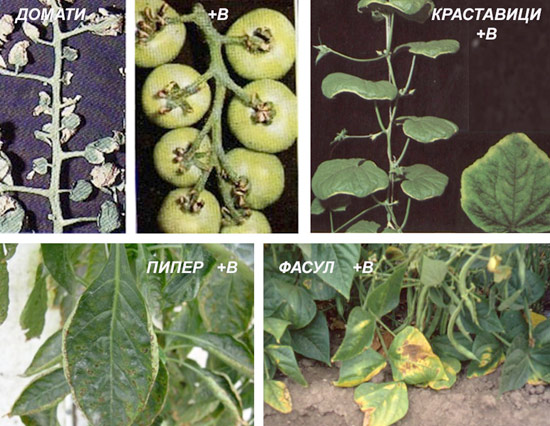
Boron excess in fruit vegetable crops
Symptoms of boron excess in fruit vegetable crops:
- Older leaves become necrotic and die. Symptoms spread upwards. Later, sunken dry spots develop in concentric circles;
- Upper leaves remain small;
- Growth is retarded;
- Flower formation is weak or absent;
- Yield decreases sharply;
- Fruit scorch occurs. In tomato, the sepals dry out.
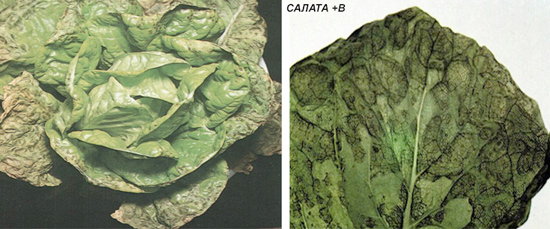
Boron excess in leafy vegetable crops
Symptoms of boron excess in leafy vegetable crops:
- Older leaves are most severely affected and symptoms spread to the younger ones. Along the leaf margins, brownish-grey sunken spots in the form of a ring develop, with dark brown venation (symptoms are particularly noticeable when the leaf is held against the light);
- In more severe toxicity, the spots coalesce and dry out, making the tissue of the entire leaf feel papery to the touch;
- Yield of quality produce is low.