

![MultipartFile resource [file_data]](/assets/img/articles/tomato-diagnostik-недостик-манган.jpg)
Do we know how to “communicate with plants"?
Visual diagnostics
MANGANESE (Mn - Manganese from Latin mangnes – magnet)
Importance of manganese for plants
Manganese is one of the microelements in the plant that has an independent role. It participates in metabolism. As an element with variable valence, it actively participates in regulating redox reactions in the processes of photosynthesis, respiration, nitrogen metabolism, etc. It is an activator of a number of enzymes (arginase, peptidase, enolase, hexokinase, etc.) and is of essential importance for chlorophyll synthesis. It also participates in the synthesis of proteins and fats. It exerts a positive effect on respiration. It improves product quality as well as resistance to adverse environmental conditions.
Manganese is incorporated into plants also in the form of complex compounds.
Plant requirements for manganese
In the plant organism manganese is present in small quantities (0.0001 – 0.02%). It accumulates in larger amounts in the leaves and in smaller amounts in the stems. Older leaves contain higher amounts of manganese than young leaves.
Divalent manganese is rapidly absorbed by the roots, as well as by the leaves in the case of foliar feeding.
The plant’s need for manganese changes during the vegetation period. In most crops, the requirement for manganese increases during flowering and fruit formation and decreases as vegetation advances.
Uptake
Plants absorb manganese mainly as a divalent cation (Mn+2), but they also absorb trivalent manganese (Mn+3) and the permanganate ion (MnO4).
MN DEFICIENCY
General symptoms – the first signs appear on the apical leaves
Manganese deficiency leads to interveinal chlorosis, while the veins themselves remain green, which gives the leaves a mottled appearance. The symptoms are similar to those of iron and/or magnesium deficiency. The difference between manganese and magnesium deficiency symptoms is that in the case of manganese the first signs appear on the young leaves, whereas in the case of magnesium they appear on the older leaves.
Manganese is a partially mobile element in the plant, so symptoms may appear first on the youngest leaves, but in cases of more severe deficiency the oldest leaves are also affected. Initially, symptoms appear as chlorosis between the central veins both on young and on old leaves, depending on the plant species. As a result, necrotic spots may appear and even leaf drop may occur. Black-brown spots appear on the veins, which are numerous on the pale apical leaves. In the next phase of manganese starvation, the whole plant acquires a brownish and yellowish hue and the young leaves become curled.
Causes
Low manganese content in the growing medium; excess calcium and/or iron; drying of the growing medium; calcareous soil; alkaline reaction; strong aeration of the growing medium.
Recommendation
Improvement of the water regime; correction of the reaction of the medium – application to the soil of acidifying substances and fertilizers; foliar feeding with a 0.1% solution of manganese sulfate. In hydroponic crops, use of a nutrient solution containing 0.3 ppm Mn.
Identification of manganese deficiency symptoms by crop type
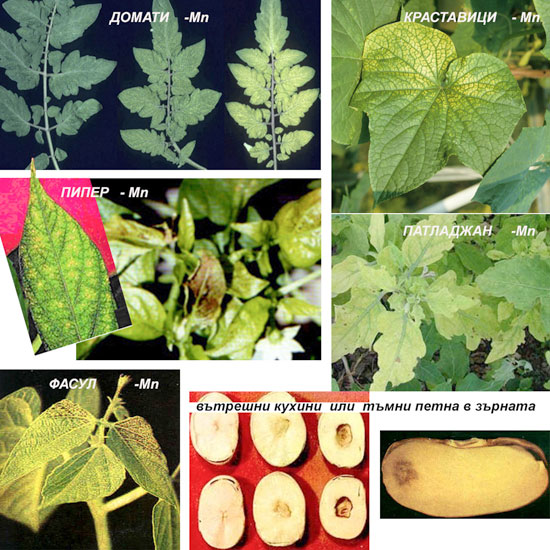
Manganese deficiency in fruiting vegetable crops
Symptoms of manganese deficiency in fruiting vegetable crops:
- The leaves exhibit characteristic mottling – the veins retain their green colour, while the tissue between them turns yellow. At a later stage, in the light-coloured area, especially around the midribs, small, depressed, gradually enlarging necrotic spots appear. In cases of severe starvation, the leaves fall off;
- Unlike iron deficiency, in prolonged or severe manganese deficiency the middle and old leaves are also affected, and thus the whole plant acquires a brownish and yellowish hue, and the young leaves become curled;
- Black-brown spots appear on the veins;
- The fruits are of reduced quality: small scattered corky spots, dark spots and/or cavities appear;
- The plants are stunted;
- Yield is reduced.
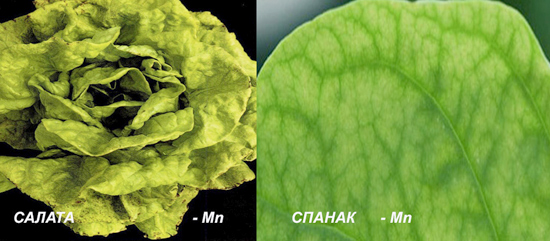
Manganese deficiency in leafy vegetable crops
Symptoms of manganese deficiency in leafy vegetable crops:
- Initially, the young leaves show interveinal chlorosis;
- The whole plant is light green. Later it becomes affected by chlorosis, followed by necrosis;
- Growth is retarded;
- Symptoms of iron deficiency develop – the leaves become pale;
- The plants are stunted and the quality is poor.
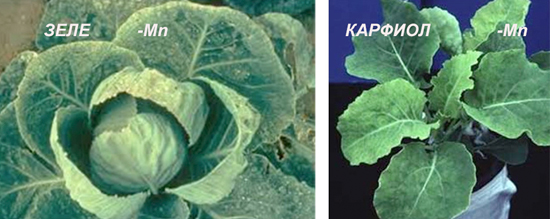
Manganese deficiency in leafy-stem vegetable crops
Symptoms of manganese deficiency in leafy-stem vegetable crops:
- Interveinal chlorosis develops, and in some cases the leaves turn yellow in patches. Small necrotic spots also appear;
- In prolonged deficiency, the youngest leaves become completely yellow;
- The leaves are smaller than normal and are deformed with chlorotic margins;
- In some cases, pinkish hues appear along the leaf margins;
- Growth is retarded and the plants are significantly smaller than typical for the variety.
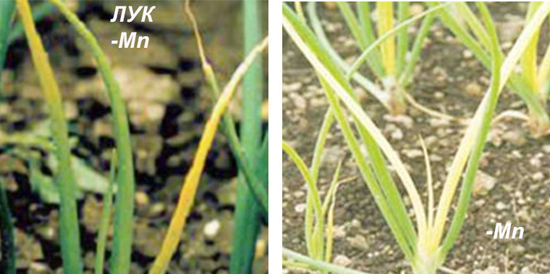
Manganese deficiency in bulb vegetable crops
Symptoms of manganese deficiency in bulb vegetable crops:
- Interveinal chlorosis develops as yellow stripes on the leaves. The tissue between the veins becomes increasingly yellow until the leaves are completely bleached;
- Quality is reduced and yield is low.
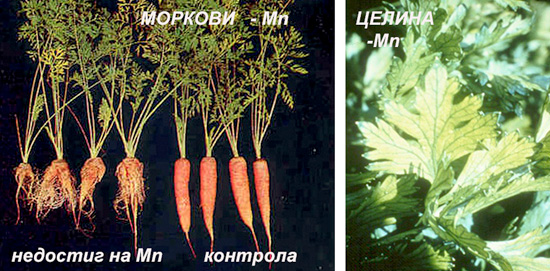
Manganese deficiency in root vegetable crops
Symptoms of manganese deficiency in root vegetable crops:
- The leaves are green with chlorotic spots in the interveinal tissue. Later the leaves become entirely yellow. The symptoms also affect the older leaves;
- Growth is slowed down;
- The roots are small, fibrous and of reduced taste quality.
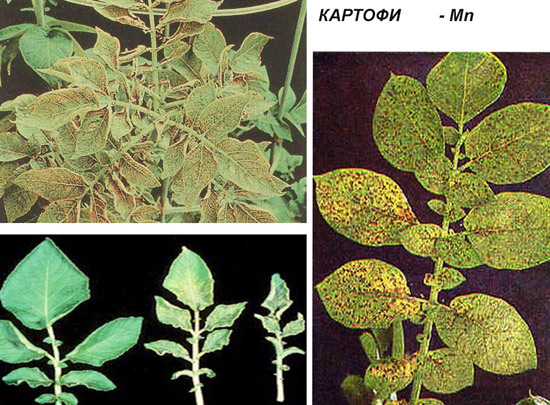
Manganese deficiency in tuber vegetable crops
Symptoms of manganese deficiency in tuber vegetable crops:
- Initially, the young leaves have a dull green colour, and later interveinal chlorosis develops with numerous small black or brown spots, located mainly along the veins, on the margins or over the entire surface of the young leaves;
- Growth is retarded and the plants are smaller than typical for the variety;
- Yield is low;
- Quality is reduced.
MN EXCESS
General symptoms
The first symptoms of toxicity are observed on the older leaves, since manganese is less mobile in the plant. The venation of the old leaves darkens, the leaves acquire a cup-shaped form and pale, depressed, irregularly shaped spots appear on the interveinal tissue. The spots located closest to the leaf margins turn black. Root growth is retarded.
With maintenance of high levels of manganese, brown spots and uneven colouring appear on the older leaves. Symptoms of iron deficiency also develop – interveinal chlorosis and necrosis of the young leaves and the apex, which leads to growth cessation.
Causes
Acid reaction (pH < 5.4) of the growing medium; use of larger quantities of superphosphate, nitrate fertilizers or other physiologically acidic fertilizers; poor drainage – waterlogging or drought; steaming of the soil.
Recommendation
Correction of pH – liming of acid soils; leaching of the substrate; improvement of drainage.
Identification of manganese excess symptoms by crop type
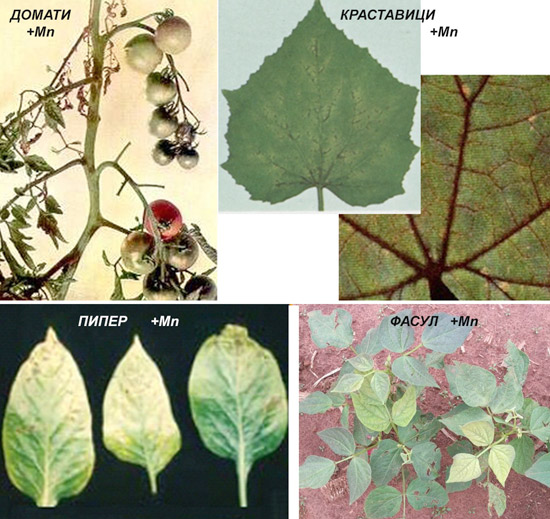
Manganese excess in fruiting vegetable crops
Symptoms of manganese excess in fruiting vegetable crops:
- Necrotic spots develop in the interveinal tissue of the older leaves. Later, necrosis appears on the midrib and on the larger lateral veins. Necrosis appears on the tips of the old leaves. Then the leaves become deformed, wrinkled and fall off;
- Numerous purple dots appear on the stems and petioles;
- The lower leaves age prematurely and fall off;
- The plant acquires a brownish and yellowish hue and the young leaves become curled;
- Growth is retarded and the plants are smaller than typical for the variety;
- Yield is low.
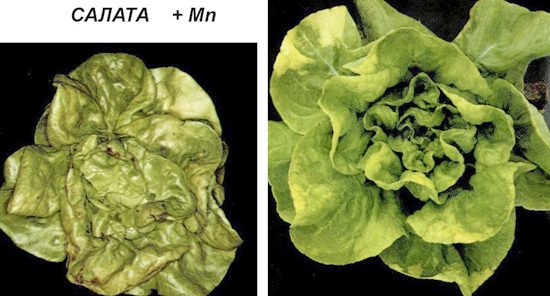
Manganese excess in leafy vegetable crops
Symptoms of manganese excess in leafy vegetable crops:
- The finer venation of the older leaves turns brown;
- Small necrotic spots develop on the tips and margins of the older leaves. Gradually, the small spots merge into larger ones and the leaves dry out. The young leaves are stunted;
- The plants become loose and open;
- Yield is low and of reduced quality.
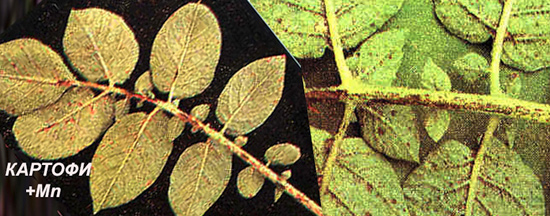
Manganese excess in tuber vegetable crops
Symptoms of manganese excess in tuber vegetable crops:
- The older leaves become pale green and necrotic spots develop, which may cover the entire leaf surface;
- Numerous purple or brown dots appear on the stems and petioles. The affected leaves become entirely yellow and fall off;
- Root development and tuber formation are impaired;
- Growth is retarded.