

![MultipartFile resource [file_data]](/assets/img/articles/садово-0.jpg)
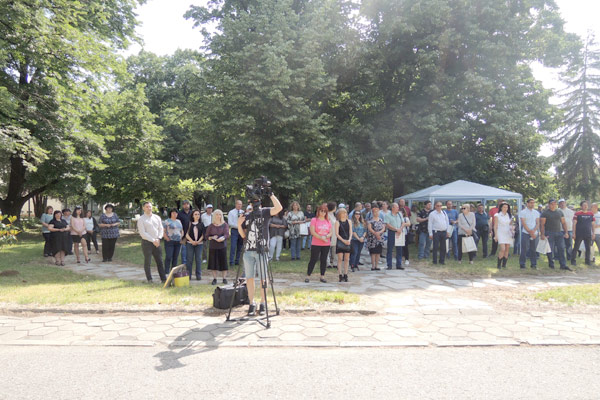
On 27 May 2022, the Institute of Plant Genetic Resources “Konstantin Malkov” – Sadovo welcomed farmers, colleagues and guests. For another year, science and business came together at the traditional event “Farmer’s Day in Sadovo”. In 2022, the occasion is not only the open day, but much more – 140 years of agricultural science in Bulgaria, 120 years since the establishment of the State Agricultural Experimental Station in Sadovo, 120 years since the birth of Acad. Pavel Popov and 45 years since the transformation of the experimental station into an Institute of Plant Genetic Resources of national importance. A remarkable year for IPGR “Konstantin Malkov” – Sadovo, said the Director of the Institute Assoc. Prof. Dr. Katya Uzundzhalieva. In addition to colleagues, farmers, business representatives, representatives of Trakia University in Stara Zagora and the Agricultural University in Plovdiv, students, as well as international guests from Romania, with whom the Bulgarian institute has joint trials, were present in Sadovo. The event was also honoured by guests from Türkiye, with whom IPGR maintains exceptionally good relations. The foreign guests from our southern neighbour have been long-standing admirers of the wheat varieties bred in Sadovo, with which they produce high-quality and tasty bread.
The Institute works with all field crops grown in Bulgaria. The National Seed Genebank is also located in Sadovo, where over 69,000 accessions are preserved. The Institute’s seed production is focused mainly on cereal field crops – barley, wheat, triticale, rye and oats. For oats, for which interest has deepened in recent years, there are also valuable developments: a winter fodder hulled variety and a spring naked variety.
The idea of “Farmer’s Day in Sadovo” is for the IPGR team to acquaint farmers and colleagues in detail with its activities. In the fields belonging to the Institute, the new varieties developed there were demonstrated, as well as those that are maintained and used for seed production. Among the wheat varieties, the new ones are “Blan”, “Sashets” and “Nadita”.
“Blan” is a new generation variety, which has excellent technological qualities and is also renowned for very good yields. On average for a three-year testing period, a grain yield of 754 kg/da was obtained from it, or 18.5% higher than that of the standard “Enola” (636 kg/da), with a proven difference in grain yield of +118 kg/da. In the national testing of the Executive Agency for Variety Testing, Approbation and Seed Control (IASAS), on average for two years “Blan” exceeds the standard varieties for group B by an average of 5%. “Blan” is a medium-early variety with a semi-erect habitus and a height of 90 cm, which ensures optimal leaf mass for plant nutrition and guarantees high lodging resistance.
The other two well-known wheat varieties are “Sashets” – with very good baking properties and “Nadita” – with very high yields.
There are already numerous positive feedbacks from farmers about the variety “Sashets”, shared Assoc. Prof. Uzundzhalieva at “Farmer’s Day”. They are convinced that the variety is very good, provides high yield and is drought-tolerant. Rye, oats, triticale, peas used for seed production were also demonstrated.
The event also focused on the new project of IPGR “Konstantin Malkov” – Sadovo under the National Scientific Programme “Intelligent Plant Production”. In this context, during the Open Day there was a demonstration of crop spraying with a drone. Scientists from the Institute explained what exactly is being done under the project and what innovations and smart technologies for supplying the soil with nutrients and moisture are envisaged in the future.
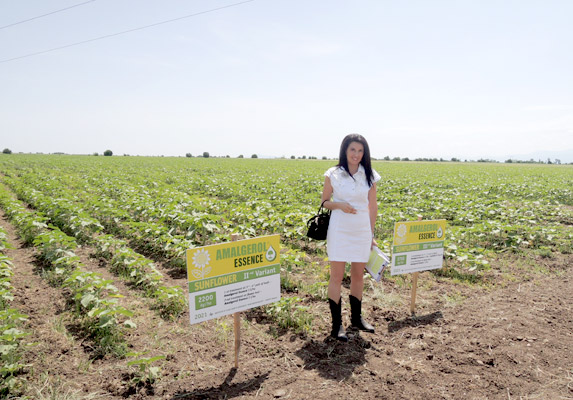
Demonstration trials were presented for testing products of the company “MEDI PLUS R” – the biostimulant AMALGEROL ESSENCE and the microbial fertilizer NUTRIBIO N, compensating for nitrogen fertilization.
In the autumn, a second edition of “Peanut Day” is also planned, dedicated specifically to peanuts at IPGR – Sadovo, in the autumn – just before the harvest of peanuts, in order to demonstrate the yield. One of the new candidate peanut varieties is “Adata”, which is currently in the process of testing at IASAS. The peanut “Adata” is characterized by large kernels, high yields and a characteristic cracking of the pods, a particularly distinctive feature of Bulgarian peanut varieties, which makes them stand out from the range produced worldwide.
Lately, Europeans have been showing increasingly frequent interest in Bulgarian peanut varieties, as a thermophilic crop suitable for cultivation under climate change conditions.