

![MultipartFile resource [file_data]](/assets/img/articles/средиземноморска-плодова-муха.jpg)
The Mediterranean fruit fly has a subtropical origin and is a relatively thermophilic species, but it has demonstrated remarkable ecological plasticity and is now distributed on all continents. In Europe it is found mainly in the Mediterranean countries and in the states surrounding Bulgaria – Greece, Turkey, North Macedonia, Serbia and Albania. However, there also exists a northern thermo-adapted population that inhabits some colder European countries such as Austria, Germany, Hungary, Sweden and the Netherlands.
The species is disseminated through infested fruits in the egg and larval stages. It can also be spread in the pupal stage with soil, planting material or packaging, as well as by the flight of adult individuals from neighbouring countries.
In our country this species was first recorded in the Burgas and Varna regions in 1956 and later on, but the populations perished during the subsequent cold winters. Over the last 20 years damage caused by it has been detected in various regions of the country, but nowhere has the species persisted for more than one or two years. The most probable reason for this is that the individuals that have penetrated into our territory are from the more thermophilic southern population, which cannot overwinter under the climatic conditions in Bulgaria. However, there is a risk that individuals from the northern population may enter our country and the species may become permanently established here.
Since 2014 adults have been captured annually (using attractant traps) in the Blagoevgrad, Kyustendil and Plovdiv regions, and during 2016–2018 damaged fruits have also been detected.
The fly is a typical polyphagous species and attacks almost all fruit crops – peach, apricot, apple, cherry, citrus, pomegranate, fig, date, banana, etc. It can also feed on pepper, tomato, eggplant, cucumber and more than 70 other plant species.
The Mediterranean fruit fly develops from 2–3 up to 15–16 generations per year, depending on the geographical region. The biology of this pest has not been studied in our country, but it probably develops about 4 generations. It overwinters as a pupa in the soil or as a larva in fruit storage facilities.
In spring, the newly emerged adult flies are sexually immature and feed on nectar and other liquids. Oviposition begins 4 to 10 days later. The pest lays eggs only in ripening fruits. If no suitable host is available, the flies can live for 4–5 months and only then start laying eggs.
The females pierce the skin of the fruits with their ovipositor and lay from 2–3 up to 20 eggs. At the oviposition site a small depression, a dark spot or resin exudation can be observed. To see the eggs, the fruit must be cut. The average fecundity in temperate geographical latitudes is about 100 eggs.
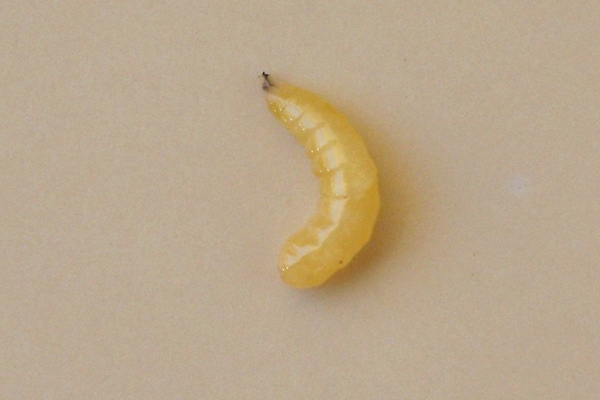
larva of Mediterranean fruit fly
Larval hatching is strongly influenced by temperature. At 26°C embryonic development is completed in 3 days, at 15–17°C – in 24 or more days. The hatched larvae bore into the fruit and feed on the fleshy part. A single fruit may contain from 1 to 10–15, and sometimes even 30 larvae. While feeding they break down the tissues, which turn into rotting pulp. The larvae gradually move from the decayed to the healthy part. Damaged fruits rot, become deformed and drop prematurely.
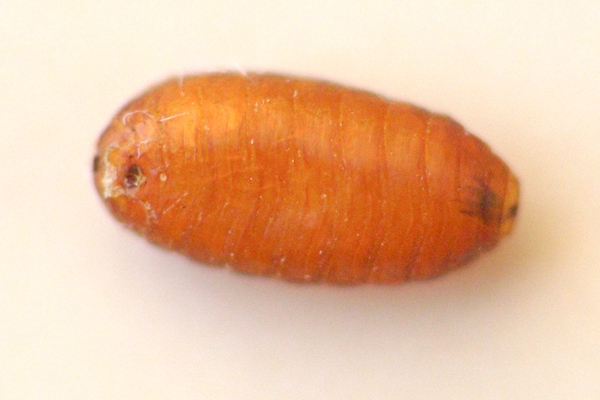
pupa of Mediterranean fruit fly
After completing their development, the larvae gnaw an exit hole in the fruit, fall onto the ground and pupate in the soil at a depth of 2–8 cm. The pupal stage lasts from 8 to 21 days. The development of one generation can last from 18–20 days up to 100 days.
For the time being, the main control method consists of strict quarantine measures – to prevent the introduction of infested fruit produce. Consignments of fruits arriving from countries where the pest is present must be kept at a low temperature (0.5–1.5° C) for 21 days. If the fruits are infested, they may be fumigated. Rotten fruits are destroyed by burying at a depth of 50 cm or by burning.
The flight of adults is monitored with yellow traps of the Rebell type. Sometimes the flies are also attracted by traps containing only a food attractant, including those placed for other pests. At low population density you can use only yellow traps for control.
Chemical control is directed against the adults, before oviposition, 6–10 days after the beginning of the flight. You may use pheromone traps – Decis Trap (5–8 traps/da), or one of the products – Deka EC (30–50 ml/da) or another insecticide based on deltamethrin, an insecticide based on cypermethrin – Aficar 100 EC (30 ml/da), Efcymerin 10 EC (30 ml/da). Among the products approved for organic production, you may use a phytoinsecticide based on pyrethrins – Pyregard, Chrysant EC (75 ml/da), based on azadirachtin – Neem Azal T/S, Oikos (0.3 g/da), Naturalis (100–200 ml/da).