

![MultipartFile resource [file_data]](/assets/img/articles/обща-череша.jpg)
Cherry fruits have valuable flavour, nutritional and dietary qualities, and in addition they ripen earliest in the year, rivalled in this respect only by strawberries. They are mainly consumed fresh, but are also an important raw material for the production of jams, jellies, syrups, juices, preserves, as well as for freezing and drying. In recent years the largest cherry production has been in Turkey, followed by the USA, Iran, Germany and Italy.
In Bulgaria, cherries are grown mainly in the Kyustendil, Pazardzhik, Sliven, Stara Zagora, Burgas and Shumen regions.
For the protection of trees and fruit yield from diseases and pests in cherry orchards, a significantly smaller number of sprayings is carried out compared to apple. Nevertheless, the issue of residues and environmental pollution is also relevant in cherry production, bearing in mind that in this fruit species the period from flowering to harvest is considerably shorter than in apple.
Phytopathological literature describes 24 fungal diseases of cherry. Among those identified in Bulgaria, the most economically important are cherry leaf spot (cylindrosporiosis) and brown rot.
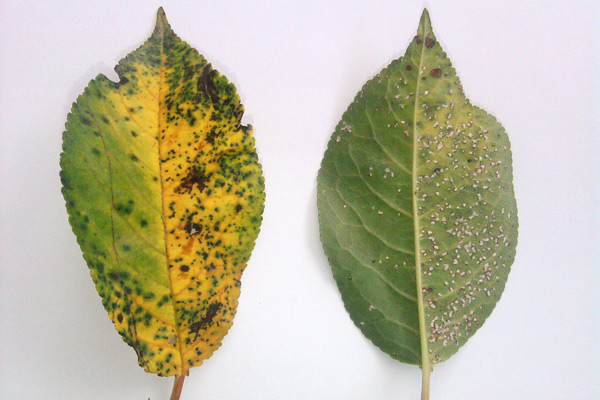
Cherry leaf spot (white rust) is the key disease of sweet and sour cherry that determines the number of fungicidal sprayings each year.
Cherry leaf spot as a disease of stone fruit was first described on the wild species Prunus padus by Karsten in 1884 in Finland, after which it was reported in a number of European countries and the USA.
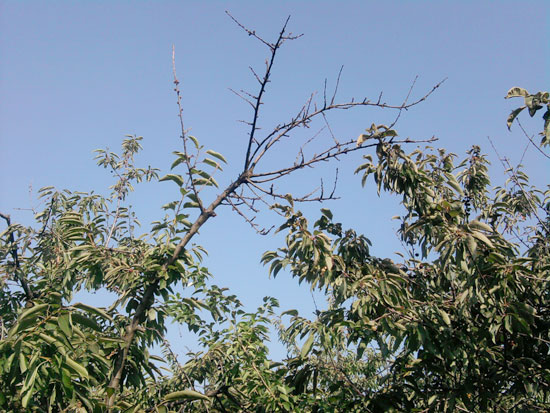
This disease causes significant damage to cherry production, as it induces premature defoliation of the trees, which not only reduces the quantity and quality of the yield, but also leads to winter injury of the trees during winters with low temperatures. Damage from cherry leaf spot is mainly on the leaves and, in some cultivars, also on the fruit pedicels.
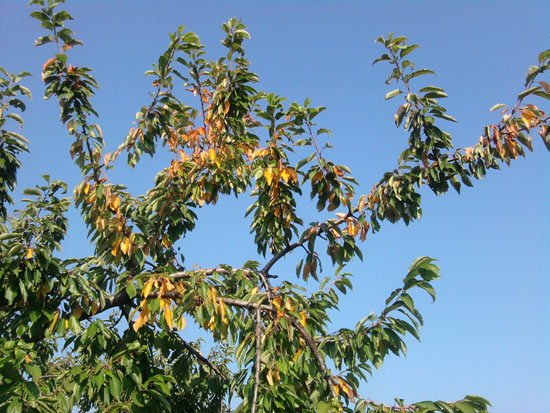
On the upper surface of infected leaves, small spots appear, about 3 mm in diameter, brownish-red to purple in colour, with a circular to irregular shape. In wet and rainy weather, abundant white spore masses are formed on the lower surface of the spots, from which one of the names of the disease, “white rust”, is derived. When numerous spots appear, the tissues between them turn yellow and later brown, and the leaves fall prematurely. Less severely affected leaves remain on the trees until the end of the vegetation period. In some highly susceptible cherry cultivars, damage is also observed on the petioles of leaves and fruits. The spots on the petioles are elongated, 3–6 mm in size, later developing into small cankers. In cases of severe infection of the pedicels, the fruits remain smaller and lighter in colour.
The causal agent of cherry leaf spot is the fungus Blumeriella jaapii (Rehm) Arx, synonym Coccomyces hiemalis Higgins; anamorph Phleosporella padi (Lib.) Arx, synonym Cylindrosporium padi (Lib.) P. Karst. ex Sacc.
Blumeriella jaapii overwinters in infected fallen leaves as a stroma, in which apothecia with asci and ascospores are formed in spring. The optimum temperature for ascus development is 13°C, and for apothecia 16.5°C. Ascospores are released after rain from the end of flowering until about 6 weeks after petal fall. The highest number of ascospores is “discharged” at temperatures of 16–30°C, and the lowest at 4–8ºC. Aservuli are also formed on the overwintered stroma, but their role has not yet been clarified. It has been established that in some climatic zones the fungus can also overwinter as mycelium in twigs, where it forms conidia in spring.
On the underside of the spots, B. jaapii forms acervuli with conidia in humid weather, through which secondary infections are carried out.
The fungus penetrates the leaves through the stomata. Leaves are not infected from bud swell until they unfold, probably because the pathogen cannot penetrate the tissues before the stomata are formed. Later, the leaves are susceptible throughout the growing season, but their susceptibility decreases with ageing.
Infection of leaves with ascospores or conidiospores depends on temperature and the wetness duration of plant tissues. Eisensmith and Jones established the relationship between the duration of tissue wetness, temperature and the infection process in connection with the application of post-infection treatments for disease control.
Recommendations for the control of cherry leaf spot include:
• Collection and destruction of fallen leaves to reduce the source of infection;
• Fungicidal sprayings at 10–14 day intervals, with the first spraying carried out at petal fall. Between 3 and 8 sprayings are recommended, depending on the conditions for disease development and the susceptibility of the cultivars grown. Under the conditions in Bulgaria, usually 2 to 4 sprayings are carried out.
For control of cherry leaf spot, the following fungicides are included in the list of authorised products: Signum - 0.03%; Syllit 40 SC - 150 ml/ha; Score 250 EC - 0.03%; Flint Max 75 WG - 30 g/ha.
Model for determining infection periods
As early as the 1980s, a team of scientists at Michigan State University (Eisensmith and Jones) developed a model for determining infection periods and their severity based on air temperature and leaf wetness duration. Initially, the authors proposed a formula for calculating an index called the “Environmental favorability index” – EFI, which is a function of temperature and leaf wetness and, based on its value, the degree of infection is estimated. Later, to facilitate the determination of infection periods, they proposed a table similar to that of Mills for apple scab. To improve the model for the application of curative sprayings, Eisensmith et al. conducted an experiment to determine the effect of interrupting the wet period (the hours during which leaves are wet) on the infection process and, more specifically, on the appearance of symptoms on the leaves. The authors established that if leaf wetness is interrupted for no more than 8 hours, the infection period continues, but the effect on damage depends on how many hours after the onset of wetness drying occurs and how many hours after the interruption the leaves become wet again. The influence of leaf age and spore concentration on infection by B. jaapii has also been established. After registering a period of infection (infection period), the authors recommend the application of curative treatments with systemic fungicides. Using this model avoids unnecessary preventive sprayings and, in some years, a smaller number of treatments is carried out.
This model was tested in Bulgaria after 1990 at the Institute of Agriculture in Kyustendil on sour and sweet cherry. Based on the experiments conducted, it was established that control of cherry leaf spot on sweet and sour cherry can be successfully achieved by applying post-infection sprayings with systemic fungicides, applied 24–96 hours after establishing an infection period. By using post-infection sprayings, unnecessary preventive treatments can be avoided and, thus, in some years the use of fungicides can be reduced.
The most reliable way to protect cherries from cherry leaf spot is to grow cultivars that are resistant or very slightly susceptible to the disease. In Bulgaria, the first studies on the susceptibility of cherry cultivars to cherry leaf spot were conducted by Velichkova in 1975, who established that among the cultivars observed, the most highly susceptible to the disease are Napoleon, Bing and Ranna Cherna Edra, while Silistrenska Cheresha and Sofiyska Ranna No. 24 are slightly susceptible. Later, at the Institute of Agriculture in Kyustendil, an assessment was made of the susceptibility of more than 40 newly introduced cherry cultivars. Based on this study, it was established that all cultivars are susceptible to B. jaapii, but to a varying degree.
The cultivars Vic, Schmidt, Bigarreau Oratovski, Patriotka Krima, Nadezhda, Krupnoplodnaya, Cherna Konyavska, Hebros, Royalton, Starking Hardy Giant, Star, Bigarreau Productive, Sunburst, Sovetskaya are slightly susceptible. Highly susceptible to the disease are Bing, Princessa, Priusadebnaya, Tekhlovitska, Windsor, Merton Crane.
It has been established that the rootstock, fertilisation rates and soil surface management systems influence the degree of attack by cherry leaf spot.
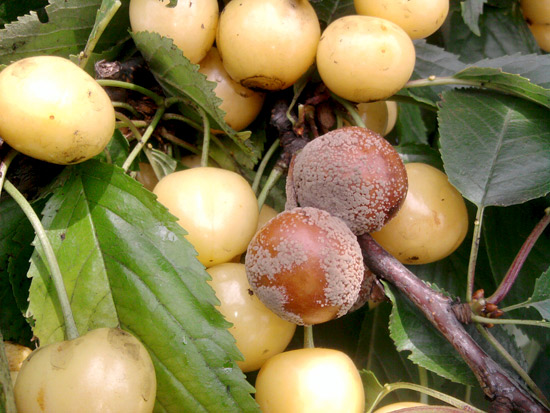
Brown rot
Brown rot of cherry is the second most economically important disease, and in some years the first in Bulgaria and in a number of other countries where this fruit species is grown.
Three species of fungi from the genus Monilinia – M. laxa, M. fructigena and M. fructicola are the causal agents of brown rot in fruit crops. M. fructicola is distributed in North and South America, Japan and Australia, where it causes serious damage to stone fruit species. This pathogen is included in the list of quarantine diseases for Europe. After 2000, numerous researchers from France, Italy, Poland, Serbia and other European countries reported damage to fruit crops caused by M. fructicola.
Species of the genus Monilinia belong to the order Helotiales, family Sclerotiniaceae.
M. laxa and M. fructigena overwinter in Bulgaria as compact mycelium in infected twigs and fruits. Sporulation begins as early as the beginning of spring, as a result of which, by the flowering period, a strong infection pressure is built up which, under favourable meteorological conditions during flowering and fruit ripening, can lead to significant damage in certain cultivars. Optimal conditions for spore formation are created at high atmospheric humidity and temperatures between 15 °C and 20 °C for M. laxa and 24 °C–27 °C for M. fructigena. Spores are spread by rain splash or by insects.
In the life cycle of fungi of this genus there are three phases, which are very important in relation to the control of these causal agents of rot in fruit crops. The first phase is during flowering, when the fungi cause damage to blossoms and twigs; the second is during fruit ripening; and the third is during storage.
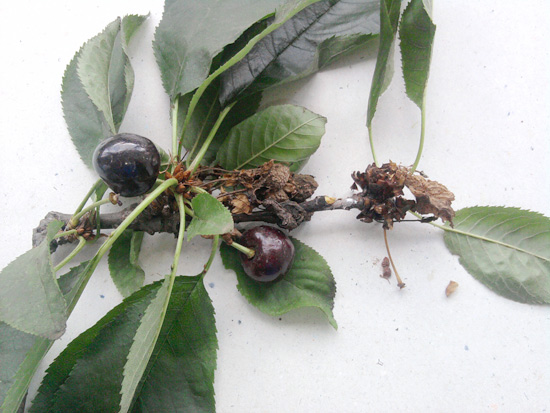
M. laxa and M. fructigena infect the blossoms, from where they penetrate into the twigs through the pedicels. Infected blossoms turn brown, and later the infection spreads to the pedicels and the respective twigs. Cankers form on infected twigs, exuding gum. On fruits, damage begins as a small, light brown spot which rapidly enlarges and covers the entire fruit. With frequent showers and high atmospheric humidity, small grey tufts of conidiophores with conidia appear on the affected parts infected by M. laxa, scattered over the entire damaged area. On fruits damaged by M. fructigena, large sporulating tufts of conidiophores and conidia appear. The tufts are ochre in colour and arranged in concentric rings. The affected fruits mummify and remain on the trees.
Among fruit species, sour cherry and apricot are highly susceptible to early brown rot on blossoms and twigs, while sweet cherry cultivars are less affected.
M. fructigena mainly infects through wounds caused by fruit cracking under conditions of high atmospheric humidity or hail, as well as by birds and insects.
Fruit cracking depends on a number of factors related to the anatomical and physiological characteristics of the fruits, such as skin thickness, number of stomata per unit area, and nitrogen concentration in the skin. In addition, it is mainly influenced by atmospheric humidity in the orchard, rainfall frequency and the duration of fruit wetness during ripening,
Measures to protect cherries from the causal agents of rot of the genus Monilinia include sanitary pruning and fungicidal sprayings.
Sanitary pruning is applied to remove infected twigs, and in addition all mummified fruits must be removed from the canopy, collected and destroyed. These measures are applied annually, bearing in mind that infection is renewed by spores formed on infected twigs, branches and fruits. Sanitary measures alone cannot solve the problem of brown rot, which necessitates fungicidal sprayings to protect trees from infection. Sprayings are carried out before bud swell, at the phenological stages “pink bud”, “flowering” and immediately after flowering to protect blossoms, young fruitlets and twigs, and later, to protect fruits, treatments are carried out in the period before ripening.
Copper-containing fungicides – Bordeaux mixture – 1%, Bordeaux mix 20 WP – 375–500 g/ha, Kocide 2000 WG – 180–280 g/ha, Funguran OH 50 WP – 0.4%, Champion 50 WP – 300 g/ha are suitable for pre-flowering sprayings and are effective both against brown rot and against shot-hole disease and bacterial canker.
For flowering and post-flowering sprayings against brown rot, the following fungicides are included in the list of authorised products: Luna Experience – 63–75 ml/ha, Chorus 50 WG – 45–50 g/ha (0.045%–0.05% with 100 l/ha spray solution), Signum WG – 30 g/ha, Difcor 250 EC – 20 ml/ha, Delan 700 WG – 0.05%.
For cherries as well, it should be borne in mind that frequent use of systemic fungicides leads to the development of resistance in Blumeriella jaapii, Monilinia laxa and Monilinia fructigena, after which these fungicides are no longer effective. To prevent the development of resistance, it is recommended to strictly follow the instructions regarding the rate (concentration) and timing of application for each product, and the maximum number of sprayings authorised for a given pathogen and crop. It is essential to alternate fungicides with different modes of action against the pathogens.