

![MultipartFile resource [file_data]](/assets/img/articles/tomato-diagnostik-недостик-мед.jpg)
Do we know how to “communicate with plants"?
Visual diagnosis
COPPER (Cu – Copper from Latin cyprium)
Importance of copper for plants
Copper is a micronutrient which, in the form of various organic and inorganic compounds, participates in the metabolism of the plant organism. It is involved in the synthesis of proteins, carbohydrates, vitamins, etc.
Copper is a component of important oxidizing enzymes – polyphenol oxidase, ascorbic acid and others, and thus participates in redox processes in plants.
Copper supports the binding of free oxygen radicals, thereby rendering them harmless. It has an effect on nitrogen metabolism. Together with molybdenum, it participates in the activity of enzymes that catalyse the reduction of nitrates to ammonia. Its role in photosynthesis and respiration is significant. It helps the formation of lignin in the cell walls, thus maintaining the strength of plants. Its role is particularly important for the formation of viable pollen and seeds. It increases plant resistance to fungal diseases and stress factors.
Plant requirements for copper
The amount of copper in plants varies on average from 1 mg/kg to 20 mg/kg dry matter. It is assumed that for the normal activity of enzymes, the copper content in plant tissues should be 1.5–2.0 mg/kg dry matter. Below this level and above 20–30 mg/kg dry matter, disturbances appear in the plant and yield decreases.
Plants absorb copper more intensively in the early stages of their development and especially during the period of intensive growth.
The rate of copper uptake by the roots depends mainly on the quantity and form of copper compounds in the soil and/or nutrient solution – at a high content of available copper, its uptake is more intensive.
Uptake
Copper is taken up by plants in the form of a monovalent ion (cuprous cation) Cu+ and a divalent ion (cupric cation) Cu2+.
COPPER DEFICIENCY
General symptoms – the first signs appear on the younger leaves
Mild or moderate copper deficiency may reduce yield or plant growth without clear symptoms. Deficiency symptoms occur most often in the early stages of plant development and especially during the period of intensive growth, when plants absorb copper more intensively.
In case of copper deficiency, chlorosis appears on the younger leaves, but not on the apical ones. The leaves are chlorotic with necrotic spots, twisted towards the upper surface. Plants lose their turgor and wilt during the sunny hours of the day, even when sufficient moisture is available. Root growth is severely retarded. Flowering is severely limited or completely absent. Growing buds die. Yield decreases sharply.
Plant susceptibility to fungal diseases increases.
Causes
Use of peat substrate; high content of phosphorus, potassium, iron, manganese, boron and/or zinc; excessive nitrogen fertilisation; high air temperature, high pH (the solubility of copper compounds decreases).
Recommendation
One of the first things that should be paid attention to is the pH of the growing medium and maintaining values optimal for the crop.
Foliar feeding with copper sulphate 0.1%, neutralised with calcium hydroxide (approximately 0.5%) to adjust the pH of the solution; careful use of fertilisers containing copper chelate or granular copper fertilisers based on soil analysis or nutrient solution analysis, since the line between copper deficiency and excess is very narrow.
Identification of copper deficiency symptoms by crop
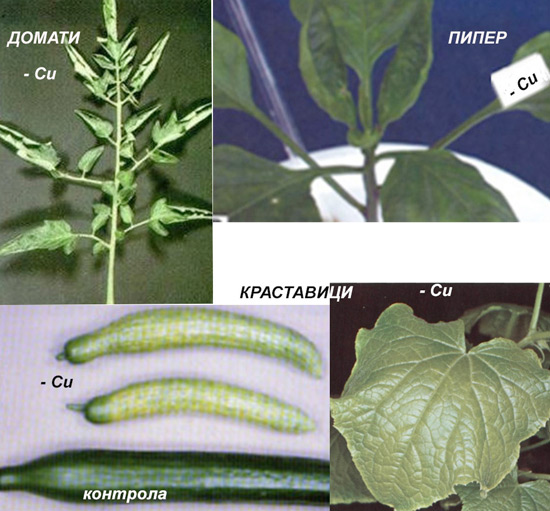
Copper deficiency in fruit vegetable crops
Symptoms of copper deficiency in fruit vegetable crops:
- Leaves are bluish-green or light green. The edges of the middle and young leaves are tube-like curled towards the midribs;
- On older leaves, necrotic spots may appear near and along the midribs. Chlorosis develops from the older to the younger leaves. In severe deficiency, chlorosis also affects the venation. Petioles are bent downwards, bringing opposite small leaflets closer to each other;
- Internodes are shortened, leaves are small and the plant acquires a bushy appearance;
- Flowering is greatly reduced or absent;
- Leads to sterility;
- Ripening is delayed;
- Fruit quality is impaired. Fruits are smaller than typical for the variety; small sunken areas appear; their colour fades and their taste deteriorates. In severe deficiency, fruits become undersized and misshapen;
- Stem growth is retarded;
- Yield decreases.
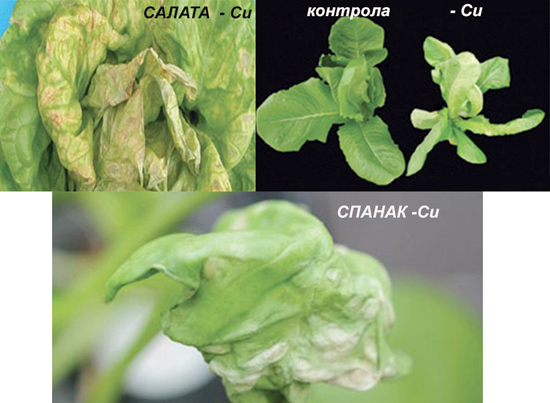
Copper deficiency in leafy vegetable crops
Symptoms of copper deficiency in leafy vegetable crops:
- Initially, the young leaves appear stunted;
- A bluish-green tint appears. Leaves acquire a chlorotic appearance;
- In the chlorotic areas of the leaves, small necrotic spots may form, especially along the margins.
- As symptoms develop, the newest leaves become smaller, lose their gloss and, in some cases, leaves may wilt.
- Growth is retarded and plants are usually compact, as the distance between leaves is shortened;
- Quality is impaired.
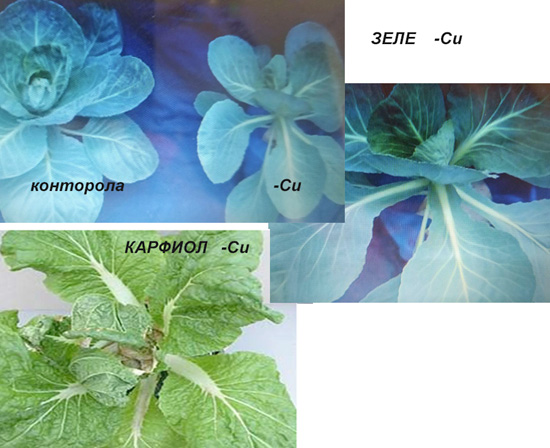
Copper deficiency in leaf-stem vegetable crops
Symptoms of copper deficiency in leaf-stem vegetable crops:
- Leaves are elongated in shape and bent downwards. Their colour is pale with broad white venation;
- Plant habit is loose;
- In more severe deficiency, chlorosis may appear on mature leaves and necrosis of the „heart”;
- Growth is retarded.
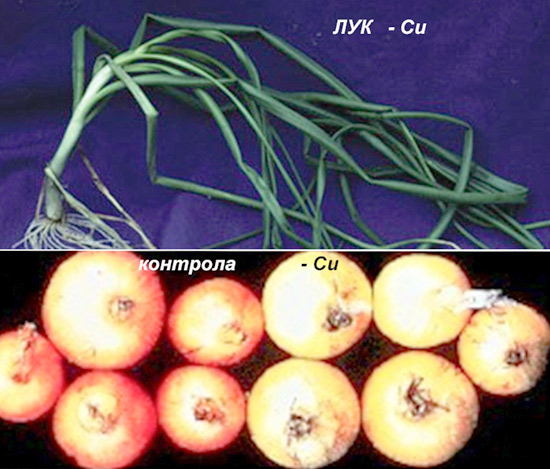
Copper deficiency in bulb vegetable crops
Symptoms of copper deficiency in bulb vegetable crops:
- The tips of the young leaves turn yellow, and later turn white and twist like a spiral or bend downwards at a right angle;
- Growth is retarded;
- The scales of the bulbs become soft, pale yellow and thin.
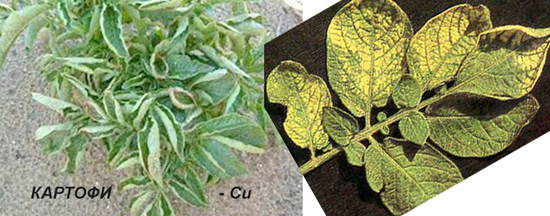
Copper deficiency in tuber vegetable crops
Symptoms of copper deficiency in tuber vegetable crops:
- Leaves are bluish-green and curl upwards towards the central vein. Chlorosis appears and/or the tips of the young leaves turn brown;
- In more severe deficiency, young leaves wilt and die;
- Growth is retarded. Severely affected plants are stunted and chlorotic.
COPPER EXCESS
General symptoms
Copper is one of the most toxic elements. It poisons enzymes and other biologically active substances.
Symptoms of copper toxicity include reduced shoot growth, with new leaves initially being greener than normal and then chlorosis appearing on the older leaves, accompanied by the formation of brown spots and leaf fall. Symptoms of iron deficiency, and sometimes molybdenum or zinc deficiency, also appear.
Toxic concentrations of copper in the growing medium (soil, substrate) inhibit seed germination. They restrict root growth by burning root tips. Branching is reduced.
Causes
Copper toxicity may occur after repeated application of farmyard manure, biosolids or pesticides with a high Cu content; acidic reaction of the medium; excessive use of copper-containing fertilisers.
Recommendations
Toxic copper concentrations are difficult to correct. A partial solution is liming the soil to reduce medium acidity to a pH of about 6.5; use of physiologically alkaline fertilisers.