

![MultipartFile resource [file_data]](/assets/img/articles/заглавна.jpg)
At this time of the month, apricot, peach and almond are in the fruit growth stage. Due to the favourable meteorological conditions – high humidity, temperatures above the climatic norms and frequent rains in May, the risk of repeated infections with fungal and bacterial diseases is high. Therefore, treatments must continue in order not to compromise the fruit yield.
The harmful activity of the peach twig borer (Anarsia) and the oriental fruit moth, which have more than one generation per year, continues.
A third post-bloom spraying is carried out 10-12 days after the second in apricot and peach and 12-14 days in almond. In apricot it is targeted against shot-hole disease, brown rot, powdery mildew, gnomoniosis, Anarsia and oriental fruit moth. In peach – against shot-hole disease, brown rot, scab, powdery mildew, Anarsia and oriental fruit moth. In almond – against shot-hole disease, scab, cercosporiosis, powdery mildew, almond sawfly and almond seed wasp.
A fourth spraying is carried out 10-12 days after the third in apricot and peach and 10-14 days in almond. It is targeted against oriental fruit moth in apricot and peach and against the same diseases and pests as during the third spraying in almond.
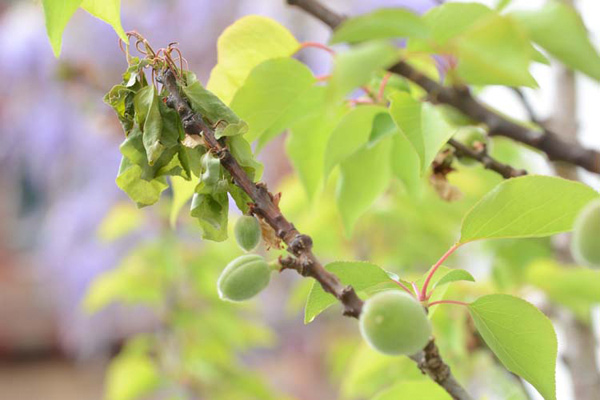
Late brown rot
The causal agent is a fungus. The symptoms of the disease are the same as those of early brown rot, with the difference that the fruiting bodies are larger and have an ochre-yellow colour. It overwinters as mycelium in mummified fruits and infected twigs. It develops on the fruits from fruit set to harvest, since the conidia of the fungus require higher temperature (the most favourable conditions for infection are at 25oC) for their formation in spring. Therefore, it develops more actively during the summer.
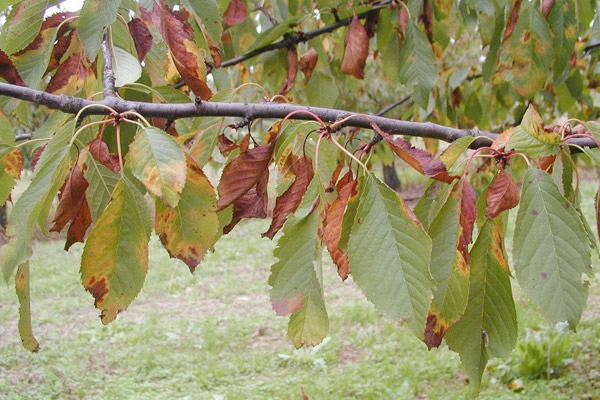
Gnomoniosis
The fungus causes massive leaf spotting, blight and premature defoliation in years with more prolonged rainfall during the spring-summer period. In the early stages of disease development, diagnosis is difficult due to the non-specific reaction.
On the leaves, indistinctly outlined chlorotic spots are formed, with slowly expanding necrosis from the centre, similar to bacterial diseases. In the later stages, gnomoniosis can be distinguished by the large size of the spots (1-3 cm), the relatively dark rusty-brown colour of the necrotic areas and the presence of numerous yellowish-brown pycnidia on the underside, which gives the affected surface a finely rough appearance.
The causal agent is preserved in the fallen infected leaves. During the winter-spring period it forms perithecia in them. They are free, solitary, immersed in the tissue. The perithecia contain mature ascospores for a period of 30 to 90 days, i.e. until the end of June. The dispersal of the ascospores and the infection they cause occurs over an extended period of time.
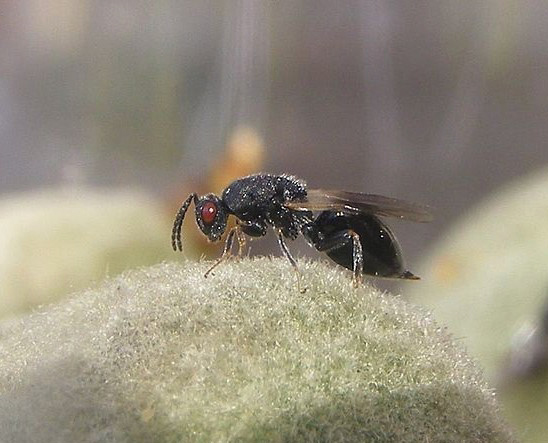
Almond seed wasp
The pest is widespread wherever almond is grown and is the most economically important pest of this crop. The almond seed wasp is a monophagous species. The damaging stage is the larva, which feeds on the kernel of the almond fruit.
The pest has one generation per year and overwinters as a fully fed larva in the fruits it has damaged, which dry out and remain on the trees. Pupation occurs in the second half of March – early April in the wormy almond fruits at an average daily temperature above 10-12 oC. The pupal stage lasts from 16 to 20 days. Over a period of 3-6 days, the emerged adults gnaw an exit hole in the hard shell. About 20-26 days after almond flowering, the seed wasps emerge. When the temperature drops below 13 oC, the wasps do not fly, but remain motionless on the fruits and leaves.
The adult insect is sexually mature immediately after emergence. Females live from 8 to 10 days, and males – from 4 to 7 days. It can reproduce and develop from unfertilised eggs. The flight coincides with the post-bloom period during the formation of the green fruits.
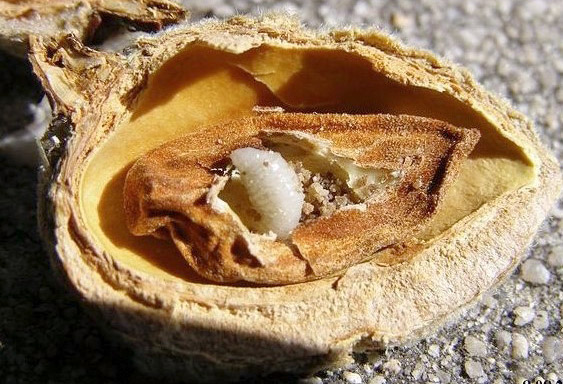
The female lays one egg in the watery tissue of the kernel, piercing the green and still soft almond fruits with the ovipositor. One female lays about 58 eggs. After 24-30 days the larvae hatch and feed on the kernels of the fruit without affecting the seed coat. They become fully fed in 28-47 days, after which they remain in the damaged fruits until spring, when they pupate.
The fruits are clearly damaged only when the larva has eaten a significant part of the kernel content. Then the pericarp of the fruits stops growing, slightly yellows and adheres to the stone. The damaged fruits do not drop, they blacken during the winter and are easily visible on the trees from a distance. After the wasp emerges, the exit hole, which has a diameter of 1 to 1.5 mm, is easily seen on them.
Control of diseases and pests
Against shot-hole disease, brown rot and scab, you may use a captan-based fungicide – Captan 80 WG (150-180 g/ha), Merpan 80 WG (225 g/ha), Scab 80 WG (180-210 g/ha);
Against gnomoniosis – one of the products – Delan 700 WG (50 g/ha), Signum (30 g/ha), Caramat 2.5 EC (300 ml/ha);
Against powdery mildew – a sulphur-based product – Sulphur WG (600 g/ha), Solfo 80 WG (750 g/ha) or Difcor 250 SC (20 ml/ha);
Against cercosporiosis you may use Capper Key (240-300 g/ha) or another copper oxychloride-based product. Topsin M 70 WG is the most effective against cercosporiosis, but it has already been withdrawn from sale. If you still manage to find it, use it.
Among the products approved for organic production, you may use Cuprantol Duo (400 g/ha) against bacterial shot-hole disease and Curatio (1.6 l/ha) against fungal diseases.
Against peach twig borer and oriental fruit moth – an insecticide with the active ingredient deltamethrin – Deka EC (30-50 ml/ha), Decis 100 EC (7.5-12.5 ml/ha), Delmur (50 ml/ha), Meteor (0.06 - 0.09%);
Economic injury level for peach twig borer – 3% damaged shoots and fruits per tree; for oriental fruit moth – 3% damaged shoots and fruits
Against almond seed wasp and almond sawfly – again a deltamethrin-based product at the same concentrations;
Products approved for organic production that you may use against the mentioned insects are – a phytoinsecticide based on pyrethrins – Pyregard, Chrysant EC (75 ml/ha) or based on azadirachtin – NeemAzal T/S, Oikos (0.3 g/ha). Against peach twig borer you may also use Sineis 480 SC (20 g/ha), Rapax (100-200 ml/ha), and against oriental fruit moth – Rapax (100-200 ml/ha), Madex Twin (10 ml/ha).