

![MultipartFile resource [file_data]](/assets/img/articles/tomato-diagnostik-недостик-желязо.jpg)
Are we able to “communicate with plants"?
Visual diagnosis
IRON (Fe from Lat. Ferrum – firm)
Importance of iron for plants
The greater part of the iron in the plant organism is in the form of organic complex compounds, associated mainly with various proteins. They perform specific functions in the plant organism. An insignificant part of it is in the form of salts.
The physiological function of iron in the plant organism includes the biosynthesis of chlorophyll. It is also bound to various amino acids and other biopolymers. Iron ions take an active part in the redox processes of photosynthesis, respiration, protein biosynthesis, biological fixation of atmospheric nitrogen, reduction of nitrates and nitrites, etc. It contributes to the development of the above-ground biomass and productivity.
Plant demand for iron
Plants use iron in small quantities, but throughout their entire vegetation period. The iron contained in the seeds can satisfy the needs of the young plant until the appearance of the first true leaves. After that, the plant starts to absorb the iron present in the nutrient medium, and as the leaf area increases, its demand for iron rises.
Iron is poorly mobile in the plant organism. Its content is highest in the roots. In the vegetative organs its amount is greater than in the reproductive ones. The greater part of the iron in the leaves is concentrated in the chloroplasts. The concentration of iron in the tissues of young plants is significantly higher than in older ones.
In plant tissues iron is present in a much higher quantity (50 – 2500 mg/kg dry matter) than other micronutrients.
Uptake
Plants take up iron as a divalent cation (ferrous ion) Fe2+ and as a trivalent cation (ferric ion) Fe3+. Divalent ions are more easily absorbed by plant roots.
IRON DEFICIENCY
General symptoms – the first signs appear on the younger leaves
A typical symptom of iron deficiency is interveinal chlorosis. The chlorosis develops from the periphery towards the inner part of the young leaves. Initially, the venation, including the smallest veins, remains green as a fine green network on the yellow leaf tissue. In more severe cases the colour changes to pale yellow to creamy white. Later, necrosis develops along the leaf margins and premature leaf fall occurs. Affected plants are poorly developed, with low yields and deteriorated product quality.
Iron deficiency can easily be confused with nitrogen deficiency. The difference is that in the case of nitrogen the symptoms first affect the older leaves, whereas with iron the first signs appear on the younger leaves.
Causes
Elevated levels of nitrate nitrogen, calcium, phosphorus, manganese, zinc and/or copper; alkaline medium (at pH > 8.0 iron passes into an insoluble form); poorly developed and weakly active root system; waterlogged soil or substrate; irrigation with water containing high levels of alkaline earth bicarbonates; frequent use of copper-based plant protection products; stress situations caused by high and low temperatures; clay soils.
Recommendation
Foliar feeding with iron chelate (EDDHMA-Fe; EDTA-Fe); correction of the reaction of the nutrient medium. In hydroponic crops, use of a nutrient solution containing 2 – 3 ppm Fe.
Identification of iron deficiency symptoms by crop type
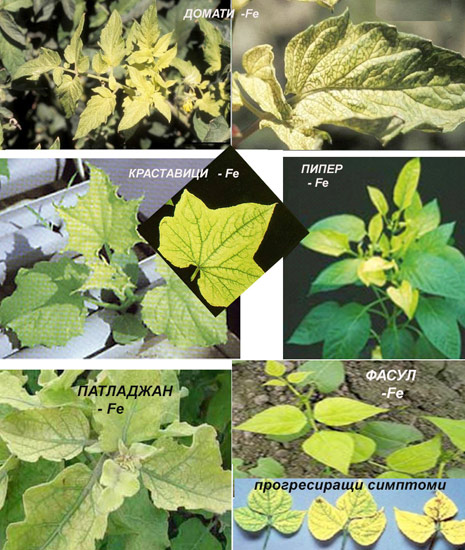
Iron deficiency in fruit vegetable crops
Symptoms of iron deficiency in fruit vegetable crops:
- The young leaves are affected by chlorosis, which starts between the veins and spreads over the entire leaf. At a later stage the chlorosis intensifies and also affects the venation. The entire leaf becomes pale yellow, almost white;
- Necrotic spots appear on the leaves;
- The colour of the fruits is lighter than the one typical of the variety;
- Growth is restricted and newly formed leaves remain small;
- Yield decreases.
- In cases of severe and/or prolonged deficiency the plant dies.
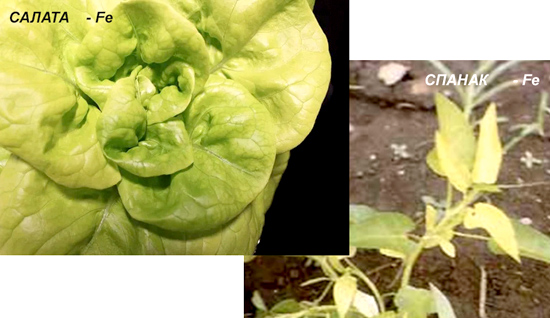
Iron deficiency in leafy vegetable crops
Symptoms of iron deficiency in leafy vegetable crops:
- Initially the leaf tissue becomes light green and develops into interveinal chlorosis. At a later stage the chlorosis intensifies and the entire leaf becomes pale yellow, almost white;
- Growth is stunted.
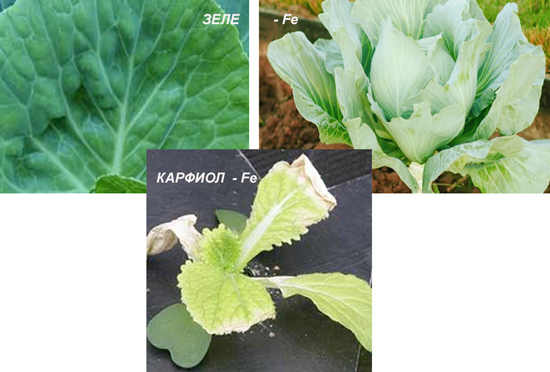
Iron deficiency in leafy-stem vegetable crops
Symptoms of iron deficiency in leafy-stem vegetable crops:
- The symptoms start with interveinal chlorosis of the younger leaves. At a later stage the chlorosis intensifies and the entire leaf becomes pale yellow, almost white;
- Prolonged iron deficiency causes suppression of root growth and above-ground plant biomass without leaf deformation. The leaves are smaller;
- Growth is stunted;
- Yield and quality are impaired.
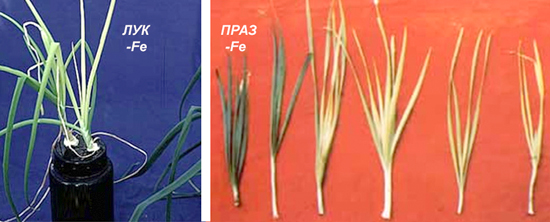
Iron deficiency in bulb vegetable crops
Symptoms of iron deficiency in bulb vegetable crops:
- The most common symptom is overall chlorosis and bleaching of the leaves;
- Growth is stunted.
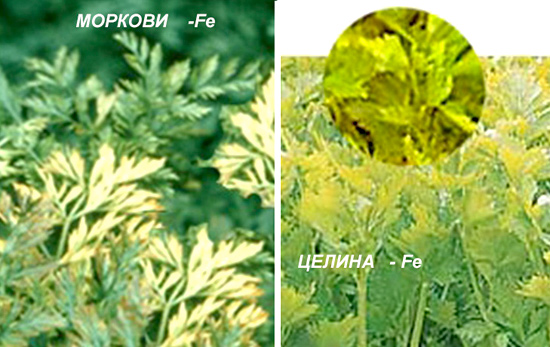
Iron deficiency in root vegetable crops
Symptoms of iron deficiency in root vegetable crops:
- Yellowing of the young leaves, with their venation standing out as a green „fishbone”;
- In case of prolonged deficiency the leaves become almost white;
- Growth is stunted;
- Yield is low.
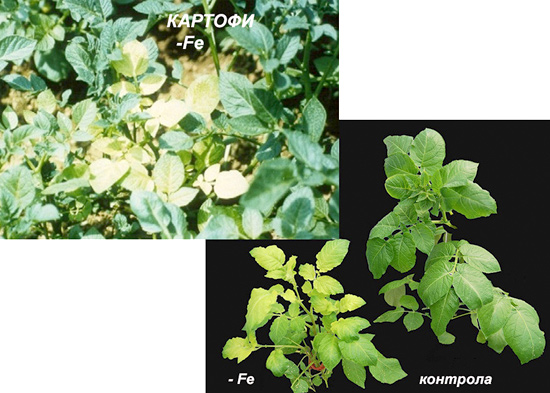
Iron deficiency in tuber vegetable crops
Symptoms of iron deficiency in tuber vegetable crops:
- Initially the tips of the young leaves remain green and interveinal chlorosis develops, which gradually progresses into overall chlorosis and ends in complete bleaching of the leaves;
- In the case of severe deficiency the plants are stunted and all apical leaves are chlorotic, almost white;
- The colour of the tubers becomes more dull;
- Yield decreases.
IRON EXCESS
Problems with excess iron are a rare occurrence.
General symptoms
The symptoms are similar to those of manganese deficiency. Chlorosis develops between the veins of the young leaves, with the venation initially remaining green. Later the entire leaf becomes yellow or fades. Brown necrotic spots may appear on the leaves and/or fruits.
Causes
High acidity of the nutrient medium (pH < 4.5); in foliar feeding, overdosing of the solution containing iron.
Recommendation
Adjustment of the acidity of the nutrient medium; use of physiologically alkaline fertilizers.