

![MultipartFile resource [file_data]](/assets/img/articles/bee-4429887_640.jpg)
On 20 May we celebrate World Bee Day, proclaimed by the UN in December 2017, to remind the public of the enormous importance of bees and bee products for life on Earth.
Bee colonies are essential for agriculture and the environment. They ensure the reproduction of plants through pollination, and beekeeping contributes to the development of rural areas.
Beekeeping is practised in all countries of the European Union and is characterised by diverse production conditions, yields and beekeeping practices. The EU is the second largest producer of honey after China, but it is also a net importer of honey from third countries. In addition to honey, the EU also produces other bee products such as bee pollen, propolis, royal jelly and beeswax.
Each Member State draws up a National Beekeeping Programme, which is supported by the EU. Within the framework of the programmes there are eight specific measures eligible for funding: technical assistance (training for beekeepers and groups of beekeepers on topics such as bee breeding or disease prevention; extraction, storage or packaging of honey); combating diseases in beehives (in particular varroosis); rationalisation of migratory beekeeping; analyses of bee products such as honey, royal jelly, propolis, pollen and beeswax; renewal of beehives; applied research; market monitoring; improvement of the quality of bee products for better utilisation of their market potential. For the period 2020—2022, EUR 240 million has been earmarked for national beekeeping programmes in the EU — an increase of 11% compared with the funding allocated for 2017–2019. Half of these funds are provided from the EU budget and the other half — from national governments.
The EU countries with the largest honey production (Romania, Spain, Hungary, Germany, Italy, Greece, France and Poland) are located mainly in Southern Europe, where climatic conditions are more favourable for beekeeping.
Nowadays, about 20,000 species of bees live on Earth. Most of them, however, do not collect honey. Only 11 bee species on the planet collect and store honey. Four of these species are used intensively for honey production worldwide, the one of greatest economic importance being the western honey bee (Apis mellifera). Its main area of distribution is in the Middle East, North Africa and Europe, and numerous subspecies exist. Today, thanks to humans, the species is distributed all over the world. In bee colonies there are three categories of bees in total – queen bee, drones and worker bees.
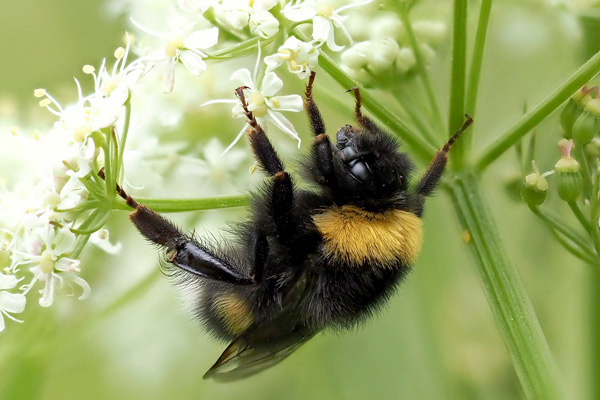
bumblebee – Bombus sp.
In Bulgaria, on the territory of Strandzha Nature Park, some of the bee species that do not collect honey but are important for the conservation of biodiversity can be found; these are bumblebees (Bombus sp.), carpenter bees (Xylocopa sp.), etc.
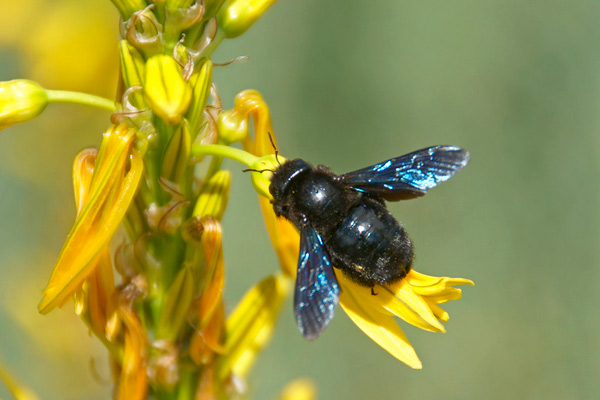
carpenter bee – Xylocopa sp.
Strandzha is one of the most favourable places in our country for the development of beekeeping because of the presence and diversity of oak trees and the warm and humid climate, which creates ideal conditions for the formation of honeydew.
Honeydew honey – forest elixir
The area of the Nature Park is renowned for its honeydew honey, produced from the sweet sap (the so-called honeydew) exuded by oak trees, which is collected by the bees.
The conservation and protection of bees is vital for all living organisms on Earth, because without them the consequences for ecosystems would be catastrophic.
Let us protect the bees, we need them!