

![MultipartFile resource [file_data]](/assets/img/articles/tomato-diagnostik-недостик-сяра.jpg)
Do we know how to “communicate with plants"?
Visual diagnostics
SULFUR (S – Sulfur, sulphur – from Latin sulphur)
Importance of sulfur for plants
Sulfur is vitally important for the formation of the living cell. It is an indispensable constituent of all plant proteins. Therefore, it takes an active part in the nitrogen metabolism of plants. Its role in protein formation is extremely important, as it is a component of many amino acids (cysteine and cystine). It plays an important role in redox processes, in the energy balance of the plant organism, in hormone functioning, enzyme activation, chlorophyll formation, etc. It is a constituent of certain physiologically active substances – coenzyme A, biotin, thiamine, etc. It influences the uptake of phosphorus, nitrogen and other nutrients. It increases the cold tolerance of plants.
It improves yield and product quality.
Part of the sulfur in the plant organism is in the form of metal sulfates. Of these, calcium sulfate is present in the largest amount; it is sometimes deposited in plant tissues as gypsum druses (single crystals), which can be seen under a microscope.
Plant requirements for sulfur
The sulfur content of plants is relatively low (0.1 – 0.2% of dry plant mass). The distribution of sulfur among organs corresponds to the distribution of proteins, which is natural since sulfur is part of their composition. Seeds and green leaves are richer in sulfur than stems and roots.
Uptake
Plants take up sulfur through the root system and through their above-ground parts. It is absorbed by the roots in the form of sulfate anion (SO42-), and by the leaves both as sulfate anion (SO42-) and as sulfur dioxide (SO2). Sulfur is absorbed by plants best at pH = 5.5 – 8.0.
Hydrogen sulfide, soluble sulfides, sulfurous acid and sulfides are highly toxic to plants!
SULFUR DEFICIENCY
General symptoms – the first signs appear on the upper leaves.
The symptoms are similar to those of nitrogen deficiency, with the difference that the young leaves and growing organs are affected, since sulfur is not subject to reutilization (reuse) within the plant organism. The young leaves acquire a light green, chlorotic or almost white colour. In some cases they are deformed. The older leaves remain green, as sulfur-containing organic compounds in them are not broken down. With prolonged starvation, the entire plant turns yellow. Anthocyanin coloration may also appear, and the leaves may acquire a purple colour or a brownish tint.
Growth is suppressed. Under severe sulfur deficiency, the stem of the plant becomes shorter and thinner and later lignifies.
Causes
Strongly acidic or strongly alkaline medium (5.5 > pH > 8.0); sandy soil; substrate drought; low air humidity.
Recommendation
Increase by about 20% the amount of sulfur-containing fertilizers used (potassium sulfate, magnesium sulfate).
Identification of sulfur deficiency symptoms by crop
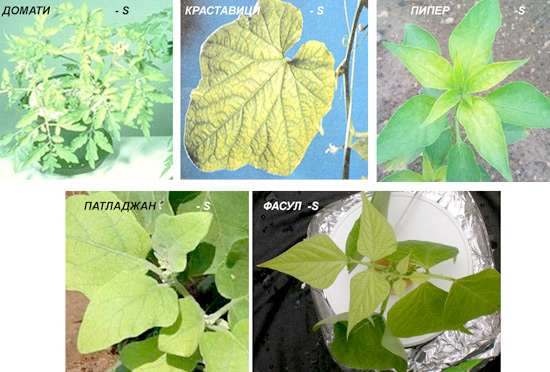
Sulfur deficiency in fruiting vegetable crops
Symptoms of sulfur deficiency in fruiting vegetable crops:
- Young leaves are small and bend downwards. They acquire a light green, chlorotic or almost white colour. The venation and petioles are reddish;
- In some cases necrotic spots develop on the leaves, while in others the petiole is more upright and brittle;
- Under severe deficiency the stem becomes shorter and thinner, shorter and prone to lignification;
- Growth is suppressed;
- Productivity decreases.
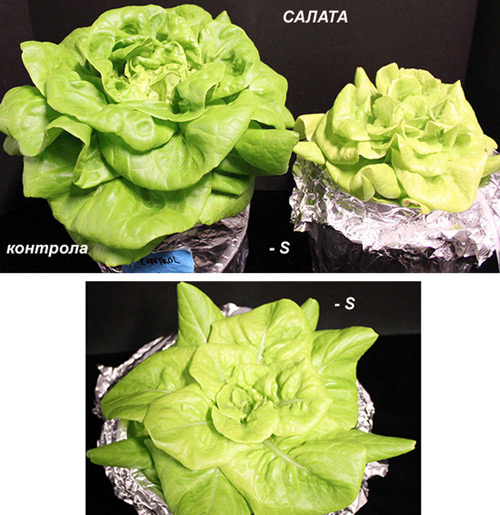
Sulfur deficiency in leafy vegetable crops
Symptoms of sulfur deficiency in leafy vegetable crops:
- New leaves acquire a creamy-white coloration;
- Growth is suppressed. Plants are smaller.
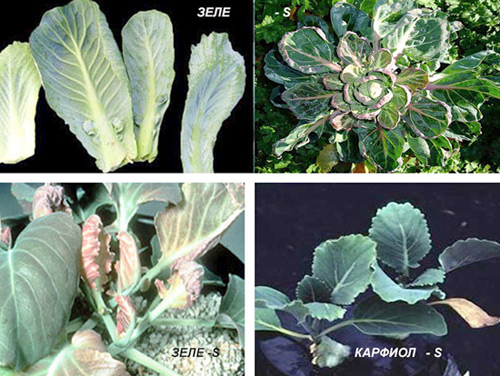
Sulfur deficiency in leaf-stem vegetable crops
Symptoms of sulfur deficiency in leaf-stem vegetable crops:
- Chlorosis starts from the young leaves and, under prolonged deficiency, progresses to the middle and older ones. The venation stands out as a blue-green network on a pale green or chlorotic surface;
- On the underside, leaves are purple or bronze-coloured. This coloration may later affect entire leaves. Symptoms develop slowly;
- Plants are usually smaller and spindle-shaped;
- Yield decreases.
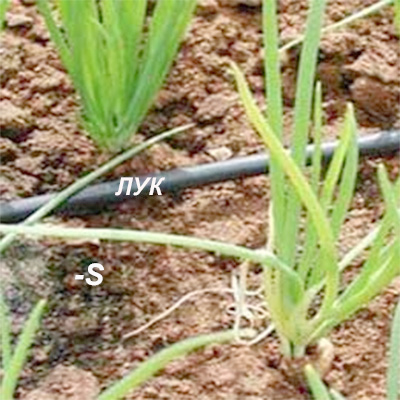
Sulfur deficiency in bulb vegetable crops
Symptoms of sulfur deficiency in bulb vegetable crops:
- Leaves become thick and deformed;
- New leaves are yellow or pale, rigid and upright, with swelling at the base;
- Under severe deficiency, new leaves are short, thickened and chlorotic;
- Product quality is impaired.
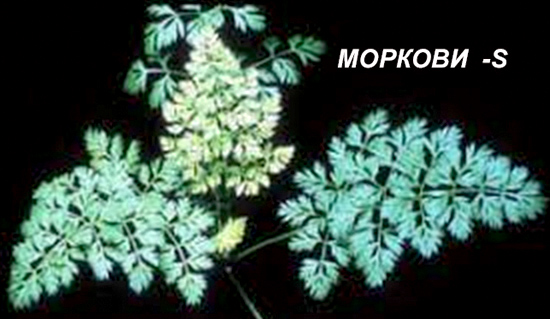
Sulfur deficiency in root vegetable crops
Symptoms of sulfur deficiency in root vegetable crops:
- Young leaves are chlorotic;
- Under severe deficiency, growth is suppressed;
- Yield is lower.
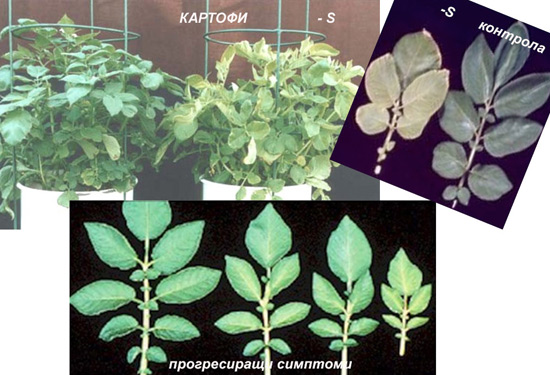
Sulfur deficiency in tuber vegetable crops
Symptoms of sulfur deficiency in tuber vegetable crops:
- Young leaves are smaller, light green or chlorotic. A slight inward curling of the youngest leaves and yellowing of the stems is observed;
- With prolonged deficiency, the entire plant turns yellow;
- Yield and product quality are lower.
SULFUR EXCESS
General symptoms
Excess sulfur is a rare occurrence. In the case of sulfur excess, stems are rigid, leaves are small, blue-green and interveinal chlorosis appears. Later they curl inwards, and their edges fade and become pale yellow.
On leaves from the middle and lower tiers, unevenly scattered water-soaked spots appear, which quickly turn white. Plants are coarse.
Causes
Incorrectly carried out soil gypsum application; air pollution with sulfur dioxide. The presence of sulfur dioxide (SO2) in the air at about 0.5 ppm is toxic to plants. At concentrations from 0.3 to 5.0 mg/m3, plants suffer chronic poisoning over the course of several days.
Recommendations
Leaching of the soil or substrate; reduction or non-use of sulfate-containing fertilizers.
Identification of sulfur excess symptoms by crop
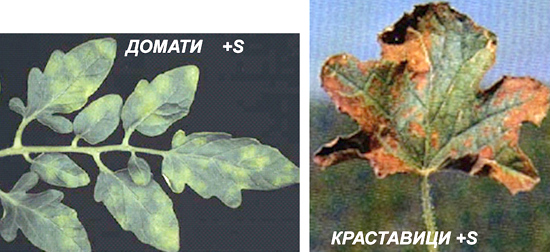
Sulfur excess in fruiting vegetable crops
Symptoms of sulfur excess in fruiting vegetable crops:
- On leaves from the middle and lower tiers, unevenly scattered water-soaked spots appear, which quickly become white, dry and papery. Such spots may also appear on the fruits;
- Leaves are coarse and rigid with pronounced necrosis, which starts from the periphery and spreads inward towards the midrib. They dry out and die;
- Growth is suppressed.