

![MultipartFile resource [file_data]](/assets/img/articles/сачмянка-праскова-плод.jpg)
During the third ten-day period of April and in May, apricot, peach and almond are in a phenophase of intensive growth, during which active cell division also takes place in the young fruit set. The assimilates from the current photosynthesis are directed towards the nourishment of the fruits.
The amount of precipitation in May increases under the influence of the cooler and more humid oceanic air mass entering from the north. The showers are short but intensive, sometimes accompanied by thunderstorms and hail. Many pests have 2-3 or more generations, and infections by diseases are repeatedly renewed depending on rainfall. In each new lesion many conidia are formed, which under favourable conditions – moisture and warmth – cause new infections. Therefore, due to the favourable thermal conditions and frequent rains in May, infections by fungal and bacterial diseases increase. Thus, treatments against diseases and pests are necessary in order not to compromise the fruit yield.
The first post-bloom spray is carried out immediately after flowering is completed. Now is the time for the second post-bloom spray. It is carried out 10–12 days after the first one. It is necessary to spray the entire trees from the top to the base of the trunk, without drenching them, and the spray solution should be applied in the form of a fine mist. Spraying is carried out in calm and sunny days at a temperature of 10–12 °C. It should not be conducted immediately before or after rain, because it will not be effective.
Second post-bloom spraying is carried out in apricot against shot-hole disease, brown rot and oriental fruit moth, weevils, leaf-feeding caterpillars, flat-headed borers, aphids, scale insects and sawflies.
In peach – against scab, shot-hole disease, brown rot, powdery mildew and oriental fruit moth, oriental fruit moth (Grapholita molesta), aphids and scale insects, leaf-feeding caterpillars, sawflies and European red mite.
In almond – against shot-hole disease, scab, cercospora leaf spot, orange leaf spots and almond sawfly, almond bud weevil, leaf-feeding caterpillars, aphids and scale insects, stone fruit sawfly and cherry leaf sawfly.
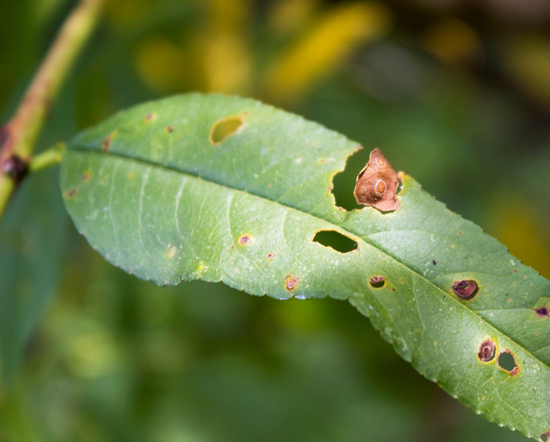
Shot-hole disease on stone fruit
It is caused by two pathogens – a bacterium – bacterial shot-hole, and a fungus – fungal shot-hole.
Bacterial shot-hole – The leaves are most severely affected, but the shoots, flower buds and fruits are not spared either. The disease develops massively if the weather is more humid and warm – frequent rainfall and temperatures from 24 to 28 °C.
The causal bacteria overwinter in infected shoots, as well as in fallen leaves and in the soil. In spring, the spores are dispersed throughout the tree crown by rain, wind and insects. For germination and new infection, the spores need a drop of water. The attacked buds darken and die. Through the infected buds and through the scars of the fallen leaves, the shoots also become infected.
The leaves become spotted and perforated in a similar way as with fungal shot-hole, but they differ in that the spots at the beginning of their development are pale green to pale yellow and greasy, with a brown centre. The formed holes are smaller but more numerous and often of irregular shape. In case of severe attack the leaves turn yellow and fall. Later, the tissue in the centre of the spots becomes necrotic and falls out.
The spots on the shoots are dark, initially raised, later sunken, accompanied by gummosis.
On the fruits, numerous, round, small – 1–2 mm – red-brown spots are formed, from which a bacterial exudate is often secreted in the form of resinous droplets.They often coalesce and form sunken lesions with cracking and gummosis.
Fungal shot-hole – It attacks leaves, flowers, fruits, shoots and branches by means of conidia. Due to its ability to infect perennial twigs and to form masses of spores on them in spring, shot-hole disease gradually becomes a chronic problem. Thus, from year to year the infection builds up until it reaches levels at which control becomes very difficult and expensive.
Under cool conditions the fungus continues to develop even during winter, whereby peach and apricot trees that have developed well in autumn may be in a deplorable condition in spring.
It overwinters as mycelium in infected shoots, and also as spores under the bud scales. Water is required for the dispersal and germination of spores and for infection. Rain washes off the spores adhering to the gum and distributes them over the tree and neighbouring trees. The most favourable conditions for infection are frequent and heavy rainfall, low-lying humid sites, abundant irrigation and unbalanced nitrogen fertilisation. The lower branches, leaves and fruits are most strongly infected. Aphids also contribute to the spread of spores. The temperature range for infection is from 5 to 30 °C. At optimum temperatures of 18–21 °C and saturated humidity, peach leaves become infected within 2–3 days, and apricot leaves within 4–5 days. On shoots the period is 10–20 and more days, with the shortest period again in peach.
On young leaves it induces the formation of round red or reddish-brown spots which, with the further growth of the healthy surrounding tissue, separate from it and fall out, leaving holes. The leaf appears as if shot with pellets. The spots, and respectively the holes, are surrounded by a reddish-brown halo.
Leaves severely attacked by shot-hole disease turn yellow and drop. In highly susceptible cultivars, a few spots per leaf are sufficient.
In peach, the twigs and their buds are most heavily infected, whereas in apricot the fruits are most affected.
Affected peach buds are black with a shiny surface due to the gum covering them. Red or reddish-brown spots form on them, which can enlarge to 2 cm or more. When, in their growth in depth, the spots reach the cambium, they induce abundant gummosis. The spots gradually turn into swellings covered with gum. Heavily attacked twigs die. Thus, in some low and humid areas – especially in river valleys – shot-hole disease can cause mass drying of peach trees.
On peach fruits, small, light spots with a dark brown halo are formed, which are not raised as in apricot, but slightly sunken. Fruits attacked early drop, while those infected later have poor market quality.
On apricot fruits, small reddish-brown pimples are formed, giving the fruit a scabby appearance. The flesh is sour and tasteless. The twigs are also attacked, with leaf scar impressions under the buds being particularly heavily infected during winter. On apricot leaves shot-hole disease is much weaker than on peach and rarely causes defoliation. Winter buds are very often infected; they remain darker in colour and are covered with gum.
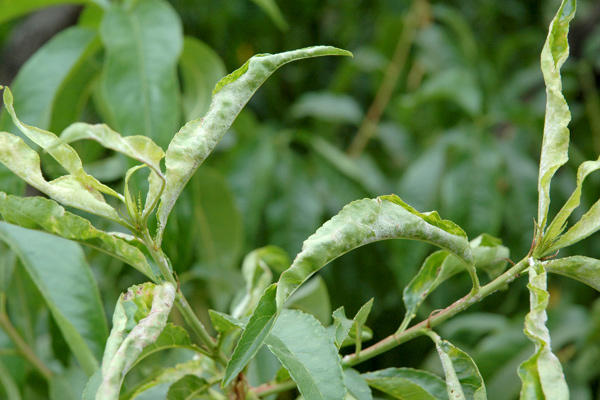
Powdery mildew on peach – fungal pathogen. It appears on all green parts. The main factor determining disease development is high air humidity. Conidia germinate at 30–60% relative humidity and temperatures from 2 to 33 °C, optimum 21–28 °C. Germination is stimulated by light. Therefore, the best illuminated shoots on the southern and upper part of the crown are most heavily attacked.
The pathogen overwinters as mycelium in the buds and as cleistothecia on the twigs (they do not ripen, or only single ones ripen). The fungus penetrates the plant tissues directly through the cuticle while it is still tender. Therefore, only the young growing parts (leaves – up to the 12th day) and fruits become infected.
Early in spring, a powdery coating can be detected at the beginning of development on infected leaf buds. They most often dry out. If a shoot develops from such buds, the diffuse form of the disease is observed. Young leaves are infected on the underside, where a coating is formed. On the upper side, chlorotic spots are observed, later their central part becomes necrotic, takes on a reddish-brown colour, separates and falls out.
Young growing fruits are susceptible up to a size of 2.5–3.5 cm in diameter. The damage appears as rounded white patches, which enlarge and cover a significant part of the surface. After some time the coating falls off and brown, corky spots remain, which are often net-cracked or leathery. Diseased fruits become deformed.
The shoots, mainly towards the tip, are covered with a dense white coating and become distorted. Towards the end of the vegetation period (September–October), on the same place, black dot-like fruiting bodies – cleistothecia – are formed.
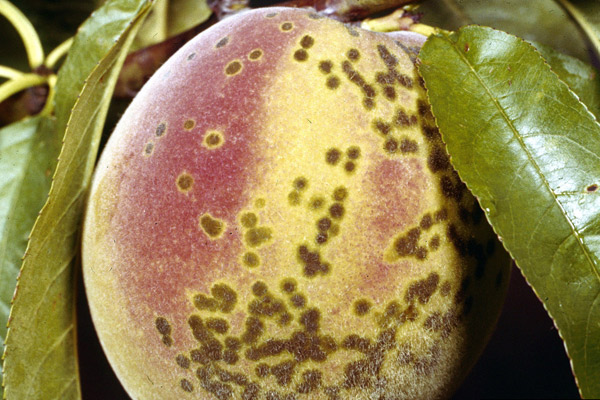
Scab on peach – the causal agent is a fungus. It attacks almond and peach. Almond is more strongly affected, and this is one of the most important diseases of this crop.
Strong development of the disease is favoured by rainfall, but leaf fall is more severe during drought.
It overwinters in the lesions on the bark of the shoots and in fallen diseased leaves. In spring, the lesions on the bark are covered with fine dark brown dust consisting of olive, one- and two-celled spores, which cause primary infections on leaves and fruits. In almond, the fungus mainly attacks the leaves, and in peach – the fruit.
A free water droplet is required for spore germination and for primary infections to occur.
Most often, on the underside of the leaves small to medium-sized, round to angular pale olive-brown spots are formed, which later become covered with a dark coating. The diseased tissue turns yellow, often becomes necrotic and perforates similarly to shot-hole disease.
Spotted leaves have a lower water retention capacity and a higher transpiration coefficient, which disturbs the water balance. They fall even in not very severe drought and, in case of heavy infection, most often from the bottom upwards, towards the tips of the shoots. Flowers and fruit set scorch and also drop.
On the shoots the spots are olive-brown, initially round, later elliptical and elongated, expanding and forming irregular longer lesions – up to 1.5 cm. When the spotting encircles the shoots in a ring, their upper part dies.
On peach the disease appears as scattered small spots, initially beige-brown, and later with an olive-green velvety surface. They merge into larger zones, most often towards the stem end of the fruit. After the coating falls off, the surface remains corky, like a scab. At harvest, damage can also be detected on the shoots.
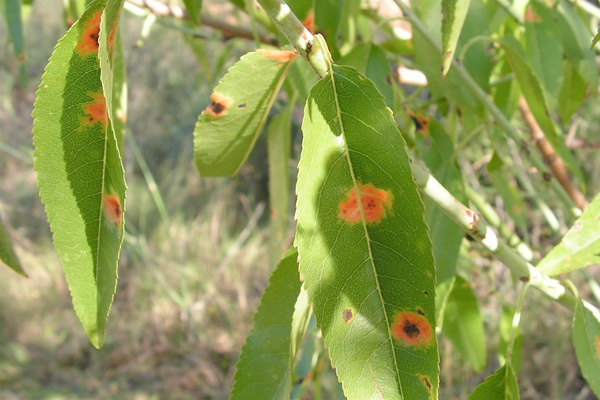
Orange leaf spots on almond – Caused by a fungus with morphology and life cycle similar to the pathogen of red leaf spot on plum.
After overwintering, perithecia are formed in them, which discharge ascospores that infect young leaves. Spores are ejected after each heavier rainfall. At the most favourable high temperature – around 24 °C – 2 hours are needed for infection, at 15 °C – 4 hours, at 10 °C – 5 hours and at 8 °C – 7 hours. There is a risk of infection until mid-June. The first spots appear in the second half of May and their formation lasts about 2 months.
On almond leaves thick, very conspicuous stromata of the parasite are formed, which, unlike the stromata of the fungus causing red leaf spot, have an orange or yellow-orange colour.
Cercospora leaf spot on almond – fungal pathogen. It is observed massively in a humid and warm spring. It infects leaves, shoots and green fruits. It overwinters in fallen leaves and shoots.
In years with a humid spring, numerous, often coalescing light brown spots are observed on the leaves. On the spots, the fruiting bodies of the fungus can be seen with the naked eye as black dots. The abundantly produced needle-shaped olive-green conidia on the leaves cause mass infections during frequent rainfall.
On the shoots the spots are elongated, slightly sunken, light brown with a dark margin, which can cause them to dry out.
Infected shoots dry up, and fruits drop.
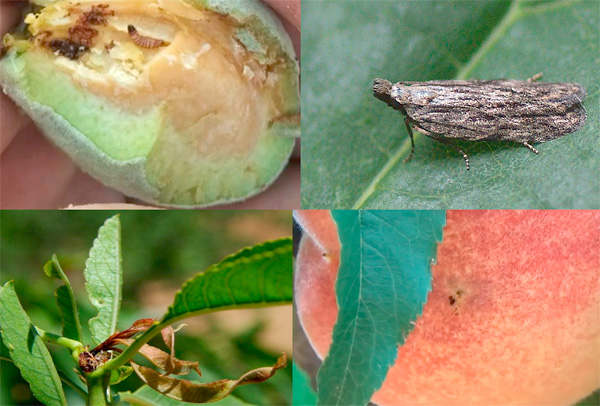
Oriental fruit moth (peach twig borer) – The caterpillar gnaws the young shoots, destroying the one-year growth and causing fruit worm damage. The oriental fruit moth develops 3 generations per year, and under favourable conditions a 4th one.
It overwinters as a caterpillar of the second, more rarely of the first instar, under the scales and at the base of buds, in branch crotches, in mummified fruits and in the trunk. It makes a small cavity, which it lines inside with frass and silk threads. On the trees the overwintering site is easily detected by the small piles of fine cinnamon-coloured excrements.
When the average daily temperature over the last 10 days remains around 9.6 °C or at an average daily temperature of 14.5 °C, the caterpillars leave their winter shelters and start feeding. Their development lasts 35–63 days. Initially they feed on buds and bark in the axils of twigs. Then they bore into the shoots near the tip, at the base of the petiole. The tip droops and dries, and gummosis develops at the site of damage. Before they are fully developed, they bore into the ovaries of flowers and young fruits. During its life, one caterpillar damages 2–3 buds, preferring leaf buds, 5–6 shoots and 1–2 young fruits.
After completing their development, the caterpillars pupate in cocoons in bark cracks, in leaves of attacked shoots, in fruit set and young fruits. The pupal period lasts 10–12 days.
Moths of the first generation begin to emerge in May, and their flight ends in the second ten-day period of June.

Oriental fruit moth
The oriental fruit moth develops from three to five overlapping generations per year. The pest overwinters as a fully developed caterpillar in a grey silken cocoon under the bark of trees, in the soil around the trunk, under fallen leaves and other plant residues.
The flight of moths from the overwintering generation starts in the first ten days of April and continues until about 10 June, of the first generation – around 10 June, of the second – from mid-June, of the third – from mid-August and of the fourth – around 20 September.
In peach and apricot, the female lays eggs on the underside of leaves, on young shoots and later on the fruits. The hatched caterpillars bore into the base of the terminal leaves and enter the pith of the young shoots, where they excavate galleries 5 to 15 cm long in peach and apricot. They feed in them and fill them with excrements, which accumulate at the exit hole when the caterpillars leave. Peach and apricot exude gum at the sites of damage.
The terminal leaves of the attacked shoots initially droop and wilt, and later dry out. During its development, one caterpillar damages 2 to 4 shoots. Caterpillars of the first and second generations develop mainly on shoots, and those of the subsequent generations – on fruits. The caterpillars bore into the fruits usually around the stem, at points where fruits touch each other, at leaf-to-fruit contact points and less frequently at other places. They attack the flesh of the fruits, excavate galleries and fill them with excrements, which often appear at the entry hole. The attacked fruits retain their external appearance, but the flesh is damaged; they ripen prematurely and fall.
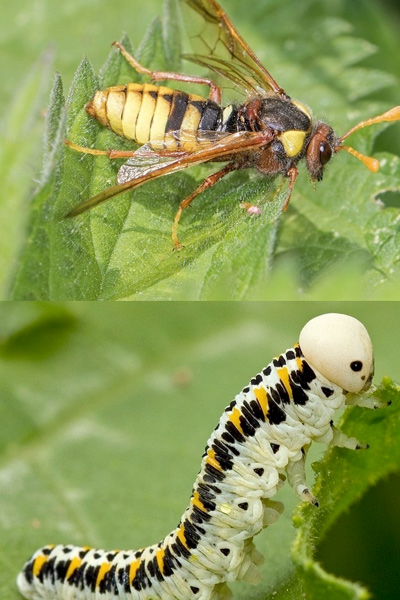
Almond sawfly – It mainly attacks almond, but also causes damage to cherry and apricot. The harmful stage is the false caterpillars, which feed on the leaves. In case of mass occurrence, they defoliate the trees.
The almond sawfly has one generation per year and overwinters as a false caterpillar in the soil at a depth of up to 10 cm. The adults usually appear in the second half of April.
With the help of its ovipositor, the female lays the eggs singly in the leaves, placing them under the upper epidermis. The false caterpillar feeds for 22–32 days. Initially it prefers the apical part of the leaves, and in the last instars it eats the entire leaf surface together with the midrib. Fully developed larvae fall or crawl down the stems to the ground, enter the soil, build an earthen chamber and overwinter there.
Control
For the second post-bloom spray in peach and apricot, one of the following products can be used – Captan 80 WG (150–180 g/ha), Merpan 80 WG (225 g/ha), Scab 80 WG (180–210 g/ha) against shot-hole disease and brown rot; Sulphur WG (600 g/ha), Solfo 80 WG (750 g/ha), Difcor 250 SC (20 ml/ha) against powdery mildew, and an insecticide with the active ingredient deltamethrin – Deka EC – 30–50 ml/ha, Decis 100 EC – 7.5–12.5 ml/ha, Delmur – 50 ml/ha, Meteor – 0.06–0.09% against all pests attacking during this period.
In almond, against the listed diseases, a copper-containing fungicide can be used – 1% Bordeaux mixture, Funguran OH 50 WP – 150–250 g/ha, Champion WP – 0.3%, Copper Key – 180–300 g/ha, and against pests – again an insecticide with the active ingredient deltamethrin at the same concentrations.
Pest control should always be carried out above the economic threshold (ETL). ETL for oriental fruit moth (peach twig borer) – 3% damaged shoots and fruits per tree; for oriental fruit moth – 3% damaged shoots and fruits; for weevils – 30–40 adults per 100 shaken branches; for leaf-feeding caterpillars – 8–12 caterpillars/100 branches when shaken or 10–15% damaged leaf area; aphids and scale insects – 10–15 individuals per 100 inflorescences or 10–15% infested shoots.; European red mite – 1–2 motile individuals per leaf.