

![MultipartFile resource [file_data]](/assets/img/articles/nature.jpg)
Strawberries and raspberries exhibit susceptibility to different groups of diseases, but under the conditions in the country, those of fungal origin are of primary importance. Under climatic conditions favourable for their development and in case of shortcomings in plant protection, fungal pathogens may prove to be an important limiting factor for future production. Spotted wing drosophila is a dangerous pest on a global scale, which does not spare domestic strawberry and raspberry production.
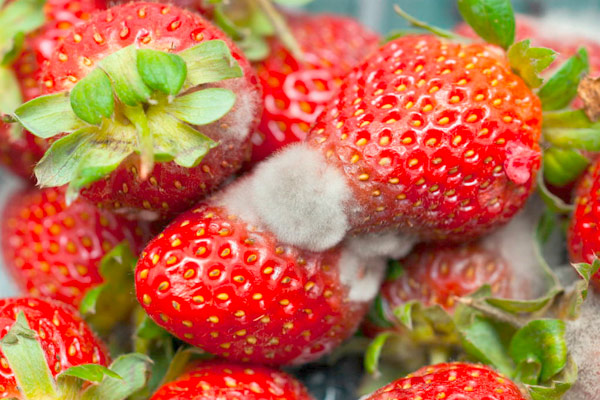
Grey mould on strawberries – Botrytis cinerea is the most dangerous disease of strawberry. All cultivars in practice exhibit susceptibility to the pathogen; under conditions favourable for disease development, control is extremely difficult and losses may affect the entire production.
Grey mould attacks all parts of the plant . Symptoms are observed on the lowest leaves as large, watery, irregular, grey-brown spots. Attacked flowers and young fruits darken and become necrotic. Under humid conditions, a grey, loose mould develops on the infected parts. In some cases the fruits appear healthy externally, but their interior is rotten.
Infection occurs during strawberry flowering. Rain, high air humidity and cool weather favour the development of the disease. Conidia are spread by frequent rains and wind. A water droplet is necessary for spore germination. Black sclerotia are formed on infected tissues.
Important activities in the control of the disease are mulching of strawberry plantations with straw or black foil and destruction of plant residues and weeds.
It is advisable to carry out two treatments – before and after flowering, and, where possible, to alternate fungicides with different modes of action on the fungus. The same fungicide should not be applied more than twice during a single growing season. It is very important not to allow high infection pressure through a complex of control measures.
Registered plant protection products: Prolectus 50 WG – 80-120 g/da; Avalon – 200 ml/da; Captan 80 WG – 150 g/da; Geox WG – 50 g/da; Erune 40 SC – 200 ml/da; Polyversum WP – 10-30 g/da; Signum WG – 75 g/da; Switch WG – 100 g/da; Cantus – 150 g/da.
Fungal pathogens in strawberries – a limiting factor for yield
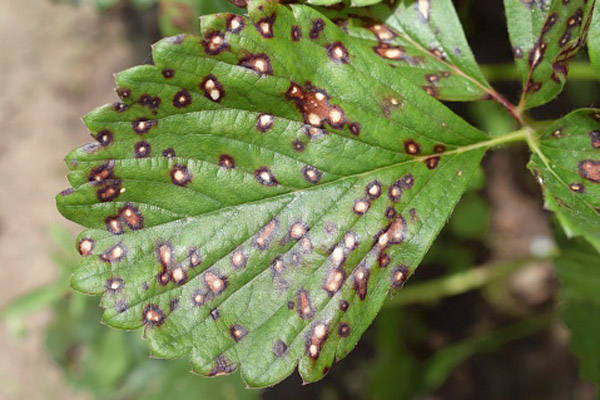
White leaf spot of strawberry – Mycosphaerella fragariae is a widespread disease that appears annually in our country, often on a mass scale, but is less dangerous than anthracnose and grey mould. It mainly attacks the vegetative parts and very rarely the fruits.
On the upper leaf surface, small, rounded, dark red spots are observed, bordered by a reddish-rusty halo, which gradually increase in size and their centre turns white. On older leaves the expression of the disease is more pronounced. Under severe attack, the spots coalesce and the tissue becomes necrotic. On the fruits, dark brown, hard spots are formed, which cover one or several achenes.
Mass infections are caused by conidia which overwinter in infected leaves. The spread of the pathogen is favoured by rainfall and temperatures of 20-25 oC.
Cleaning and destroying the dry leaves at the beginning of the vegetation period and after fruit harvest reduces the primary infection. The disease is controlled by fungicide treatments immediately before and after strawberry flowering.
Registered plant protection products: Bordo Mix 20 WP – 375-500 g/da; Kocide 2000 WG – 125 g/da; Cidely Top – 100 ml/da; Switch WG – 100 g/da;
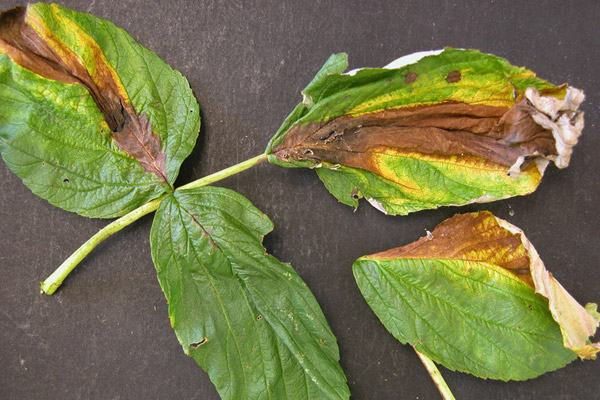
Bud blight of raspberry (didymella) – Didymella applanata
Around the buds, bluish-violet, elliptical spots develop on the canes of the affected raspberry plants. The spotting may encircle the stem in a ring, causing the bark to crack. During winter, the attacked canes usually freeze, and weak and deformed shoots develop from the infected buds. On the leaves, small necrotic spots are observed; the leaves turn yellow and fall off, while the petioles remain hanging on the stem.
The causal agent survives in the form of mycelium in infected canes and in spring forms perithecia with ascospores, which cause primary infections at the base of the shoots. Rain, high air humidity and cool weather favour the development of the disease. Plantations established in lower areas, in regions with high groundwater level, acidic soils and where unilateral nitrogen fertilisation is applied, are more severely attacked by didymella.
Treatments are carried out before and after raspberry flowering.
Registered plant protection products: Bordo Mix 20 WP – 375-500 g/da; Signum WG – 100 g/da; Score 250 EC – 30-40 ml/da in 100 l spray solution.
Spotted wing drosophila (Drosophila suzukii) – a dangerous pest on a global scale
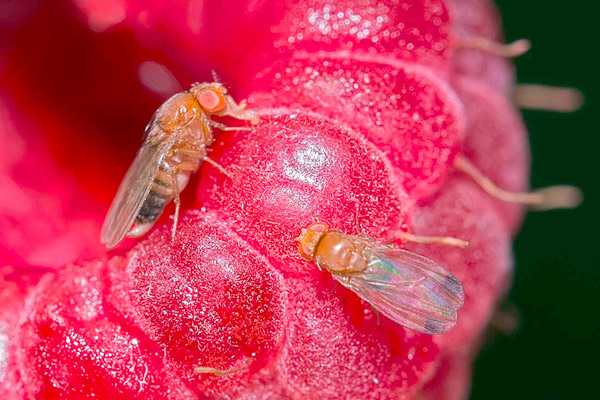
Spotted wing drosophila – Drosophila suzukii
A small but very dangerous fruit fly that attacks many fruits, and is a serious pest of raspberry. The main damage is caused by the larvae, which feed on the fleshy part of the fruit. The female lays her eggs on healthy, ripening fruits. Control is directed against the adult female before she lays her eggs.
Registered plant protection products: Exalt – 240 ml/da, NeemAzal T/S – 0.4 g/da.