

![MultipartFile resource [file_data]](/assets/img/articles/черна-сливова-плодова-оса.jpg)
![MultipartFile resource [file_data]](/assets/img/articles/жълта-сливова-плодова-оса.jpg)
In our country two species of plum sawflies are found – the black plum sawfly and the yellow plum sawfly. The biology and morphology of both species are very similar, but the black plum sawfly is more frequently encountered in the orchards. Therefore, we will consider only this species.
Sawflies can completely destroy the crop, therefore treatments are absolutely necessary.
The black plum sawfly – Hoplocampa minuta is one of the most common and dangerous pests of plum in our country. The larva causes worminess of the fruits also in myrobalan plum, bullace, cherry and apricot. Each year the average percentage of fruits attacked by the false caterpillar reaches 10–20% for the whole country. In certain places and regions the infestation is very high – up to 90–100%.
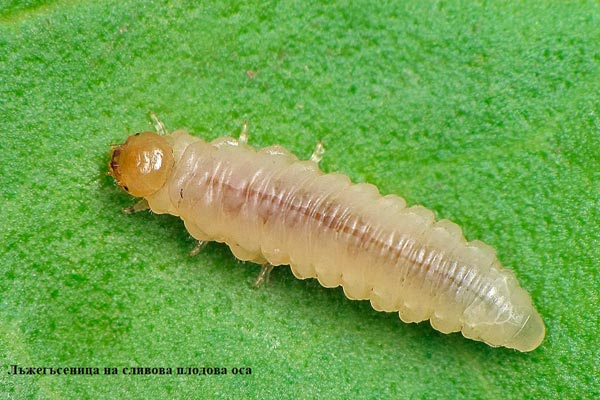
false caterpillar of plum sawfly
The black plum sawfly has one generation per year. It overwinters as a false caterpillar in a cocoon in the soil at a depth of 2–10 cm. Caterpillars overwinter more successfully in moist sandy and sandy-loam soils.
Pupation takes place in spring, about ten days after the soil temperature reaches 8–10 oC. The flight of the sawflies begins a few days before the flowering of blackthorn and early plum cultivars. Peak flight occurs around mid-April.
In order to reach sexual maturity, the sawflies feed on nectar.
They lay their eggs during the day, when it is warmer, in the sepals and less frequently in the calyx itself of still unopened flowers – with only the tips of the petals protruding. In cool and rainy weather, during the cooler hours of the day and at night, they hide in the flowers.
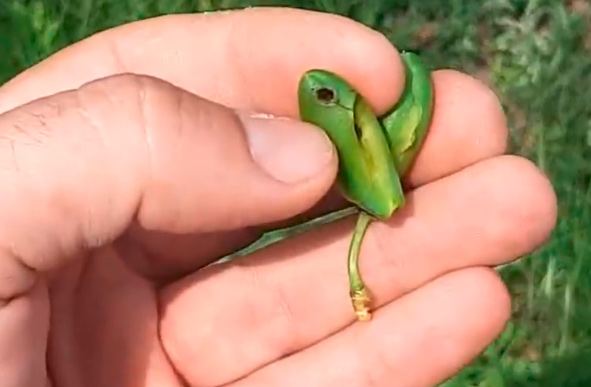
entry hole of the false caterpillar
With their ovipositor they make an incision in the upper epidermis of the sepals and lay 1 egg, less frequently 2 or 3 eggs, in the pocket thus formed. Over a period of two weeks a single female lays a total of 60–70 eggs.
At the oviposition site an irregularly shaped brown spot appears. The infestation density is determined by the number of such spots.
Egg production depends greatly on meteorological conditions. High average daily temperatures and low air humidity are unfavourable for oviposition. At a temperature of 20.5 oC and humidity of 39% oviposition ceases.
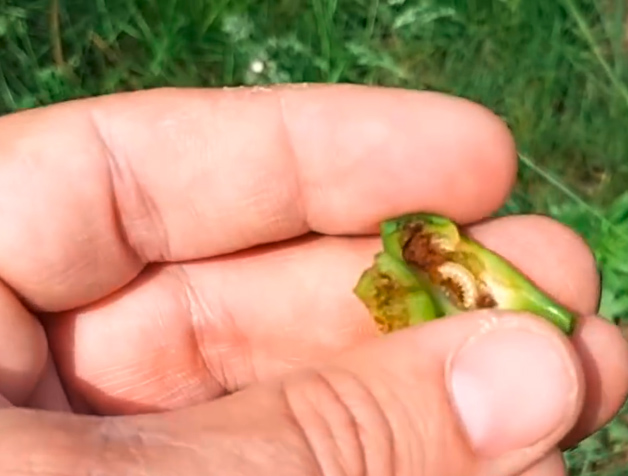
damage from larva in longitudinal section
Embryonic development lasts from one to two weeks. The hatched false caterpillars move for some time over the surface of the flowers, after which they enter the young fruits and feed on their interior, filling them with black sooty matter. Damaged fruitlets are recognised by the round hole that the false caterpillar makes in order to enter. If there is a second hole, it has already left the fruit. When cut open, the attacked fruits emit a bedbug-like odour. The false caterpillars develop over a period of 2–3 weeks and damage from 2 to 5 fruitlets, which fall together with their stalks. After 1–2 days they leave them and search for a suitable place to overwinter, entering the soil to a depth of 5 to 25 cm, depending on the soil type. Diapause occurs in 2.25 to 25% of the population, and sometimes up to 61%.
Control of plum sawflies
The most suitable moment for control is against the hatched false caterpillars, before they have entered the fruits. Therefore, treatment is carried out after flowering, when 3/4 of the petals have wilted but have not yet fallen. If no pre-bloom spraying against adults has been carried out at the white bud stage, this spraying is mandatory. The economic threshold for treatment is 5% damaged flowers.
For control, pyrethroid insecticides with the active substance deltamethrin are used – Deka EC (30–50 ml/da), Decis 100 EC (7.5–12.5 ml/da), Delmur – 50 ml/da, Meteor – 0.06–0.09%; esfenvalerate – Sumicidin 5 EC (0.02%); cypermethrin – Afikar 100 EC (30 ml/da), Efcy-metrin 10 EC (30 ml/da) or botanical insecticides based on pyrethrins – Pyregard, Abanto, Chrysant EC, Natur Breaker (75 ml/da).
The listed insecticides are dangerous for bees, but since they are non-systemic and dry quickly, in order to protect these highly valuable insects you must spray in the evening.