

![MultipartFile resource [file_data]](/assets/img/articles/apfelbluehte-1.jpg)
FRUIT CROPS
During this period the pome fruit species enter from the phenophase “flower bud burst” – “pink bud” to the phenophase “flowering”. The phenophase of development of the stone fruit species is “white bud” - “full bloom” - “fruit set“. During this period, vegetation sprays are carried out against a number of economically important diseases and pests of fruit crops.
Pome fruit species
DISEASES
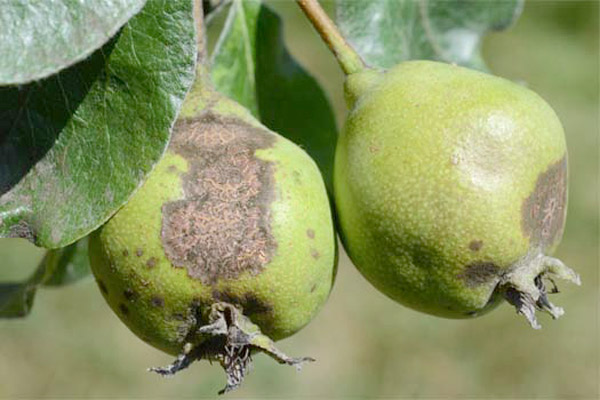
Apple and pear scab – Venturia inaequalis, Venturia pirina
The pathogen attacks the leaves immediately after bud burst. When the leaves unfold, the fungus infects both the lower and upper surfaces. On the lower surface of young leaves a velvety, oily-green mouldy growth develops, with indistinctly outlined margins. On the upper side of the leaves, grey, smooth spots are formed, with a dark green growth in the centre. Spots also develop on the leaf, flower and fruit stalks. As a result, the flowers and young fruitlets drop.
Pest control strategy
During the vegetation period, preventive pre-bloom treatment of apple and pear is carried out. Post-bloom treatments are performed at an interval of 8-10 days, depending on the fungicide used, weather conditions and the level of infection. To prevent the development of resistance, it is mandatory to alternate products with different active ingredients and modes of action.
Authorised plant protection products:
Apple
Belis - 80 g/ha; Delan 700 WG 0.035%, Difcor 250 SC - 15 ml/ha; Luna Experience - 20-75 ml/ha; Merpan 80 WG - 0.15%; Syllit 544 SC - 125 ml/ha; Score 250 EC - 0.02%; Thiovit Jet 80 WG - 600 g/ha; Faban - 120 ml/ha; Flint Max 75 WG - 0.02%; Folpan 80 WG - 0.15%; Fontelis SC - 75 ml/ha; Chorus 50 WG - 0.03% (preventive) 0.05% (curative); Champion WP - 0.3%
Pear
Difcor 250 SC - 15 ml/ha; Captan 80 WG - 150-180 g/ha; Luna Experience - 20-75 ml/ha; Polyram DF - 200 g/ha; Sancozeb 80 WP - 200 g/ha; Scab 80 WG - 188 g/ha; Thiovit Jet 80 WG - 600 g/ha; Faban - 120 ml/ha; Funguran OH 50 WP - 150-250 g/ha; Champion WP - 300 g/ha.
Powdery mildew on apple – Podosphaera leucotricha
In spring, with the onset of vegetation, the systemic form of the disease appears from buds infected in the previous year. The infected shoots are weak, with shortened internodes, the leaves are narrow, small, boat-shaped, hard and brittle, and the flowers are sterile. All infected plant tissues are entirely covered with a powdery coating of the mycelium and spores of the fungus.
Pest control strategy
To prevent the local form of the disease and repeated infections during the vegetation period, regular spraying of the trees is necessary.
Authorised plant protection products: Belis WG - 80 g/ha; Embrelia - 150 ml/ha; Score 250 EC - 0.02%; Sercadis - 15 ml/ha; Flint Max 75 WG - 0.02%.
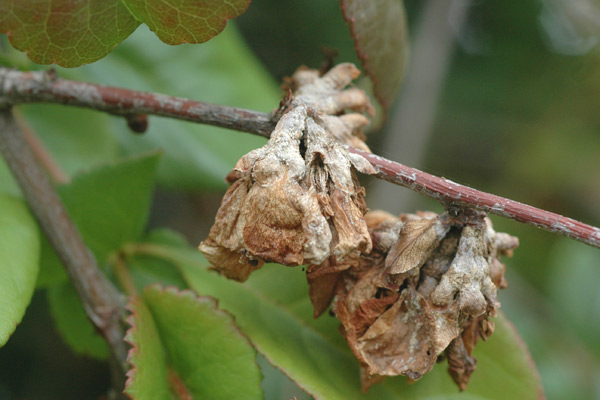
Dieback (mummification) of quince fruitlets – Monilinia cydoniae (Schell.)
The symptoms of the disease first appear on the young apical leaves, where light brown spots form in their central part, which expand along the venation and soon cover the entire leaf blade. In wet weather, a light mouldy coating with an almond smell appears on the upper side of the spots. From the leaves, the pathogen colonises the shoot tips and flower buds, which become necrotic. After flowering, the attacked fruitlets do not develop and dry up together with the adjacent one or two leaves.
Pest control strategy: Under favourable conditions for the development of the disease, vegetation sprays are carried out - before flowering, at the phenophase “pink bud” and immediately after the end of flowering.
Authorised plant protection product: Scab 80 WG - 188 g/ha.
Fire blight – Erwinia amylovora
The manifestation of the disease is expressed in damage to the flowers, and later also to the leaves. The infected flowers turn brown, wilt and die, and the necrosis spreads downwards along the flower stalk and encompasses the leaves. They become dark brown to black, wilt, adhere to the infected flowers and remain on the trees as if burnt. The shoot tips bend in the shape of a “shepherd’s crook”. In wet weather, the infected parts are covered with bacterial exudate.
Pest control strategy
Monitoring should be carried out and, upon detection of the described symptoms, treatment with a plant protection product should be applied. In case of severe infection and in extreme necessity (the presence of sap flow poses a serious risk of spreading the infection with the tools), pruning and burning of the diseased branches is carried out.
Authorised plant protection products: Bordo Mix 20 WP - 375 - 500 g/ha; Kocide 2000 WG - 155-680 g/ha; Funguran OH 50 WP - 110-500 g/ha.
PESTS
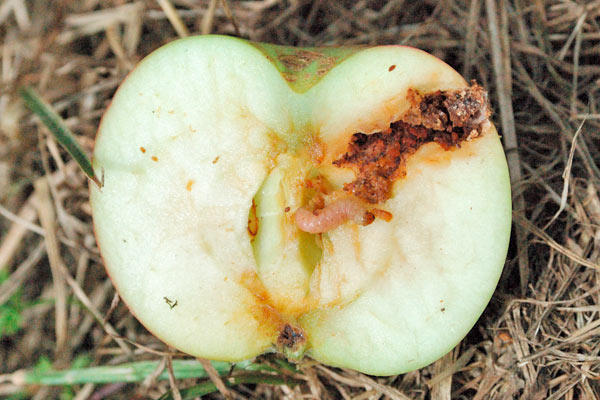
Codling moth – Cydia pomonella
The flight of the first generation moths begins at the end of apple flowering. The females lay their eggs singly, mainly on the upper side of the leaves, on the bark of spur twigs and on the young fruits.
Pest control strategy
Chemical treatment is carried out at mass flight and first laid eggs, with hormonal insecticides (chitin synthesis inhibitors) at an Economic Injury Level (EIL) of 2-3 moths/trap/week.
Authorised plant protection product: Deca EC - 30 ml/ha; Delegate 250 WG - 250 g/ha; Decis 100 EC - 7.5-12.5 ml/ha; Imidan 50 WG - 150 g/ha; Sumi Alpha EC (Sumicidin) - 0.02%; Sherpa 100 EW - 300 ml/ha.
Apple sawfly – Hoplocampa testudinea
The sawfly flies immediately before apple flowering. It feeds on pollen and nectar. The females lay, in the phenophase “bud stage”, one egg in the floral cup, near the ovary under the stamens, making an incision with their ovipositor at the base of the sepals. The damage is caused by the larva, which hatches at the end of apple flowering. It bores under the skin of the fruitlet and makes a gallery under it, which often encircles the fruit along its bulging part. As the fruit grows, the cells become corky and depressed.
Pest control strategy
Chemical control is directed against the adults, before and during egg laying - at the phenophase “flower bud” and against the larvae at the development stage “beginning of hatching”, which is immediately after petal fall, at an EIL: 2-3 adults/100 twigs; 1-3% damaged fruitlets.
Authorised plant protection products: Decis 2.5 EC - 0.03%; Meteor - 60-90 ml/100 l water.
Pear psylla – Psylla pyri
In April, the hatching of larvae from the overwintering generation of the pest begins. The adults of the first generation appear at the end of the month. Damage is caused by the larvae and nymphs, which suck sap from the buds, floral parts, leaves and fruits. They form dense colonies on the apical parts of the shoots and twigs, excreting abundant honeydew, on which sooty mould fungi develop.
Pest control strategy
Chemical control is carried out against adults and larvae at an EIL: in the phenophase “bud stage” - 2-3% infested rosettes and in the phenophase “fruit set” and “fruit growth” - 4-6% shoots with colonies.
Authorised plant protection products: Apache - 37.5-120 ml/ha; Vaztak Nov 100 EC - 20 ml/ha; Decis 100 EC - 12.25 ml/ha; Masai WP - 25 g/ha; Meteor - 90 ml/100 l water; Naturalis - 100-200 ml/ha; Ovitek - 2000 ml/ha.
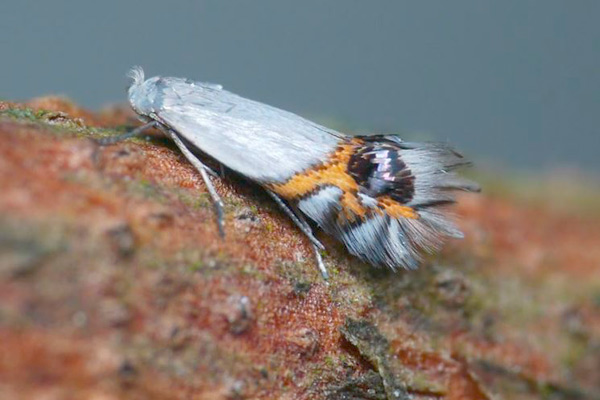
Spotted tentiform leafminer moth – Cemiostoma scitella
The flight of the moths begins in April and coincides with the beginning of flowering of winter apple cultivars. The females lay their eggs on the lower side of the leaves. Damage is caused by the larvae, which feed on the parenchyma tissue of the leaves directly under the upper epidermis, moving in a spiral. When the epidermis above the mine is removed, the path of the larva, outlined by its excreta, can be seen.
Pest control strategy
Chemical control is carried out against adults before egg laying and at the beginning of larval hatching at an EIL: in the phenophase “fruit set” and “fruit growth” - 2-3 eggs and mines per leaf.
Authorised plant protection products: Affirm Opti - 200 g/ha; Delegate 25 WG - 30 g/ha; Lamdex Extra - 60-100 g/ha; Meteor - 60-90 ml/100 l water; Mospilan 20 SG - 20 g/ha; Sumi Alpha 5 EC/Sumicidin 5 EC - 0.02%.
Aphids
Adults and larvae suck sap from the lower side of the leaves, the leaf and flower stalks and the apical parts of the shoots. They are very dangerous at the beginning of the vegetation period, when they form colonies on the shoots, buds and leaves. The attacked parts become deformed and their growth stops.
Pest control strategy:
In the phenophase “bud stage” treatment is carried out at an EIL of 10-15 colonies/100 inflorescences or 10% infested rosettes.
Authorised plant protection products: Deca EC/Desha EC/Dena EC - 30 - 50 ml/ha; Eforia 045 ZC - 150 ml/ha; Calypso 480 SC - 0.02%; Karate Express WG/Ninja/Forza - 40-60 g/ha; Luzindo 40 WG - 0.025%; Masai WP - 25 g/ha; Movento 100 SC - 0.1%; Ovitek - 2000 ml/ha; Proteus O-Tec - 0.05-0.06%; Teppeki - 14 g/ha.
Stone fruit species
DISEASES
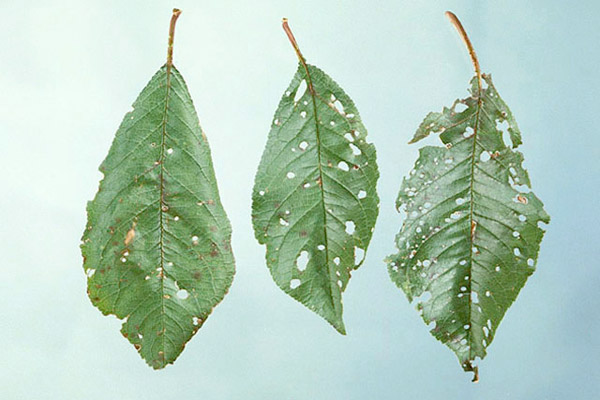
Shot-hole diseases – Xanthomonas campestris, Bacillus pumilus
The shot-hole syndrome is caused by bacterial and fungal pathogens and attacks all growing green parts - leaves, shoots and fruits. On the attacked parts, small, rounded, reddish spots develop, which become necrotic in the centre.
Pest control strategy
Control of the pathogens is carried out by applying a pre-bloom spray in the phenophase “flower bud“ and 2-3 post-bloom sprays at intervals of 7 days.
Authorised plant protection products:
Peach
Bordo Mix 20 WP - 375-500 g/ha; Captan 80 WG - 150-180 g/ha, Merpan 80 WG - 200 g/ha.
Apricot
Bordo Mix 20 WP - 375-500 g/ha; Vitra 50 WP/Cuprohy 50 WP - 150 g/ha; Captan 80 WG - 150-180 g/ha; Funguran OH 50 WP - 150-250 g/ha; Champion WP - 300 g/ha.
Plum
Captan 80 WG - 150-180 g/ha; Funguran OH 50 WP – 110-200 g/ha; Champion WP ( Macc 50 WP, Champ WP ) - 300 g/ha.
Sweet and sour cherry
Captan 80 WG - 150-180 g/ha; Funguran OH 50 WP - 130-200 g/ha; Champion WP (Macc 50 WP, Champ WP ) - 300 g/ha.
Blossom blight (early brown rot) – Monilinia laxa
The disease develops massively in cool and rainy weather, in the phenophase “flowering”. The first symptoms are observed on the flowers and petals, which become necrotic and dry out - “burning” form. The infection passes from the flower along the stalk into the bearing fruiting twig and shoot, which also dry out. The infected fruitlets turn brown.
Pest control strategy:
Sprays are carried out according to the following scheme:
1st spray - in the phenophase “flower bud”;
2nd spray - before the phenophase “beginning of flowering”;
3rd spray - in the phenophase “petal fall”;
4th spray - ten days after the third one.
Authorised plant protection products:
Peach: Delan 700 WG - 0.05%; Captan 80 WG - 150-180 g/ha; Luna Experience - 63-75 ml/ha; Prolectus 50 WG - 80 g/ha; Signum - 0.03%; Systhane 20 EW - 12.5-30.0 ml/ha; Systhane Ecozom EW - 65-200 ml/ha.
Apricot: Bordo Mix 20 WP - 375-500 g/ha; Vitra 50 WP/Cuprohy 50 WP - 150 g/ha; Captan 80 WG - 150-180 g/ha; Luna Experience - 63-75 ml/ha; Signum - 60-75 g/ha; Systhane 20 EW - 12.5-30 ml/ha; Systhane Ecozom EW - 65-200 ml/ha; Thiram 80 WG - 0.3%; Funguran OH 50 WP - 150-250 g/ha;
Plum: Difcor 250 SC - 20 ml/ha; Captan 80 WG - 150-180 g/ha Systhane 20 EW - 12.5-30 ml/ha; Systhane Ecozom EW - 65-200 ml/ha.
Sweet and sour cherry: Captan 80 WG - 150-180 g/ha; Luna Experience - 63-75 ml/ha; Thiram 80 WG - 0.3%.
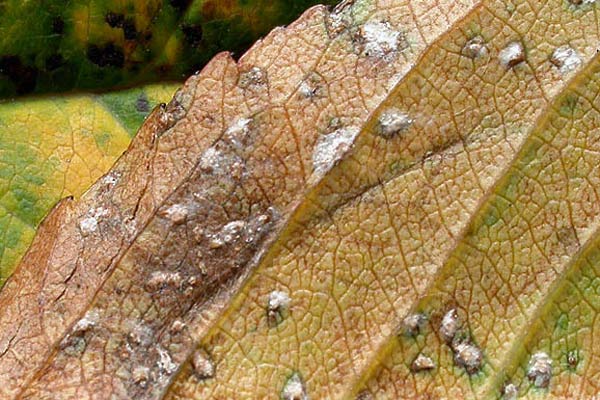
Cherry leaf spot (cylindrosporiosis) on sweet and sour cherry – Blumeriella jaapii
The first infections occur in wet, rainy and moderately warm weather and coincide with the appearance of the first leaves. Numerous small purple spots appear on the infected leaves, which later turn brown and scorch. At high humidity, on the lower side of the leaves, at the sites of the spots, a coating of white pustules can be seen. Similar symptoms are also observed on the stalks and fruitlets. Fully developed leaves are resistant to infection.
Pest control strategy:
The first spray during the vegetation period is carried out immediately after flowering, and the second and third - at 10-14 day intervals, depending on weather conditions and the persistence of the fungicide used.
Authorised plant protection products: Signum - 0.03%; Syllit 40 SC - 150 ml/ha; Score 250 EC - 0.03%; Flint Max 75 WG - 30 g/ha.
PESTS
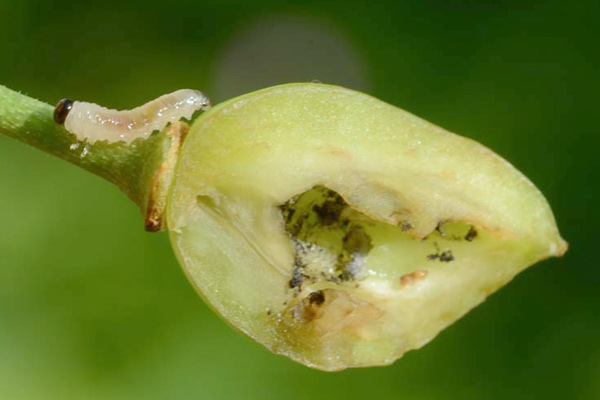
Black plum sawfly – Hoplocampa minuta Christ.
Damage is caused by the false caterpillar of the pest, which hatches at the end of plum flowering. It feeds on the interior of the young fruits and fills them with black sooty matter. In order to complete its development, a single larva damages up to 5 fruitlets, which then fall prematurely together with the stalk.
Pest control strategy:
A post-bloom spray should be carried out (when 2/3 of the petals have wilted but not fallen) against the false caterpillars before they bore into the fruitlets. In case of severe infestation, a second spray should be applied when the first damaged fruitlets begin to fall.
Authorised plant protection products: Deca EC - 40 ml/ha, Sumi Alpha 5 EC/Sumicidin 5 EC - 0.02%.
Plum fruit moth – Cydia funebrana
The moths emerge during the first half of April (about a week before the codling moth). They fly early in the morning, at an air temperature not lower than 13-140C. The females lay their eggs mainly on the fruitlets and less often on the leaves and branches.
Pest control strategy:
Chemical treatment is carried out against the adults before egg laying, with hormonal products, at an EIL of 2-3 moths/trap/week.
Authorised plant protection product: Affirm Opti - 250 g/ha, Deca EC - 70 g/ha, Delegate 250 WG - 30 g/ha, Decis 100 EC - 7.5-17.5 ml/ha, Coragen 20 SC - 16-30 ml/ha, Sumi Alpha 5 EC - 0.02%.
Oriental fruit moth – Grapholitha (Cydia) molesta
The flight of the moths begins at the beginning of April. They fly throughout the daylight hours and in the evening, at temperatures above 140C. The females lay their eggs singly, on the lower side of the leaves and on the young shoots.
Pest control strategy:
Chemical control is carried out at the end of the moth flight.
Authorised plant protection product: Avant 150 EC - 33.3 ml/ha, Affirm Opti - 200 g/ha, Voliam Targo - 75 ml/ha, Deca EC - 50-70 ml/ha, Delegate 250 WG - 30 g/ha, Dipel DF - 75-150 g/ha, Lamdex Extra - 70 g/ha, Coragen 20 SC - 16-30 ml/ha, Sumi Alpha 5 EC - 0.02%.
Cherry weevil – Rhynchites auratus
The mass occurrence of the pest coincides with the end of flowering and the beginning of fruit set. Damage is caused by the adults, which gnaw the buds, flowers, leaves, young fruitlets, and later also the fruits, on which they make deep round pits.
Pest control strategy
Treatment is carried out against the adults, after flowering. The pest is detected early in the morning by shaking the branches - EIL - 3 weevils/10 twigs/tree.
Authorised plant protection product: Meteor - 60-90 ml/100 l water.