

![MultipartFile resource [file_data]](/assets/img/articles/мъхнат-бръмбар.jpg)
The hairy beetle and the smelly beetle belong to the family Scarab beetles (Scarabaeidae) and have similar biology and morphology. At present they are attacking flowering fruit trees, with the hairy beetle causing the more significant damage. Therefore, protect the trees in order not to compromise the fruit harvest.
Hairy beetle
The hairy beetle is widespread throughout the entire country. It is a very dangerous pest of a large number of plants. The main host plants are from the family Rosaceae. It attacks primarily pear, followed by apple, plum, cherry, peach, apricot, quince, strawberry, blackberry, raspberry, dog rose and rose. It also attacks pea, alfalfa, clover, broad bean, vetch, cabbage and carrot, grapevine, and cereal crops. In addition, it feeds on buttercup, peony, coltsfoot, dandelion, creeping thistle, cornflower, daisy and yellow narcissus.
It overwinters in the soil, preferring light but humus-rich soils, especially those manured with farmyard manure, since the larvae feed on it.
It develops one generation per year.
In spring, the beetles appear in the second half of March or the first half of April. Mass flight occurs in the second half of April and the first ten days of May. Early in spring, the beetles feed on the floral parts of dandelion and coltsfoot. After the beginning of flowering of fruit trees, they move onto them, and afterwards onto berry and vegetable crops – especially on the flowers of spinach and cabbage, and to a lesser extent on broad bean and carrot. Later the beetles fly into fields with flowering cereals and especially rye.
The beetles are very active in sunny weather. Then they fly from tree to tree and feed intensively. In cool, cold and rainy or overcast and windy weather, they hide under soil clods or remain motionless on the plants. At night they hide in the soil under stones or in the unopened flowers of the attacked plants.
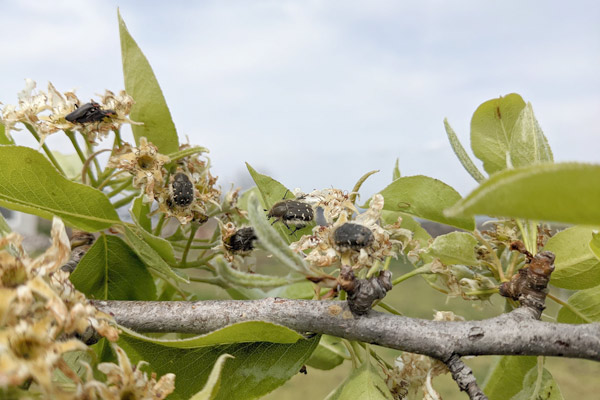
Attack by hairy beetle
The beetles gnaw the pistils, stamens and petals. Such flowers turn yellow and look as if frost-damaged. In addition to these injuries, the hairy beetle gnaws pits on the young fruit of the fruit trees, which become deformed. In some cases, it also gnaws the leaves.
Fertilized female beetles lay their eggs in the soil at a depth of up to 12 cm. They lay their eggs singly or in small groups – up to 6 per group. Oviposition begins at the end of April and ends in July. One beetle lays from 6 to 33 eggs. Embryonic development lasts from 12 to 14 days. The larvae begin to hatch in the second half of May. The peak of hatching is towards the end of May and the beginning of June. The larvae feed mainly on decaying organic residues, but also on potatoes. The larval stage lasts 86-87 days. After completing their development, the larvae prepare an earthen chamber in the soil and pupate in it. Pupation begins at the end of July and the beginning of August and ends at the end of September. The pupal stage lasts from 14 to 29 days. Beetles of the new generation start to emerge at the beginning of August. They do not come to the surface in the same year, but remain in the soil to overwinter.
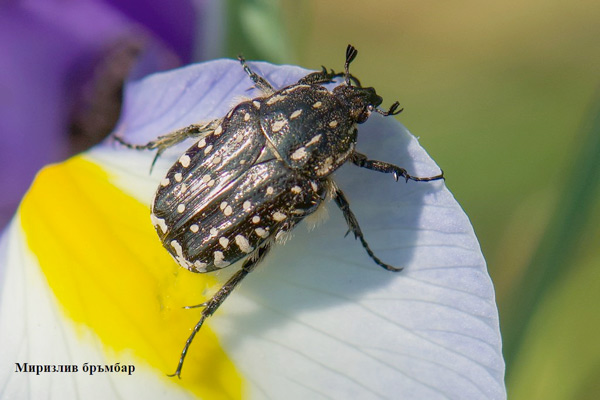
Smelly beetle
The smelly beetle is widespread throughout the country. It occurs together with the hairy beetle, and in some places it predominates. It causes significant damage mainly to vegetable and field crops, and to a lesser extent to fruit crops.
Hosts of the adult insect are quince, pear, apple, plum, cherry, dog rose, rose, spinach, cabbage, broad bean, radish, carrot, kohlrabi, oilseed rape, sunflower, rye, clover, alfalfa, petunia, tulip and lilac. Among wild-growing plants it damages dandelion, buttercup, cornflower, chamomile, yarrow, poppy, barberry, creeping thistle, mustard, thorn apple and vetch.
In spring, the beetles appear in the second half of April, and their peak occurrence is in the second half of May. Initially they settle on dandelion, tulip, dwarf apple and pear trees, and later migrate to quince, plum, cherry, cabbage, spinach, rose, dog rose, clover, rye and various weed species. At the end of the flight period the beetles gather on the flowers of spear thistle, thorn apple and creeping thistle.
In cloudy weather they hide in the soil at a depth of up to 5 cm. After sunset they leave the flowers, burrow into the soil under the tree canopy at a depth of 3-4 cm and remain there until morning.
Oviposition starts in the second half of May and continues until the end of August. The beetles lay their eggs singly or in clusters of 2 to 15. One female lays from 4 to 33 eggs, most often in greenhouses stocked with tomato and pepper seedlings, where suitable conditions exist for larval development. The egg-laying period lasts from 7 to 43 days. Embryonic development lasts from 7 to 15 days. The newly hatched larvae immediately enter the soil, feeding on humus substances. Depending on soil moisture, they are found at a depth of 6 to 30 cm. Larval development depends on temperature and lasts from 50 to 102 days. After completing its development, the larva prepares a pupal chamber in which it spends 6-10 days in a prepupal stage and then pupates at a depth of 10-20 cm. Beetles of the new generation appear at the end of August. Their emergence continues until the beginning of November. They remain in the soil to overwinter at a depth of 10-20 cm and emerge the following spring.
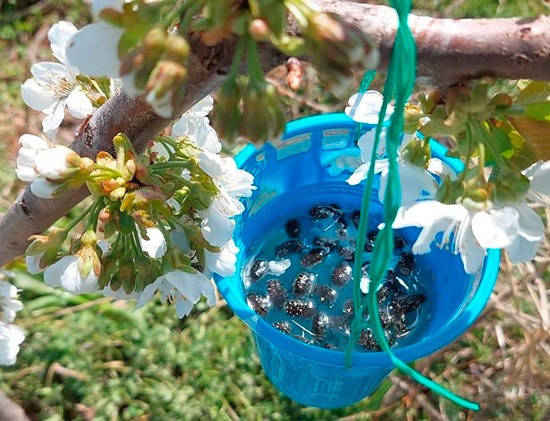
Control of hairy and smelly beetle
Control of the hairy and smelly beetle during flowering is mainly preventive, in order not to affect bees while they are collecting pollen and nectar.
For control, blue sticky pheromone traps are used, blue bottles with the bottom cut off filled with water and vinegar placed on the branches, and blue basins with water and vinegar placed in the inter-rows.
If there is still a risk of crop failure, evening spraying may be carried out with suitable contact insecticides – Sumicidin 5 EC (0.02%), Aficar 100 EC (15 ml/da), Efcymertrin 10 EC (15 ml/da). Control measures are implemented at an economic injury level of 3-5 adults/100 rosettes, or 5% damaged inflorescences.