

![MultipartFile resource [file_data]](/assets/img/articles/erbsen-aussaat-1.jpg)
From mid-April, sowing of early crops begins – potatoes, peas, onions from seeds and sets, parsley, celery, etc. Only healthy and disinfected seed and planting material should be used for sowing.
Diseases and pests to watch out for during this period:
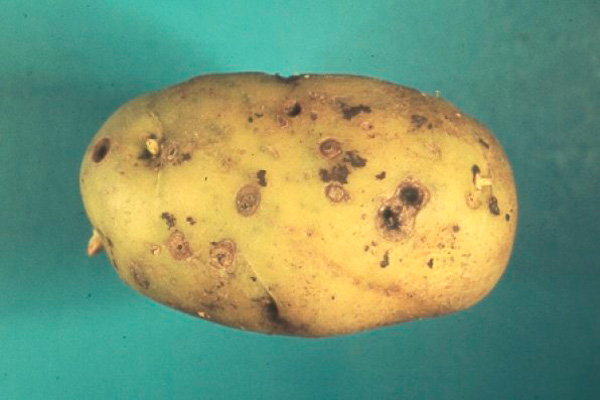
Rhizoctonia on potatoes (Rhizoctonia solani)
Dark to black sclerotia of the fungus are observed on infected tubers. Black-brown spots appear on the sprouts of infected tubers, which cause their death. It is spread through diseased tubers. It develops under monoculture cultivation and on heavy soils. It persists as sclerotia on the tubers and in the soil. It develops in the temperature range 6-33°C and humidity 30-90%.
Control
Introduction of a 6-8 year crop rotation; Use of healthy planting material; Treatment with PPP;
Registered PPP: Proradix 2 g/100 kg tubers (for treatment of the tubers before or during planting).
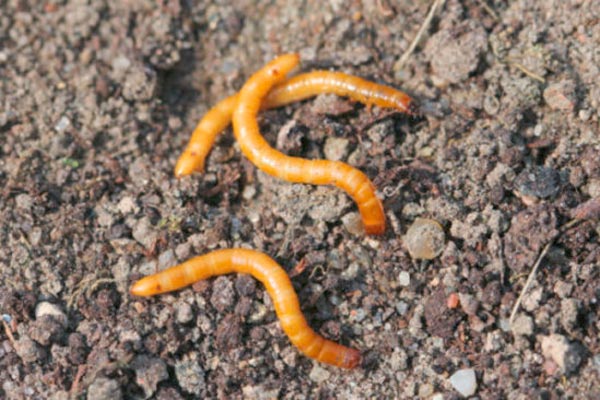
Wireworms (fam. Elateridae)
The larvae bore into the potato tubers. As a result, they rot because pathogenic microorganisms enter through the galleries. The larvae are most harmful at a temperature of 14-17°C and 65% field capacity.
Control:
When 4-6 larvae/sq. m are established, insecticides are applied in the furrow simultaneously with planting.
Registered PPP: Vydate 10G 2 kg/ha; Ercole GR 1000-1500 g/ha; Nemathorin G 2 kg/ha; Trika Expert 1000-1500 g/ha; Belem 0.8 MG/Colombo 0.8 MG 2.4 kg/ha; Colombo Pro 2.4 kg/ha; Naturalis 200-300 ml/ha; Force®Evo 1.2-1.6 kg/ha; Microseed Geo 1.2-1.5 kg/ha.
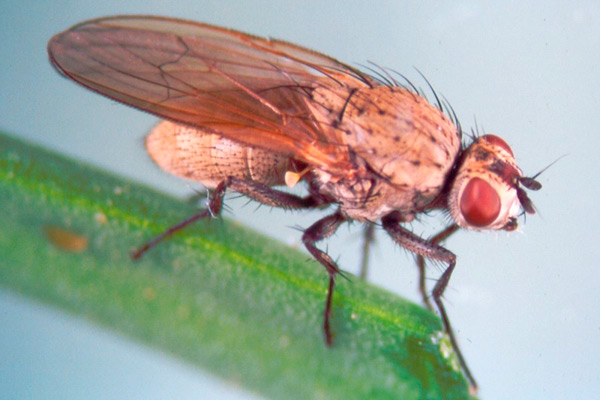
Onion fly (Delia antiqua)
In our country it is a specialized pest of onion, but it also slightly attacks garlic. The onion fly develops two full and a partially second generation. It overwinters as a pupa in the soil at a depth of 10-20 cm. The flight of flies of the first generation begins at the end of April, during the flowering of sour cherries. They lay their eggs on the leaves, on the bulbs and on the soil surface near the plants. Damage is caused by the larvae of the first generation. They bore into the plants at the base of the leaves. They make longitudinal galleries in the stems and move towards the bulb. The damaged plants lag in development, fade, lodge and finally dry up. As a result of the damage, the tissues ferment and emit an unpleasant smell of rotten onion. Several larvae can develop in one plant, and if they cannot feed themselves, they attack the stems of neighboring plants.
Control:
Onions should be planted early, because late sowings are attacked more severely. The crops must have a good stand. Plants showing signs of damage must be removed in good time to prevent larvae from moving to healthy plants. No bulbs should be left unharvested, and volunteer onions should be destroyed, as the development of the fly continues in them. Chemical control is directed against adults before egg laying at 5 flies/10 sweeps with an entomological net. Some broad-spectrum plant protection products from the pyrethroid group may be used, with strict observance of the pre-harvest intervals.
Registered PPP: Belem 0.8 MG/Colombo 0.8 MG 1.2 kg/ha; Force 1.5 G 1000 g/ha applied at sowing/transplanting.
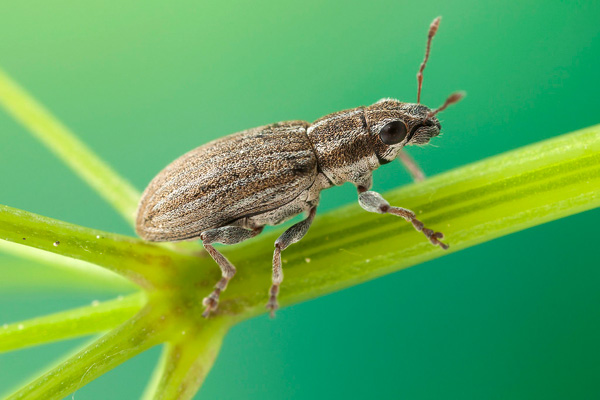
Pea (root nodule) weevils (Sitona spp.)
The adults are small grey-black beetles which, early in spring after the weather warms up, emerge and start feeding on the youngest and most tender leaves of the plants. They make semi-lunar notches. In some years, in cases of mass infestation, they can destroy entire crops. The larvae damage the root nodule bacteria on the roots. Thus, the amount of fixed nitrogen is reduced, and with it the pea yields.
Control:
It is necessary to maintain a spatial isolation of at least 500 m between annual legume crops and old lucerne fields, thereby limiting the spread of root nodule weevils.
Registered PPP: Decis 100 EC 6.25 ml/ha.