

![MultipartFile resource [file_data]](/assets/img/articles/greenhouse-6226263_640.jpg)
In the seedling section and the greenhouse
In the seedling section, care for the seedlings (tomato, pepper, eggplant, cucumber) intended for the field continues. To obtain healthy seedlings, the difference between daytime and nighttime temperatures must not exceed 6 – 8oC, in order not to induce “false damping-off” of the seedlings. In the seedling section, humidity is maintained at 50–60% of field capacity and substrate temperature at 20–25oC. The control of the nutrient regime is of great importance for the quality of the seedlings – pH = 6.2 – 6.8, total salt concentration of the substrate – EC = 1.2 – 1.8 mS/cm depending on the seedlings (dense, pricked out) and the crop.
In the greenhouse the early production of tomatoes and cucumbers has already been planted. If the greenhouse is unheated, the planting of peppers will take place at a later stage. The diseases and pests observed on the already transplanted plants are the same as those attacking the seedlings. It is necessary to carry out regular monitoring for early detection of the occurrence of diseases and pests and preventive plant protection, in accordance with the economic injury levels (EIL).
DISEASES
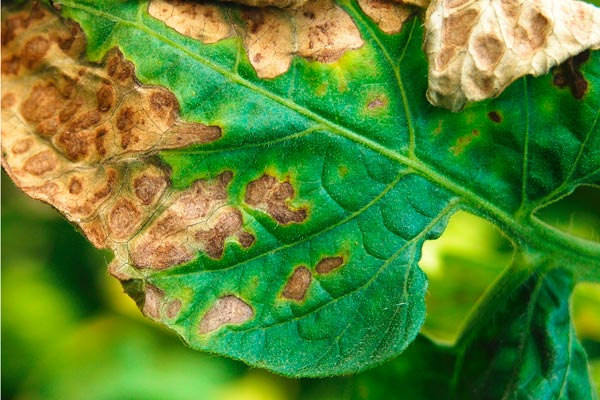
Early blight (brown leaf spots) (Alternaria spp.)
The spots on the leaves are dark brown to black with a concentric structure. Similar spots appear on the other above-ground parts as well. Infection of the flower stalks causes flower drop. The spots on the fruits are most often located around the stem scar and also have a concentric structure. The diseased parts are covered with a dark coating of the fungal sporulation. The pathogen prefers old leaves that have completed their growth. It develops under high relative humidity.
Control
Maintaining an optimal temperature and humidity regime in the protected cultivation facilities; regular ventilation of the facilities; treatment with plant protection products (PPP) at the onset of the disease or in the presence of favourable conditions.
Registered PPPs: Azaka 80 ml/da; Dagonis 100 ml/da; Zoxis 250 SC 70–80 ml/da; Kopfor Extra 200 g/da; Ortiva Top SC 100 ml/da; Polyram DF 0.2%; Prev-Gold 200–600 ml/da; Sinstar 70–80 ml/da; Taegro 18.5–37.0 g/da; Tazer 250 SC 80–200 ml/da.
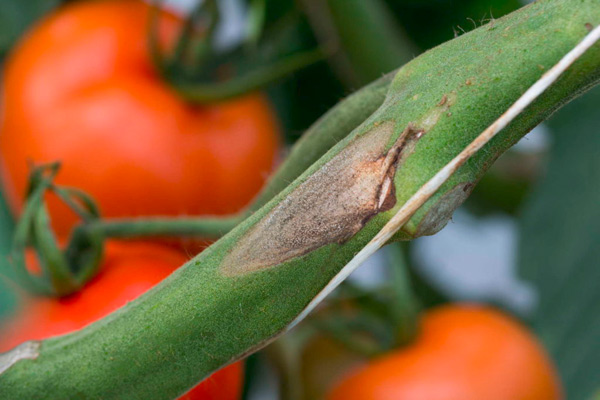
Grey mould (Botrytis) rot on tomato (Botrytis cinerea)
It attacks all above-ground parts of the plants. It develops under high air humidity. The spots are water-soaked and later become necrotic, covered with abundant grey-brown mycelium and fungal sporulation. The conidia of the pathogen are spread by air currents and cause new infections. The pathogen can also exist as a saprophyte in the soil.
Control
Maintaining optimal air humidity in the seedling section; regular ventilation; removal of infected plant parts and their destruction outside; at the appearance of the first spots, treatment with PPP is carried out.
Registered PPPs: Avalon 200 ml/da; Geox WG 50 g/da; Erune 40 SC 200 ml/da; Pretil 200 ml/da; Prolectus 50 WG 80–120 g/da; Signum 100–150 g/da; Switch 62.5 WG 100 g/da; Folpetis 50 SC 250 ml/da; Fontelis SC 240 ml/da.
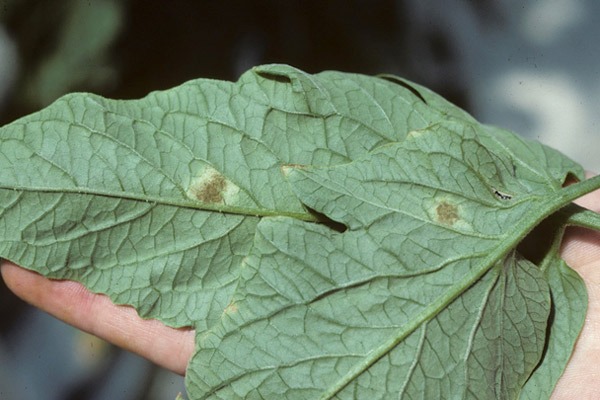
Leaf mould (Fulvia fulva)
On the upper side of the leaves relatively large, light spots with irregular shape and indistinct margins appear. Later they turn yellow. Under high air humidity, their lower surface is covered with a light coating of fungal sporulation, which later darkens and becomes velvety brown. When the number of spots on a leaf is considerable, they coalesce and the leaf becomes necrotic. Under favourable conditions, the plants may be completely defoliated. It develops under high air humidity.
Control
Cultivation of varieties resistant to the disease (most of the varieties offered on the market are resistant). Maintaining optimal air humidity in the seedling section; regular ventilation; balanced fertilization; destruction of plant residues and weeds, as the pathogen survives in them. Where necessary – treatment with PPP.
Registered PPPs: Eminent 125 ME 40–60 ml/da; Zoxis 250 SC 70–80 ml/da; Ortiva Top SC 100 ml/da; Signum 100–150 g/da; Sinstar 70–80 ml/da; Folpetis 50 SC 250 ml/da.
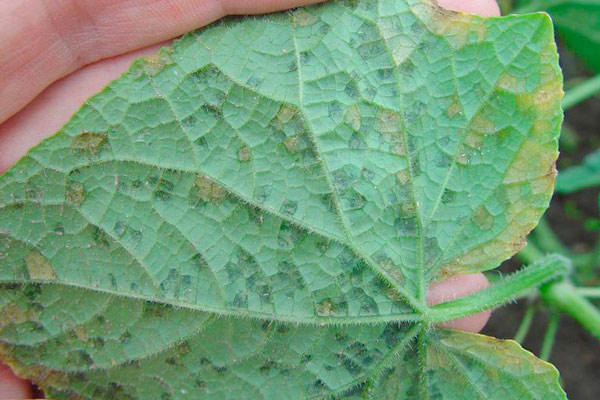
Downy mildew of cucumber (cucumber downy mildew) (Pseudoperonospora cubensis)
This disease is important for cucumber cultivation throughout the entire vegetation period. On the upper side of the leaves, yellowish spots of irregular shape appear, delimited by the veins. In wet weather they are water-soaked, and their lower surface is covered with a loose grey-violet coating of fungal sporulation. Later the spots enlarge, coalesce and the entire leaf becomes necrotic. Under high air humidity in the seedling section, the disease may affect the entire plant within a short time and strongly reduce the yield.
Control
Maintaining an optimal air and humidity regime; regular ventilation of the section; starting the heating in the early hours of the day prevents dew formation and downy mildew infection; removal of the first diseased leaves and their destruction outside the greenhouse. Where necessary, treatment with PPP.
Registered PPPs: Enervin SC 120 g/da; Zoxis 250 SC 70–80 ml/da; Equation Pro 40 g/da; Infinito SC 120–160 ml/da; Korseit 60 WG 20–30 g/da; Prev-Gold 160–600 ml/da; Taegro 18.5–37.0 g/da.
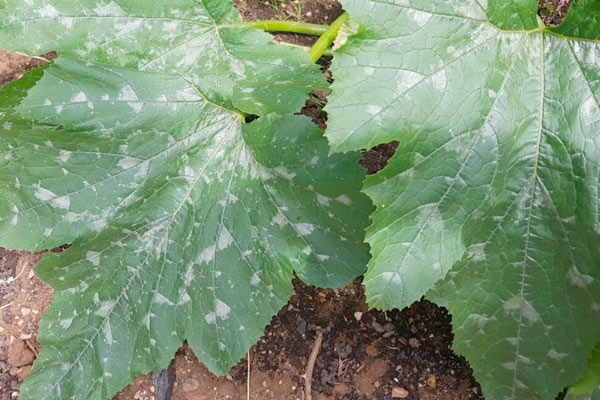
Powdery mildew of cucumber (Podosphaera xanthii, Erysiphe cichoracearum).
On the leaves small spots of irregular shape appear, sprinkled with a white powdery coating of fungal sporulation. Later the spots coalesce. The leaves become necrotic. Spots can be observed on the upper and lower leaf surfaces, on the petioles and the stem. The pathogen overwinters as conidia on plant residues, as mycelium and spores on greenhouse crops. The conidia are spread by air currents and cause new infections. Favourable conditions for development are: disturbed temperature and humidity regime; unbalanced nitrogen fertilization; reduced light intensity.
Control
Cultivation of resistant varieties; removal of plant residues from the previous vegetation; balanced nitrogen fertilization; maintaining an optimal temperature and humidity regime; treatment with PPP at the appearance of the first spots.
Registered PPPs: Vivando 20 ml/da (0.02%); Dagonis 60 ml/da; Domark 10 EC 50 ml/da; Zoxis 250 EC 70 ml/da; Collis SC 40–50 ml/da; Legado 80 ml/da; Ortiva Top SC 100 ml/da; Sivar 80 ml/da; Sonata SC 500–1000 ml/da; Trunfo 80 ml/da; Fitosev 200 ml/da; Fontelis SC 240 ml/da.