

![MultipartFile resource [file_data]](/assets/img/articles/hazelnuts-4285540_640_1_.jpg)
![MultipartFile resource [file_data]](/assets/img/articles/truffles-4539078_640_1_.jpg)
In recent years, the idea of establishing hazelnut plantations infected with truffle fungi has gained popularity. The aim is to obtain two products – hazelnut kernels and truffles. Although quite attractive, this idea is difficult to apply and there are a number of conditions that must be met in order to be successful.
Here are some of them:
Varietal authenticity of the hazelnut
The technology for obtaining mycorrhized planting material from hazelnut begins with the inoculation of very young hazelnut trees, because it is most successful at this stage of development of the plant’s root system. They can be obtained in only two ways – either by micropropagation or from seeds. This means that, in order to rely on nut production from a specific hazelnut variety, the planting material used for inoculation must be certified and micropropagated.
Soil conditions
The best soil conditions for truffle cultivation are karst soils rich in calcium, with a high pH reaching even up to 9. These soil conditions are very unfavorable for hazelnut cultivation.
Mixed plantation
Cultivation of truffles means the creation of an agroforestry system – a set of species that favour the development of truffles. These are oak species (downy oak, pedunculate oak, Turkey oak, etc.), linden, hornbeam, hazel, birch, poplar. For a truffière to be successful, it must reproduce the natural conditions in the forest, which implies the establishment of a mixed plantation. Oak species must predominate in it. In this case, monoculture cultivation of hazelnut is not recommended.
Cultivation technology
The truffière is cultivated organically – no plant protection products are applied there. This implies the only possible choice in combined cultivation – the hazelnut plantation must be managed organically with one particular feature – without soil fertilization and without any products being applied through the soil. Under these conditions, obtaining regular and stable hazelnut yields is at the very least doubtful.
Location
According to specialists, the best place for establishing truffières is near forests or in areas where truffle deposits have been found. It is considered that suitable strains have been naturally preserved there, which are adapted to these conditions and their cultivation will be successful. They recommend that truffières be established with planting material inoculated with these local truffle strains.
Pruning
The exploitation period of an artificially established truffière is about 20 years, with the main limiting factor being the age of the trees, and more precisely the access of light beneath their canopies. This necessitates, after the fifth year, the performance of strong annual pruning to open up the crowns. This type of pruning in hazelnut is carried out more gently when it comes to nut production, because it regulates the achievement of regular yields.
Ectomycorrhizal species
Truffle strains are ectomycorrhizal and depend on symbiosis with certain tree species. Fruit species such as apple, pear, plum, cherry are unsuitable for establishing truffières.
In summary, the choice of growing hazelnuts for nut production or for truffles must depend on a number of factors, but in all cases it must be based on reliable information. The information presented above is the result of training under the ERASMUS+ programme at the Laboratory of Applied Mycology of the University of Perugia, Italy – one of the few institutions in Italy engaged in the certification of truffle-mycorrhized planting material.
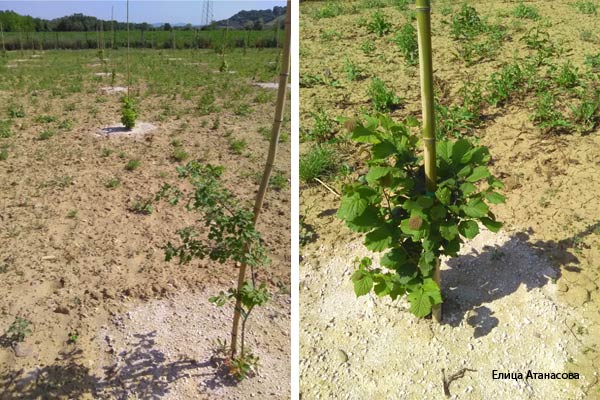
Two-year-old plantation near the town of Spello, Umbria, Italy, 2019. The plantation was established in 2018 with various tree species inoculated with a local truffle.
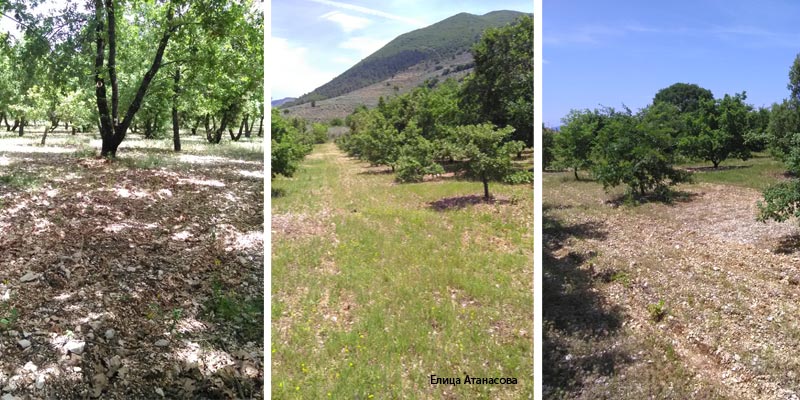
50-year-old truffière in the Umbria region, Italy – a traditional region for truffle harvesting. The trees are of different ages because they are renewed at certain intervals. In the distance, in the middle of the photo, on the hillside, there are natural truffle sites.
Photos: Chief Assistant Elitsa Blagoeva, Agricultural Academy, Experimental Station of Agriculture in the Eastern Rhodopes – Kardzhali