

![MultipartFile resource [file_data]](/assets/img/articles/tomato-diagnostik-недостик-фосфор.jpg)
PHOSPHORUS (P – Phosphorus from Greek „Φωσφόρος” – light)
Importance of phosphorus for plants. Phosphorus is a key element for plant life. Its role is multifaceted. Its main function is the storage and transfer of energy in plants. It participates in the composition of biologically important organic compounds – nucleic acids, phytin, vitamins, enzymes, hormones, etc. It is also present in the plant organism in the form of inorganic phosphates, which have a dual role in the plant organism – on the one hand, they are a reserve for the formation of organic phosphates and on the other – phosphorus is a factor for the course of certain biochemical processes. It accelerates the growth of the root system in depth; accelerates flowering, fruiting and ripening; improves product quality. Plants supplied with phosphorus are more resistant to diseases and cold.
Plant requirements for phosphorus. Phosphorus is a macronutrient. In the plant organism it is distributed extremely unevenly. At the beginning of vegetation, it is concentrated in the organs with the most vital activity – leaves, apical stem and root meristem. A characteristic feature of phosphorus is that it is subject to redistribution (reutilization) in the plant organism – it moves from ageing organs and tissues to the young ones.
Young plants absorb phosphorus more intensively than older ones. This is related to their rapid development. Unlike adult plants, they do not absorb sparingly soluble phosphorus compounds. During the formation of the reproductive organs and especially during fruit ripening, intensive movement of phosphorus towards them begins.
Uptake
Phosphorus is taken up by plant roots mainly in the form of orthophosphoric acid ions – H2PO4- and HPO42-.
PHOSPHORUS DEFICIENCY
General symptoms –. the first signs appear on the lower leaves.
Phosphorus is a mobile nutrient. In case of deficiency, the lower and older leaves become depleted of phosphorus more rapidly due to its movement towards the young leaves and organs.
With slight phosphorus deficiency, no external symptoms are observed, but growth slows down. With more severe deficiency, the growth of the root system in depth and its branching are most severely affected. The leaves are small and narrower than normal with curling margins. The number of flowers decreases sharply. The lower and older leaves are small, hard and curled; their upper side is bluish green, the underside – purple, and the veins – violet-red. This leaf coloration is due to the fact that, under phosphorus deficiency, sugar content increases, which contributes to the accumulation of the pigment anthocyanin. The affected leaves develop chlorosis and fall prematurely.
Causes
Low phosphorus level in the nutrient medium; low temperature of the nutrient medium (below 15oC); high salt concentration; high content of nitrate nitrogen, chlorine and/or iron; drought; increased acidity or alkalinity of the medium; damaged root system.
Recommendation
Fertilization of soil-grown crops with P2O5 up to 50 kg/da before planting; top dressing with soluble phosphorus fertilizers P2O5 up to 20 kg/da; use of ammonium sulfate instead of nitrate fertilizers; liming when soil pH is low. For hydroponic crops, use a solution containing 50 ppm P and increase the temperature of the nutrient medium.
Identification of phosphorus deficiency symptoms by crop
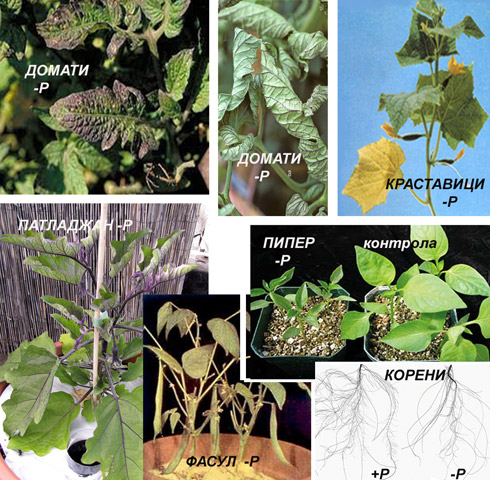
Phosphorus deficiency in fruit vegetable crops
Symptoms of phosphorus deficiency in fruit vegetable crops:
- The leaves are small, stiff, with a dark green or bluish green upper side, and a purple underside; the veins are violet-red;
- The lower leaves are yellow with brownish-purple spots and drop prematurely;
- Fewer flowers are formed;
- The stems are thin with shortened internodes. Under severe deficiency, growth stops;
- The fruits are smaller. Yield decreases;
- Growth of young roots is suppressed.
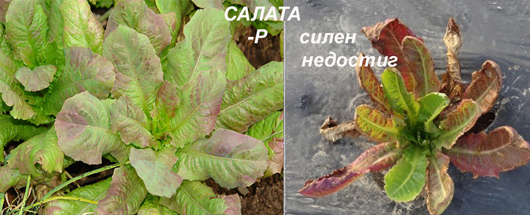
Phosphorus deficiency in leafy vegetable crops
Symptoms of phosphorus deficiency in leafy vegetable crops:
- The first symptoms begin with dark green coloration of the entire plant and stunted growth;
- Chlorosis starts on the older leaves, after which they acquire a purple to red coloration along the margins, which progresses to necrosis. Under moderate deficiency, necrotic spots move from the leaf margin towards the interior;
- Under severe deficiency, necrosis affects the entire plant and it dies;
- Yield decreases.
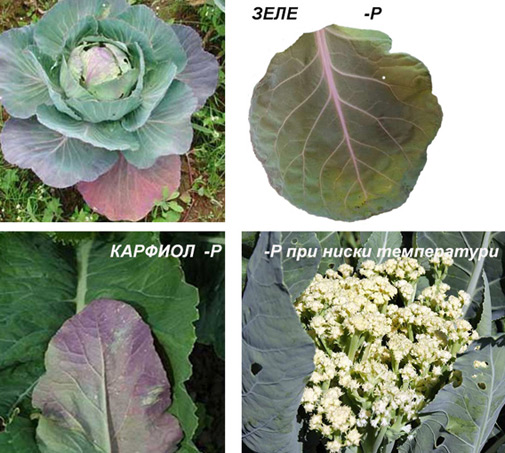
Phosphorus deficiency in leafy-stem vegetable crops
Symptoms of phosphorus deficiency in leafy-stem vegetable crops:
- The older leaves are dull with purple tints. Their tips turn brown and die;
- Leaves and stems appear stunted;
- Maturity is delayed;
- In cauliflower, the leaves are pointed with purple edges, and the curd becomes granular and loose. The effect is intensified at temperatures lower than the optimum for the respective cultivar;
- The size and quality of the head are affected. Yield decreases.
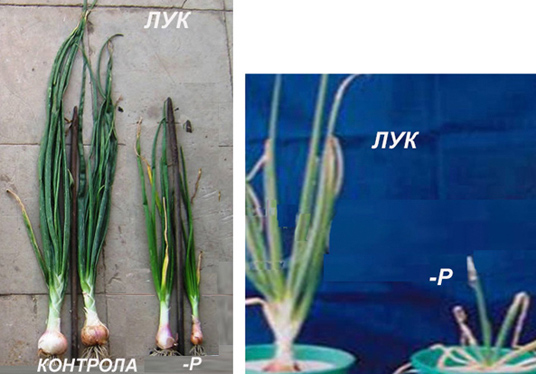
Phosphorus deficiency in bulb vegetable crops
Symptoms of phosphorus deficiency in bulb vegetable crops:
- Growth is slow. Maturity is delayed;
- The percentage of bulbs with reduced quality is high;
- The leaves acquire a dull green colour and die back from the tips without yellowing;
- Under severe deficiency, growth stops.
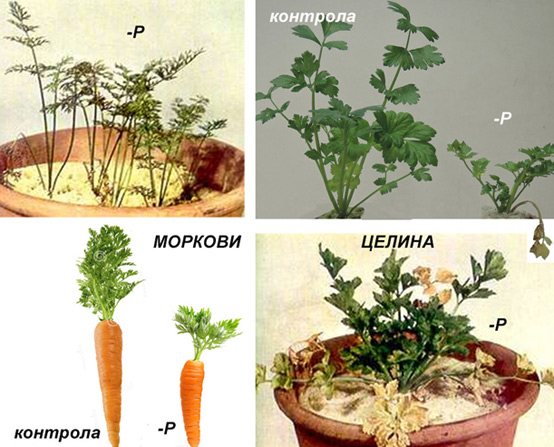
Phosphorus deficiency in root vegetable crops
Symptoms of phosphorus deficiency in root vegetable crops:
- The leaves are thin with anthocyanin coloration. Under severe deficiency, chlorosis and necrosis begin on the lower leaves and they drop early; .
- Growth is slowed. Plants are smaller;
- The root crop is of reduced quality – smaller or severely stunted.
- Yield is compromised.
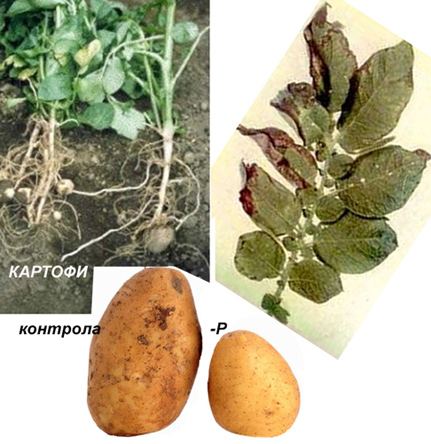
Phosphorus deficiency in tuber vegetable crops
Symptoms of phosphorus deficiency in tuber vegetable crops:
- Initially, the leaves elongate and are slightly deformed. Brownish spots appear. The leaves are dull dark green, and their edges and underside are purple-coloured;
- Under severe deficiency, plants are stunted with thin stems and smaller, upward-curled leaves;
- The root system is poorly developed;
- Growth is retarded;
- They do not form tubers, or form a small number of small tubers. Yield is low.