

![MultipartFile resource [file_data]](/assets/img/articles/ръжда-пшеница-заглавна.jpg)
Summary
Rusts are one of the factors for obtaining high and stable yields in winter wheat cultivation. These include brown leaf rust, yellow rust and stem (black) rust. Under our climatic conditions, leaf rust has the greatest economic importance due to its annual occurrence in wheat stands. Symptoms of yellow rust are observed relatively less frequently, as the disease develops mainly in areas with a more humid and cool climate. The occurrence of stem (black) rust is associated with the presence of the alternate host – barberry, but the damage it causes can completely compromise the stands.
One of the most important and widespread foliar diseases of wheat is brown rust, caused by the pathogen Puccinia recondita Rob. ex Desm. Due to its broad ecological plasticity, it is also the most widespread rust on wheat in our country. Although it is not the most harmful, the disease ranks first in economic importance because it develops almost every year. Its high reproductive potential, its ability to overwinter under the climatic conditions of the country and the differences in virulence within the pathogen population largely determine its harmfulness. Rust infections cause profound disturbances in the physiological and biochemical processes of plants, which lead to a strong reduction in productivity and to deterioration of grain quality. Cyclically, they develop on an epiphytotic scale.
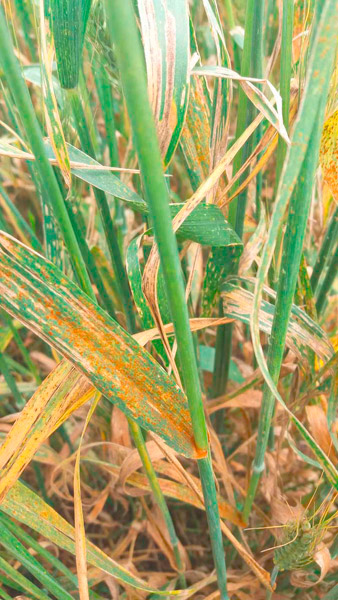
Brown rust
Brown rust attacks all green parts of the plants. External symptoms of the disease are observed on the leaves and leaf sheaths in the form of rusty-brown uredinia. Subsequently, the infected tissues turn black due to the formation of black telia. On wheat cultivars susceptible to the disease, the pathogen forms large uredinia, without chlorosis and necrosis being observed around the infected tissues. On resistant cultivars, the uredinia are small to medium-sized, surrounded by necrotic or chlorotic zones. On immune cultivars, the leaves remain sterile. At a high degree of infection, the stands are scorched. The disease can develop throughout the entire vegetation period, but it is most often observed from heading to ripening. With an earlier and massive manifestation, the plants remain shorter, tiller less and form smaller ears. Wheat plants infected with brown rust have a reduced number of grains per ear. The grain from these ears is smaller, shrivelled, light and floury. Such grain produces low-quality flour and bread. The massive development of brown rust is promoted by warm days (20–25oC) and nights with showers, especially in the afternoon hours, and the formation of dew. Heavy nitrogen fertilization and the cultivation of susceptible cultivars may lead to earlier spring appearance and spread of the disease, but usually mass infection begins after ear emergence, with late-ripening cultivars being more severely affected.
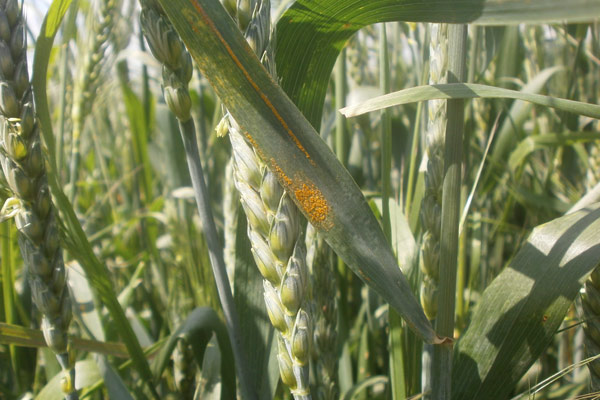
Yellow rust
Over the last 3–4 years, yellow rust, caused by Puccinia striiformis f. sp. tritici, has represented a serious problem both for producers and for wheat breeders. The disease has greater economic importance in northern regions with a more humid and cool climate. If in some years such meteorological conditions also occur in other regions where wheat is grown, significant damage from the pathogen can be expected. Yield loss from yellow rust can reach up to 100% if the disease appears in the early growth stages of the wheat plant and continues to develop throughout the entire vegetation period. In most cases, yield loss varies from 10% to 70% depending on cultivar susceptibility, the rate of development and the duration of the disease. External symptoms of the disease are observed on the leaves and leaf sheaths in the form of small, lemon-yellow uredinia. Very rarely can symptoms be observed on stems, glumes and awns. The uredinia are arranged in groups between the veins of the leaves, forming wide stripes reaching a length of up to 10 cm. The stripes are accompanied by chlorosis and necrosis of the tissues. In cases of severe manifestation of the disease, the plants have reduced growth, the leaves dry up and fall off, and the entire field acquires a characteristic yellowish colour. At the end of the vegetation period, simultaneously with the uredinia, small, linearly arranged telia are formed, which are covered by the epidermis. The development of the pathological process is inhibited at temperatures around 20–25°C. Therefore, the pathogen manifests itself more strongly in areas with higher altitude, in years with a late spring and cool summer, as well as with frequent rains during the heading period.
Recent studies show that the increased spread of yellow rust is due to two newly formed races. They are similar in phenotype and virulence and possess exceptional aggressiveness even at higher ambient temperatures.
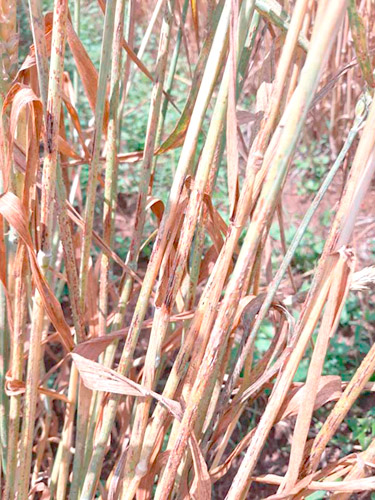
Black (stem) rust
Black (stem) rust (Puccinia graminis f. sp. tritici) on wheat is an economically important disease that occurs relatively rarely on the territory of the country, but has a strong harmful potential and can cause very serious damage. Since this type of rust is a heteroecious pathogen, its spread is linked to the presence of the other species involved in its life cycle – Berberis vulgaris (barberry). The occurrence of black rust in our country is associated with the transfer of inoculum by air currents, in particular with the transfer of urediniospores from some southern countries, especially after the second half of May. In terms of economic importance, stem rust ranks second after leaf rusts, with the damage it causes depending on the time of its appearance – the earlier it appears, the greater the damage. Yield losses from stem rust can reach up to 100% in the case of epiphytotic development of the pathogen.
Black stem rust is most often observed on stems and leaf sheaths and less frequently on other green parts of the plants. On the affected parts, elongated sori covered by the epidermis are formed, which, after its rupture, turn into powdery, rusty-brown masses of uredinia. Initially, they are single and scattered. With massive development of the disease, the sori become numerous and merge, forming variously sized, rusty-brown, powdery patches or stripes with a torn epidermis. Later, when the plants begin to ripen, the uredinia turn black and become telia, in which the winter spores – teliospores – are formed. In cases of severe infection, especially in dry and hot weather, the plants ripen earlier, and their grains remain shrivelled, with reduced weight and severely impaired quality. On resistant cultivars, the uredinia are smaller and are surrounded by a chlorotic halo. On immune cultivars, only sterile chlorotic spots are formed. Damage to the last internode has the greatest impact on productivity. In severely affected plants, white heads are observed; the plants break and lodge. The development of the fungus Puccinia graminis is favoured by humid and moderately warm weather in May (the period from heading to flowering). With early and dense sowing, weed infestation and unbalanced nitrogen fertilization, the pathological process is more intense.
photos: Institute of Plant Genetic Resources “K. Malkov” – Sadovo
Literature:
1. Mebrate, S., Dehne, H., Pillen, K., Oerke, E. (2008), Postulation of Seedling Leaf Rust Resistance Genes in Selected Ethiopian and German Bread Wheat Cultivars, Crop Sci., 48, 507-516.
2. Nakov, B., Karov, S., Popov, A., Neshev, G. (1999), Special Phytopathology, Sofia, 22-24.
3. Karzhin, H. (2003), Study on rusts in wheat in Bulgaria and means for their control, Monograph – DZI General Toshevo.
4. Nedyalkova, S., Ur, Z., Bozhanova, V., Chavdarov, P. (2014), Evaluation of accessions from closely related and distant species of durum wheat for resistance to brown rust and powdery mildew, Conference in Karnobat.
5. Roelfs, A., Singh, R., Saari, E. (1992), Rust Disease of wheat: concepts and methods of disease management, Mexico, D.F. CIMMY, p. 81.
6. Bolton, M., Kolmer, J., Garvin, D. (2008), Wheat leaf rust caused by Puccinia triticina, Molecular Plant Pathology, 9, 563-564.
7. Zheng, Q., Huang, W., Cui, X., Dong, Y., Shi, Y., Ma, H., Liu, L. (2019), Identification of wheat yellow rust using optimal three-band spectral indices in different growth stages. Sensors 19, 35.
8. Brown, J., Hovmøller, M. (2002), Aerial dispersal of pathogens on the global and continental scales and its impact on plant disease, Science 297, 537–541.
9. Chen, X. (2005), Epidemiology and control of stripe rust (Puccinia striiformis f. sp. tritici) on wheat, Can. J. Plant. Pathol. 27, 314–337.
10. Shahin, A. (2020), Occurrence of new races and virulence changes of the wheat stripe rust pathogen (Puccinia striiformis f. sp. tritici) in Egypt, Archives of Phytopathology and Plant Protection, 53(11-12), 552-569.
11. Stancheva, Y. (2002), Atlas of diseases of agricultural crops, Volume 3 – Diseases of field crops. Pensoft, Sofia-Moscow.
12. Figueroa, M., Hammond‐Kosack, K., Solomon, P. (2018), A review of wheat diseases—a field perspective. Molecular plant pathology 19, 6, 1523-1536.