

![MultipartFile resource [file_data]](/assets/img/articles/екскориоза-лоза.jpg)
Excoriation of grapevine is widespread in the viticultural regions of our country and is often confused with other diseases. The causal agent of the disease excoriation is the fungus Phomopsis vticola Sacc.
The causal agent of the disease overwinters as fruiting bodies in the bark of the matured shoots and as mycelium in the buds and wood. The main symptoms are found on the lowest internodes – dark brown to black necrotic spots with an elongated shape. Gradually, the bark at the sites of the spots turns white, cracks and tears. This makes the shoots fragile and brittle. Their growth may be suppressed when they develop from infected buds.
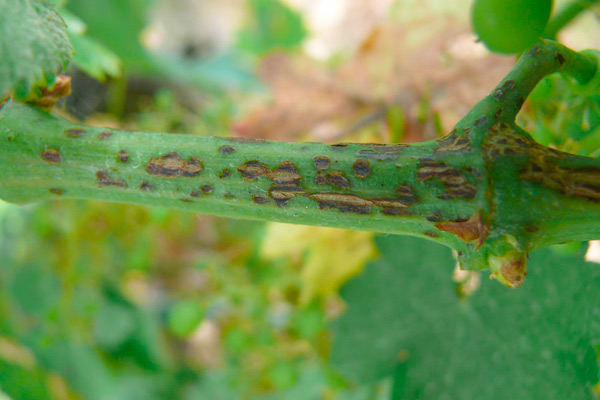
In spring, a large number of the buds at the base of the shoots do not develop, or soon after their development the young shoots die. This necessitates the extension of the fruiting units during pruning and hampers the maintenance of the training system. Damage to the shoots adversely affects the ripening of the wood, which leads to a reduction in the resistance of the vines to low temperatures. The affected perennial wood gradually dries out, individual perennial parts (arms, cordons) or entire vines die.
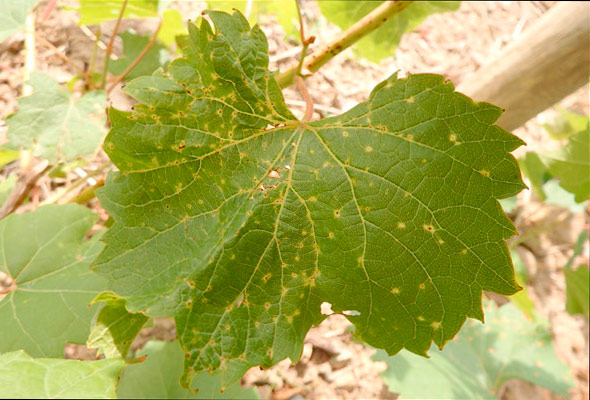
The most favourable conditions for the development of excoriation are moderately warm and humid weather, at 98–100% relative humidity and the presence of free water droplets on the plants. Vines are most susceptible to infection from the bud swelling stage to the 3rd–4th leaf stage of the shoots.
An important measure in controlling the disease is pruning of the infected lignified parts, which are a source of infection, as well as the maintenance of high-level agronomic practices, regular hoeing and balanced fertilisation.
Plant protection sprayings are carried out in the periods critical for the development of the pathogen.
First spraying – about 40% of the buds located at the base of the shoots are at the “butterfly” stage;
Second spraying – 40% of the buds are at the 2nd–3rd leaf stage.
After the start of treatments for downy mildew control, separate sprayings against excoriation are not necessary.
*Registered fungicides for control:
Mikal Flash – 0.3%, Momentum Extra WG – 300 g/ha; Solofol – 188 g/ha; Thiovit Jet 80 WG – 1250 g/ha; Follow 80 WG/ Friller 80 WG/ Flowet 80 WG – 187.5 g/ha; Kumulus – 750 g/ha; Quadris 25 SC – 0.075–0.1% (75–100 ml/ha with 100 l/ha spray solution); Microthiol Special Liquid – 1210 ml/ha; Folpetis 50 SC – 200–300 ml/ha.
* The article was updated on 05.01.2025.