

![MultipartFile resource [file_data]](/assets/img/articles/Aprikosenbluete.jpg)
The flowering time of fruit tree species depends on temperature, altitude and latitude. It is also determined by the biological characteristics of the species – early, mid-early and late flowering.
Usually, at this time of the month all apricot trees are already in bloom. Flowering lasts 2–3 weeks. With the aim of preserving the good health condition of the plants and obtaining a quality yield spraying is required.
During the flowering period, apricot is sprayed against blossom blight (early brown rot) – the most important disease of this fruit species. Agrotechnical measures to limit overwintering fungal inoculum and the implementation of winter and pre-bloom treatments are an important prerequisite for effective blossom spraying. Therefore, they should not be omitted.
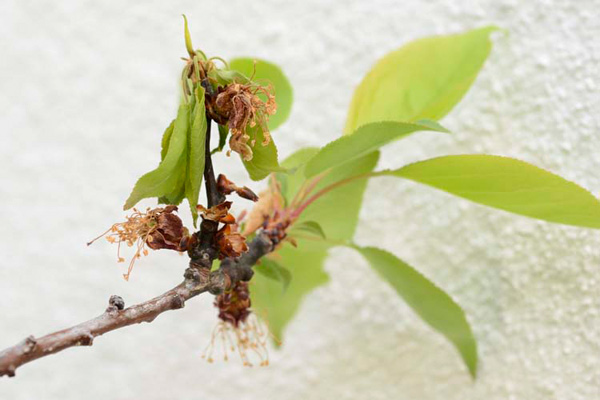
Blossom blight (early brown rot)
The causal agent of the disease is a fungus. It attacks blossoms, leaves, shoots, twigs and fruits. The affected parts acquire a characteristic brown colour, from which the name of the disease is derived.
The fruiting bodies of the fungus differ from those of the causal agent of late brown rot in that they are smaller and greyish and are never arranged in concentric rings. The conidia of the causal agent of blossom blight (early brown rot) are more resistant to low winter temperatures, and their formation can occur at a lower temperature. Higher humidity is required for their formation.
Infections are carried out by conidiospores, which are formed as soon as the snow melts and are dispersed by wind, rain and insects.
The development of the disease can occur even at temperatures above 0 oC, but very slowly. The optimal temperature is from 18 to 22 oC.
High relative air humidity is a determining factor for the strong development of the disease. This is why the disease develops most intensively under frequent and prolonged rainfall, in humid and poorly ventilated sites and in heavily crowded orchards, where raindrops or dew remain for a long time.
Under favourable temperature and humidity, infection proceeds within a few hours. The incubation period under such conditions is 3–5 days, and the period until the appearance of fruiting bodies – 8–10 days.
The first symptoms are observed on the blossoms. Necrotic spots form on the petals, which cover the entire flower – the so-called “blossom blight”. The infection spreads to the twigs, which dry up together with the leaves on them.
In some cases blossom blight (early brown rot) also affects the thicker scaffold branches, on which cankers and lesions are observed – similar to those caused by frost injury and gummosis. The cankers weaken the branches and may cause their death. Grey, powdery, spore-forming tufts develop on all affected parts. The damaged parts do not fall off, but remain until the following spring.
Control
During flowering, treatment is carried out with one of the following plant protection products – Chorus 50 WG (0.045–0.05%), Delan 700 WG (50 g/da), Score 250 EC – 0.02–0.03%, Difcor 250 EC – 20 ml/da, Luna Experience (63–75 ml/da). If the spring is dry, a single blossom spray at the beginning of flowering is sufficient. Under frequent rainfall, low temperatures and high relative humidity, 3 sprays are necessary – at the beginning of flowering, at full bloom and at petal fall. It is advisable to carry out the treatment in the evening, in order to protect bees.