

![MultipartFile resource [file_data]](/assets/img/articles/tomato-diagnostik-недостик-azot.jpg)
NITROGEN (N – Nitrogen)
Importance of nitrogen for plants
Nitrogen is the “vital engine” of the plant. It is a constituent of a large number of organic compounds that perform important functions in the plant organism – amino acids, phosphatides, alkaloids, vitamins, nucleic acids, ATP, etc. Its physiological importance is related primarily to the synthesis of protein substances. It is a major component of chlorophyll – C33H72O5N4Mg. Therefore, plants adequately supplied with nitrogen have dark green leaves and accelerated growth.
Plant demand for nitrogen
Nitrogen in the plant organism is subject to reutilization (re-use). It moves from ageing and dying organs and tissues to the younger and more active ones, and subsequently to the reproductive organs. Thus, the plant uses nitrogen very economically.
In the initial growth stages most plants require a small, yet absolutely essential, amount of nitrogen. The demand for nitrogen is highest during the period of intensive growth of vegetative organs and during the formation of reproductive organs. During the ripening period it is not beneficial for plants to be supplied with large amounts of nitrogen. This leads to continuation of growth and of the photosynthetic activity of the leaves, which delays ripening.
Uptake
Nitrogen is taken up by plant roots mainly in the form of nitrate (NO3–) and ammonium (NH4+) ions.
Nitrogen deficiency
General symptoms – the first signs appear on the lower leaves
Nitrogen is a mobile nutrient element. Under nitrogen starvation, chlorophyll in ageing and dying organs and tissues is destroyed and the released nitrogen is translocated to the growing points. As a result, the green colour turns pale green. Gradually the entire leaf, including the veins, acquires a uniform yellow colour, which may progress to yellow-white. The symptoms intensify under moisture deficit.
A characteristic sign of nitrogen starvation is growth retardation. Leaves and fruits are smaller than those typical for the grown crop and variety, and flower bud formation is reduced. Yield decreases.
Causes
Low nitrogen level in the nutrient medium; low temperature of the nutrient medium; moisture deficit; use of an organic substrate with a high carbon level (bark or sawdust).
Recommendations
Increase the nitrogen level in the nutrient medium – soil fertilization with 3 – 5 kg N/da; foliar fertilization with 1.0% calcium nitrate. Hydroponic crops are irrigated with a solution containing 150 – 200 ppm N; optimization of the irrigation regime.
Identification of nitrogen deficiency symptoms by crop type
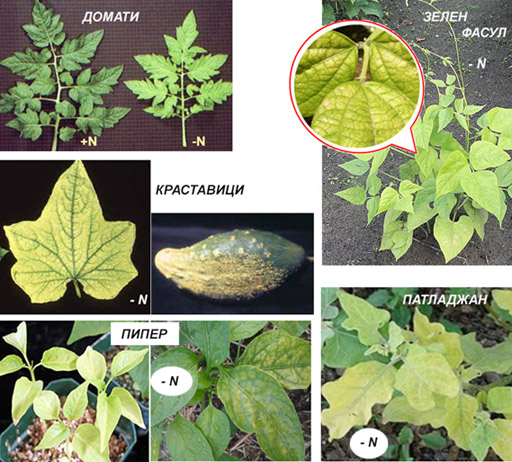
Nitrogen deficiency in fruit vegetable crops
Symptoms of nitrogen deficiency in fruit vegetable crops (The classification of vegetable crops used is based on their productive organs:
- Chlorosis on the lower and ageing leaves;
- Fruits are smaller than those typical of the variety, with impaired appearance and taste qualities;
- Growth is retarded;
- Yield is low.
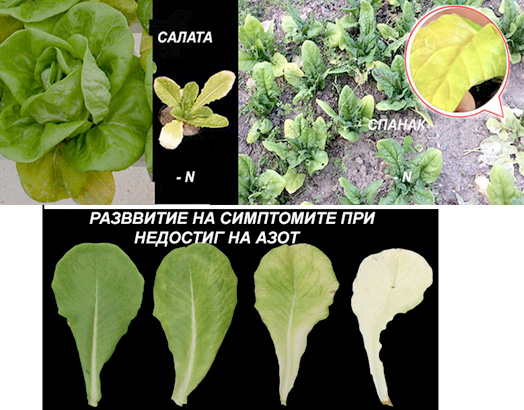
Nitrogen deficiency in leafy vegetable crops
Symptoms of nitrogen deficiency in leafy vegetable crops:
- Leaves become light green and subsequently yellow to pale. Under more severe or prolonged nitrogen deficiency, chlorosis also affects the young leaves;
- Necrosis appears on the leaves;
- Under severe deficiency, growth ceases.
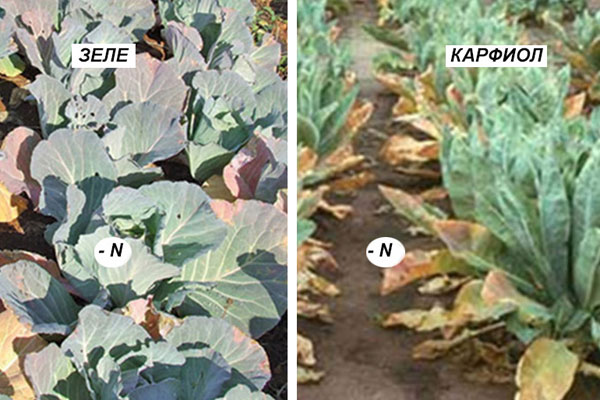
Nitrogen deficiency in leaf-stem vegetable crops
Symptoms of nitrogen deficiency in leaf-stem vegetable crops:
- The lower leaves fade and a pinkish coloration appears. Symptoms intensify during the winter months;
- Under more severe and/or prolonged deficiency, necrosis appears;
- Plants are smaller;
- Yield is lower.
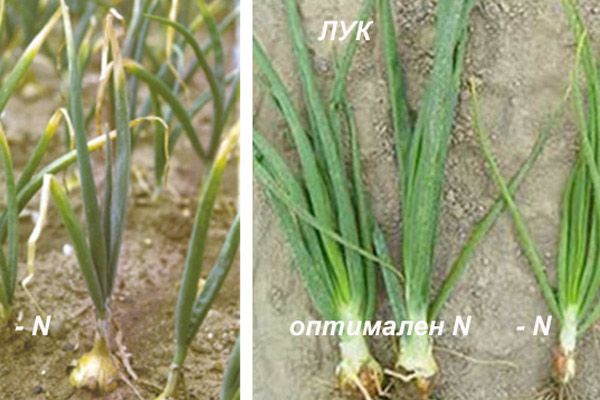
Nitrogen deficiency in bulb vegetable crops
Symptoms of nitrogen deficiency in bulb vegetable crops:
- Leaves turn yellow or greenish-yellow. Necrosis appears at their tips. Under severe deficiency they die;
- Growth is slowed;
- Yield decreases.
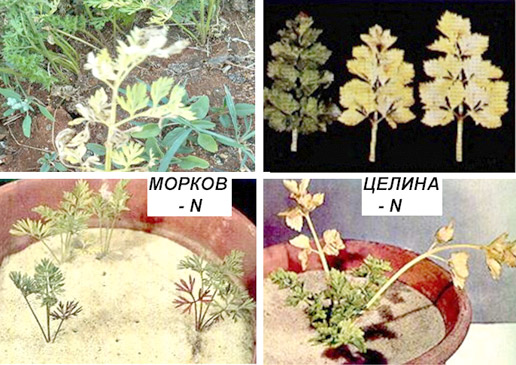
Nitrogen deficiency in root vegetable crops
Symptoms of nitrogen deficiency in root vegetable crops:
- Growth is slowed;
- Leaves are thin and light green. The lower leaves turn yellow with red hues. Chlorosis spreads to the young leaves;
- Under more severe nitrogen deficiency, necrosis begins on the older leaves and they fall off;
- Symptoms of nitrogen deficiency in carrots most often appear in the period before harvest;
- Yield decreases.
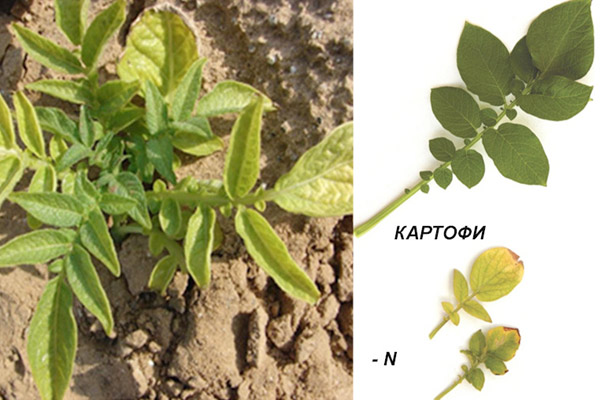
Nitrogen deficiency in tuber vegetable crops
Symptoms of nitrogen deficiency in tuber vegetable crops:
- Initially the lower leaves become light green to yellow; the symptoms spread over the whole plant. Tip burn may appear;
- Newly formed leaves are smaller. Leaf mass is reduced;
- The vegetation period becomes shorter, which negatively affects yield.