

![MultipartFile resource [file_data]](/assets/img/articles/10.jpg)
From the end of March, Japan is gradually covered with blooming cherry blossoms. The Sakura season turns the country into a pink fairy tale. Japanese cherry trees are among the most famous landmarks in the country and are deeply embedded in Japanese culture. Not only are the Japanese known for their festival of admiring the cherry blossom (usually between late March and April and mid-May), but these ornamental trees have been transformed into art, poetry, food and beverages. The Japanese in particular appreciate their short but exceptionally beautiful lifespan – many of them bloom for only a week or two, which is why sakura is perceived as a symbol of the transience of life.
Several lesser-known facts about the tree of nascent life:
The Japanese cherry (Prunus serulata) is a flowering Asian tree belonging to the Rose family (Rosaceae)
Sakura is a generic name for plants that belong to the Rosaceae family. The names of the tree that we use in Europe are many: cherry blossom, sakura, Japanese cherry, mountain cherry, oriental cherry or East Asian cherry.
The extraordinary ornamental tree of Japan
The Japanese ornamental cherry trees Sakura are not famous by chance. There are a total of about 300 varieties of Japanese cherry. This number includes native varieties and hybrids, with different numbers of petals, blossom sizes and a palette ranging from dark to light shades of pink. Some of them are wild varieties originating from the forests of Japan, such as Yamazakura, but the majority have been cultivated by people over the centuries for ornamental use in gardens and parks.
Varieties of Japanese cherry
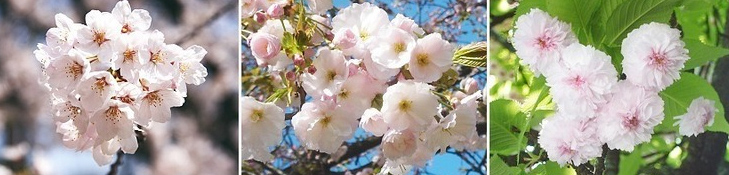
Number of petals
Most wild trees, but also many cultivated tree varieties, have blossoms with five petals. However, some species have blossoms consisting of ten, twenty or more petals. Trees with blossoms of more than five petals are called Yaezakura (yaezakura).
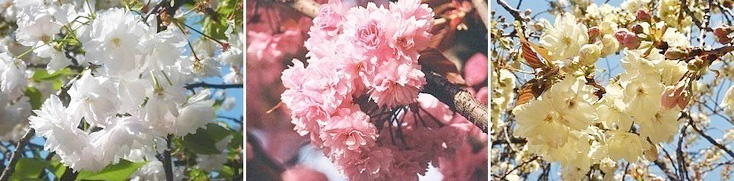
Colour of the blossoms
Most varieties have light pink to white blossoms, but there are also cherry trees with dark pink, yellow or green blossoms. In addition, the colour of the cherry blossoms of some varieties may change while they are in bloom. For example, a blossom may open as a white flower and change its colour to pink over the course of several days.
Leaves
On early-blooming trees, the leaves usually appear only after full bloom, which gives the trees a very attractive appearance while they are in full blossom. On later-blooming trees, the leaves usually appear before flowering, which gives the trees a more heterogeneous appearance. Furthermore, the colour of the leaves differs among the various varieties. In most cases they are green, however some are copper-brown, and others are something in between green and copper-brown.
Flowering time
Most varieties of cherry trees bloom in spring. Yaezakura, i.e. cherry trees with blossoms of more than five petals, are usually the last to open their blossoms, about two to four weeks after most five-petaled species. Some extreme varieties bloom in late autumn and during the winter months. Different species of cherry trees are planted not only because of the wider range of colours, but also because their blossoms open at different times and thus the pleasure of observing the flowering trees can be extended to several weeks; it has also been turned into a tourist attraction, which starts at one end of the island and continues north to its other end.
The most common cherry blossoms in Japan include:
• Somei Yoshino cherry
• Yamazakura cherry
•Shidarezakura (Weeping cherry)
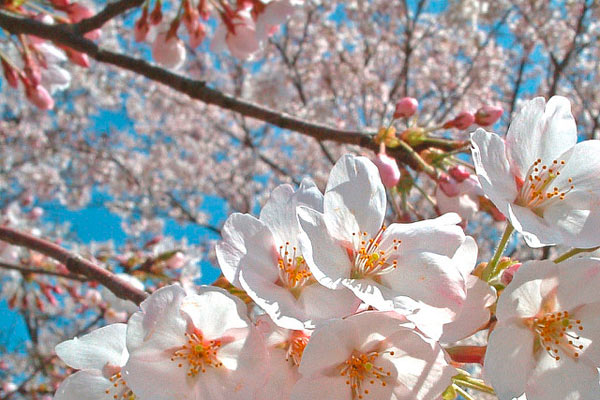
The most widespread is the fast-growing Somei Yoshino cherry (with the scientific name Cerasus x yedoensis (Matsum.) A.V.Vassil.), which has five-petaled blossoms in a slightly pink to almost white colour. The variety was cultivated during the Edo period in Tokyo and is found almost everywhere in Japan.
When the sakura season officially begins in Japan, Somei Yoshino is the first tree to bloom, to the delight of its expectant observers, but its flowering lasts only about a week before its petals completely cover the ground. Its appearance is particularly impressive partly due to the fact that the leaves of the trees appear only after the peak of the flowering season.
Yamazakura is the most common cherry variety in Japan that actually grows wild in nature, unlike varieties such as Somei Yoshino. Its blossoms are slightly pink and have five relatively small petals. The leaves of Yamazakura develop simultaneously with the blossoms, giving the tree a somewhat less intense appearance than Somei Yoshino.
Weeping cherry trees have drooping branches and are among the most common and beloved cherry trees in Japan. There are two types: trees with blossoms of five petals and trees with blossoms of more than five petals. The latter are called Yaeshidarezakura and bloom about a week later than those with 5 petals.
Hanami – the Cherry Blossom Festival
Hanami represents the season of blooming of the Japanese cherry, accompanied by the traditional ritual of observing and admiring the cherry blossoms.
In spring, picnics are invariably held under the heavily laden cherry trees, where everyone from children to the elderly together enjoy the transient beauty of Sakura. The blossoming starts in March in the south – in Okinawa, continues in April further north – in Kyoto and Tokyo, and finally arrives in Hokkaido in May.
The custom of “Hanami” has existed since the 3rd century. At that time, sweet idleness in nature was a privilege of the aristocracy at the imperial court, who drank sake under the cherry blossoms and devoted themselves to classical poetry.
Although poetry is no longer written in Japanese parks, the custom of drinking rice wine under the cherry blossoms has been preserved.
Hanami is not only an aesthetic celebration of contemplating the blooming cherries, but also a major social event at which new friends, colleagues or classmates can get to know one another. In fact, the new academic year begins in April and coincides with the festivities around Sakura.
Therefore, mini feasts are arranged at the picnics under the blooming trees, with homemade rice balls, assorted sandwiches and sweets.
Or, as a Japanese proverb says, “Hana yori dango“ – Pleasures first, contemplation of the blossoms later.
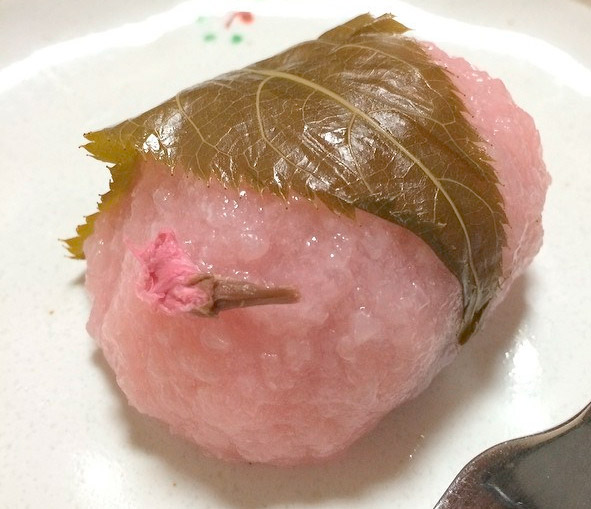
Everything is edible
After the petals and leaves undergo a fermentation process, they can be used to make various sweets and confectionery, called sakura mochi. These are Japanese delicacies consisting of red bean paste, entirely or partially wrapped with pink-coloured mochi and wrapped in a sakura leaf.
Sakura mochi is a Japanese delicacy consisting of red bean paste, entirely or partially wrapped with pink-coloured mochi and wrapped in a sakurazuke leaf.
Sakura in Bulgaria
In the South Park of Sofia there is a Japanese alley with over 100 sakura trees. Usually in April, lovers of sakura can enjoy the blooming trees and touch the ancient Japanese message that beauty in life is transient and momentary.