

![MultipartFile resource [file_data]](/assets/img/articles/apple_blossom_apple_tree_flower_232245.jpg)
They are directed against the primary infection caused by the overwintering inoculum of the diseases and against the activation of the first forms of pests.
The development of fruit trees at the beginning of vegetation depends on the exact timing and the quality of the treatments carried out.
The most critical phenophases for infection by diseases and damage from pests are from “bud swelling” to “flowering”. In stone fruit species this period is relatively short and most often a single pre-bloom spraying is carried out. In contrast, the slower development of pome fruit requires three treatments, starting from the “green tip” stage to the “pink bud” stage.
Cool and humid weather in the initial phenophases of fruit trees favours the development of the most economically important harmful organisms. Therefore, it is necessary to use the most appropriate fungicides and insecticides in order to protect the crops as effectively as possible from diseases and pests.
Diseases
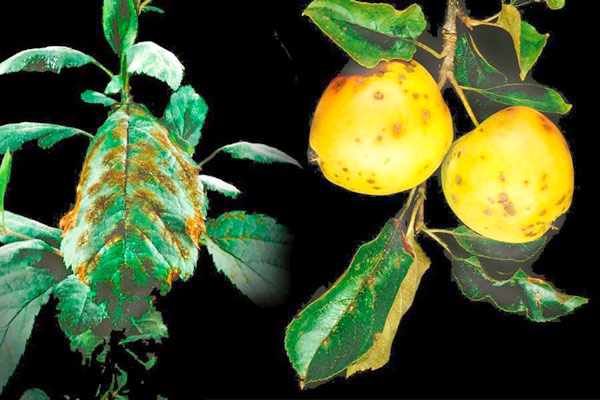
Apple scab – Venturia inaequalis
The manifestation of the disease begins on young leaves, in the form of round, greasy spots on both sides of the leaf blade, which gradually become covered with a greenish-grey coating and necrotize. Symptoms are also observed on leaf, flower and fruit stalks, as well as on the fruitlets and fruits of the apple. The attacked organs turn yellow, dry up and fall off. The fruits become deformed. Infections are triggered by optimal temperatures and wetting of plant tissues, in the mouse-ear phenophase of apple, in which it is necessary to spray.
Registered fungicides for control:
COPRANTOL DUO – 300 g/ha – applied at BBCH 91-55 stage (shoot growth completed; terminal bud developed; leaves still entirely green – visible flower buds (still closed); VITRA 50 WP / CUPROHIDE 50 WP – 150 g/ha; AIRONE SC – 200 ml/ha; CAPTAN 80 WG – 150-180 g/ha; KOCIDE 2000 WG – 155-680 g/ha; KUMULUS DF – 750 g/ha; CUPROXAT FL - 0.3%; MERPAN 80 WG – 200 g/ha; POLYRAM DF – 0.2%; SULIT 544 SC – 125 ml/ha; THIOVIT JET 80 WG – 600 g/ha; FONTELIS SC – 75 ml/ha; FUNGURAN OH 50 WP – 110-500 g/ha; CHORUS 50 WG – 30-50 ml/ha - – applied at the “mouse-ear” stage; CHAMPION WP – 0.3 % - applied at the “mouse-ear” stage;
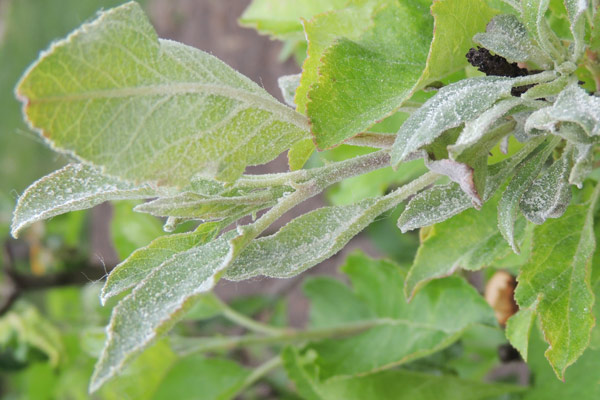
Powdery mildew on apple – Podosphaera leucotricha
The pathogen overwinters as mycelium in infected leaf and flower buds, from which weak shoots develop, with shortened internodes and boat-shaped curved, narrow leaves and deformed flowers. The diseased plant tissues are covered with a powdery coating, which gradually darkens. The attacked parts necrotize and fall off. On the surface of the fruits, russeted net-like spots appear, which gradually penetrate deeper.
Registered fungicides for control
SERCADIS – 15 ml/l - applied at BBCH 53-81 stage (flower buds swelling to beginning of ripening); FLINT MAX 75 WG – 20 g/ha
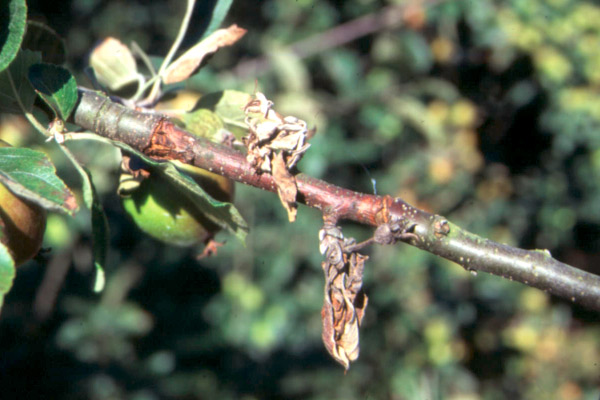
Blossom blight (early brown rot) in stone fruit species
The first symptoms of the disease are observed as necrotic spots on the petals, gradually encompassing the entire flowers –“blossom blight”, the shoots and leaves, which dry out. On infected scaffold branches cankers and lesions with gummosis are observed. Fruitlets turn brown, the fruits rot, mummify, and at high relative air humidity and moderate temperatures they become covered with grey powdery tufts. The attacked plant parts do not fall off, remain on the trees and in them the pathogen overwinters as mycelium.
Blossom blight attacks primarily plum, apricot, peach, sweet cherry and sour cherry.
To control the disease, it is necessary to carry out:
Pre-bloom spraying - at flower bud phenophase;
Bloom spraying - at the beginning of flowering;
Post-bloom spraying - after petal fall;
Fourth spraying - in wet and cool weather during the flowering period and in case of severe infection - 8-10 days after the third one.
Registered fungicides for control
DIFCOR 250 SC – 20 ml/ha; CAPTAN 80 WG – 150-180 g/ha; LUNA EXPERIENCE - 63 - 75 ml/ha; MERPAN 80 WG – 225 g/ha; PROLECTUS 50 WG – 80 g/ha; SIGNUM WG – 30 g/ha – for peaches, SIGNUM WG – 60-75 g/ha – cherries, nectarines, apricots; FONTELIS SC – 120 ml/ha – applied from first open flowers to end of flowering (all petals have fallen).
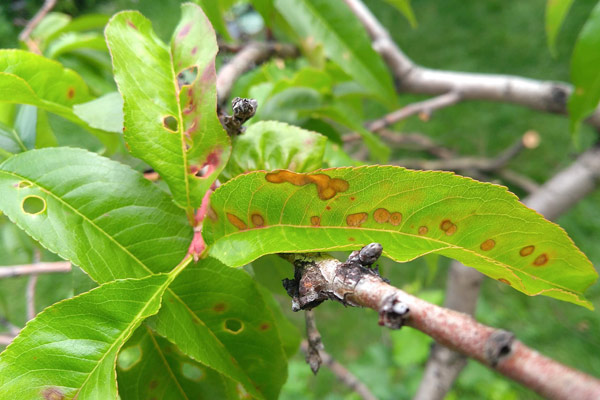
Shot-hole disease in stone fruit species
On the leaves, shoots and fruits small reddish spots develop, which gradually merge into irregular shapes. The tissue in the centre of the leaf spots necrotizes and falls out. On apricot fruits, small reddish scabs form around the stalk, while on sweet and sour cherry fruits dark spots appear, which gradually sink in and adhere to the stone. On peach and almond, gum exudation occurs at the site of damage. The pathogen overwinters as mycelium in infected twigs.
The following treatments should be carried out:
First spraying - at flower bud phenophase;
Second spraying - after flowering;
Third spraying - 7 days after the second one.
Registered fungicides for control
CAPTAN 80 WG – 250 g/ha - from first open flowers to harvest maturity; VITRA 50 WP / CUPROHIDE 50 WP – 150 g/ha – at bud break: bud scales open, light green sectors visible; KOCIDE 2000 WG – 155-280 g/ha - up to the beginning of bud burst.
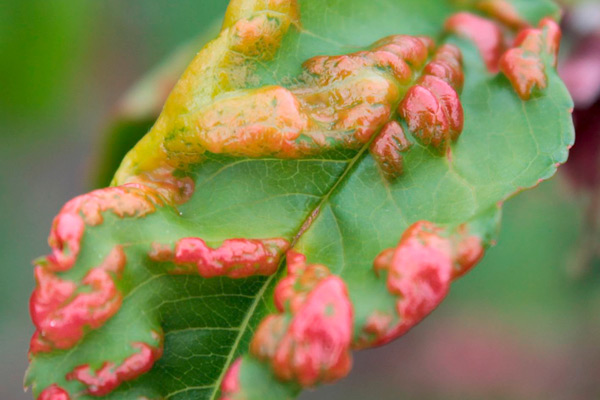
Peach leaf curl
The disease is caused by a fungus (Tafrina deformans), which overwinters between the bud scales or on the bark of infected shoots. Symptoms are single or numerous, pale green, pale yellow or bright red swellings on the upper side of the leaves, which are sunken on the underside. A greyish-white coating develops on the infected tissues. The damage can affect entire leaves, which then necrotize and fall off. Control of peach leaf curl is carried out by autumn-winter spraying. If these have been omitted, up to bud swelling with 1% BORDEAUX MIXTURE SOLUTION it is possible to carry out 1-2 treatments at 10-day intervals in the period from bud swelling to flower bud phenophase, using contact or systemic products.
Registered fungicides for control
CHAMPION/MAKK 50 WP/CHAMP WP - 0.3%; BORDEAUX MIX 20 WP – 375-500 g/ha; COPPER KEY – 240-300 g/ha; MERPAN 80 WG – 225 g/ha - flower buds closed, light brown scales visible; SIGNUM WG – 100 g/ha; SULIT 544 SC – 165 ml/ha - from beginning of bud swelling to end of flowering; CAPTAN 80 WG – 250 g/ha - flower buds closed, light brown scales visible; COPRANTOL DUO WG - 400 g/ha - shoot growth completed; leaves dark green – in some buds the light green scales are slightly open.