

![MultipartFile resource [file_data]](/assets/img/articles/lepka.jpg)
The main crops from this group in our country are winter wheat and winter barley. Oats, rye and triticale are grown on smaller areas. The results of numerous scientific experiments prove that in recent years yields of winter cereals under moderate weed infestation have decreased by 15 to 25%, and under severe infestation, especially with species such as charlock mustard, wild oat, blackgrass, creeping thistle, cleavers, etc., the actual losses exceed 60–70%. These and other weed species seriously hinder the mechanized harvesting of the crop, reduce the productivity of combines and deteriorate the quality of harvesting.
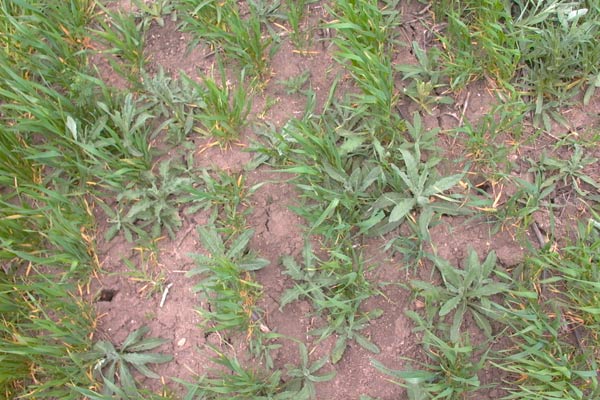
Creeping thistle in wheat
Stands of winter cereal crops with a solid surface are infested by about 100 species. The following weeds are widely distributed in them: from the group of winter–spring species – eastern larkspur, corn poppy, field mayweed, etc.; from the group of early spring species – charlock mustard, cleavers, wild oat, etc.; from the group of ephemerals – ivy-leaved speedwell, common chickweed, fumitory, henbit dead-nettle, etc.
Eastern larkspur – Annual winter–spring weed. The stems are erect, slightly branched, glandular-hairy mainly in their upper part. The blades of the lower and upper leaves are tripartite, with segments that are thinner in the upper leaves. The plant has significantly more foliage and more numerous but shorter segments than field larkspur. The inflorescence is a raceme. The flowers are irregular with individual stalks, violet to bluish-violet, more rarely pink and only in isolated cases white. The fruit is a strongly hairy pod with glandular-hairy stalks. The seed is inversely ovoid, pointed towards the tip and narrowed towards the base. It is black in colour, and the plates are light brown. It reproduces by seeds which germinate in autumn and the plants overwinter, or en masse in March–April. When the upper part of the stem is cut after harvest, weak additional branches develop. The seeds ripen during harvest and are taken with the crop. There are about 30–50 seeds in one pod, and one plant forms on average 1500 (max. 15 600) seeds. It predominates on brown forest and meadow cinnamon soils.
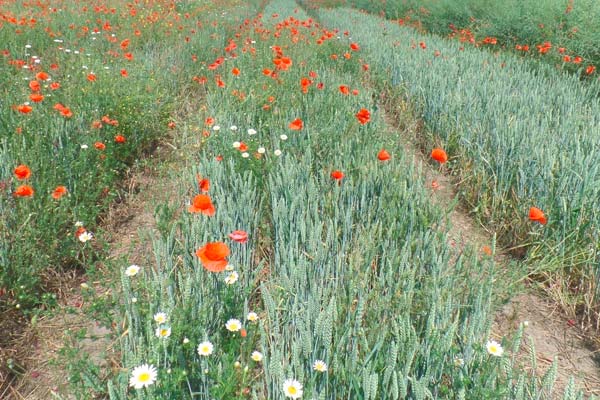
Weed infestation with corn poppy and field mayweed in wheat
(Department of Agriculture and Herbology at the Agricultural University – Plovdiv)
Corn poppy – Annual winter–spring weed. The stems are hairy, erect and often branched, dark green, with a height of 20–60 to 90 cm. The leaves are simple or pinnate, with petioles. The flowers are red and large. The fruit is an inversely ovoid, single-chambered capsule. The seed is reddish-brown, kidney-shaped, covered with large, irregular and lighter pits. The hypocotyl is light green or slightly violet. The cotyledons are ovoid, blunt at the tip, with petioles. The first leaves emerge directly from the cotyledonary knee. They are simple, pinnately cut, hairy and slightly violet on the underside, with a clearly defined midrib and petioles. It reproduces by seeds which germinate in the soil at a depth of 2–4 cm in autumn (October), forming rosettes with which the plant overwinters. In colder winters it partially freezes. Part of the seeds germinate in March–April. The plants formed from them develop directly a flowering stem. The seeds retain viability in the soil for more than 8 years. It flowers and bears fruit in May–June in winter cereal crops. When the upper part of the main stem is cut, new branches are formed which reach flowering. The seeds ripen 15–30 days after flowering. One plant forms from 5000 to 100 000 (max. 11 000 000) seeds. They are dispersed in the soil and partially harvested with the crop. The species is light-demanding, drought-tolerant and relatively cold-resistant. It develops on all soil types, but predominates on their lighter variants.
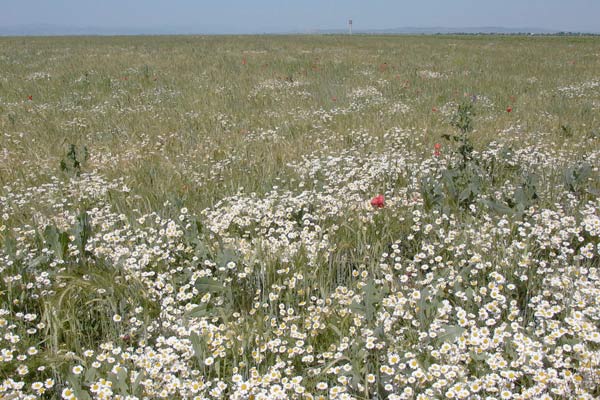
Severe infestation of a wheat stand with field mayweed
Field mayweed – Annual winter–spring weed. The stems are branched, erect and hairy, with a height of 20 to 60 cm. The leaves are sessile, with the lower ones more strongly dissected. They are usually bipinnate with 2–4 pairs of segments, and the upper ones are simply pinnate with 1–2 pairs. The inflorescence is a capitulum. The peripheral flowers are white and ligulate, and the inner ones are yellow and tubular. The fruit is prismatic with 8–10 longitudinal ribs, yellow-brown in colour. The surface of the seeds, mainly along the longitudinal ribs, is slightly rough, with rather deep grooves between the ribs. The hypocotyl is short, and the cotyledons are elliptical. The first pair of leaves are lanceolate and pinnately cut, with two pairs of lateral and one terminal lobe. They are covered with dense hairs. The leaves of the second pair are also pinnate with irregularly serrated lobes. It reproduces by seeds which germinate in the soil in autumn, forming small rosettes with which they overwinter. It flowers and bears fruit in July–August (September). One plant forms on average 1200 (max. 34 000) seeds. A large part of them end up in the crop. The species is light-demanding. It exhibits considerable cold resistance. It develops on light and sandy soils.
Charlock mustard – Annual early spring weed. It emerges in March and April–May, and in moist conditions also during the autumn months. In cold winters it freezes. It develops rapidly and strongly suppresses all winter cereals. The stems are erect, branched and covered with sharp hairs, dark green or violet in colour, with a height of up to 150 cm. The leaves are rough and slightly hairy, with sharp hairs. The basal leaves are slightly lyrate, and the stem leaves are sessile, almost entire, with a slightly irregularly serrated margin. The flower is intensely yellow. The fruit is a silique, often coloured anthocyanin-violet, with both valves covered with sharp hairs. The seed is round, brown-red, with transitions to black. The hypocotyl is dark violet. The cotyledons are heart-shaped, with a clearly defined and branched violet midrib at the upper end, dark green on the upper surface and dark violet on the underside. The first pair of leaves are almost sessile, entire and slightly serrated. On the upper side they are dark green, with a clearly defined midrib and 2–3 lateral veins branching from the central one. These leaves are rarely covered with hairs on both sides, denser along the midrib, the margin and the base of the leaf. The violet colour disappears with the warming of the weather. The second and third leaves are more or less lyrate, with hairs, dark green in colour. It reproduces by seeds which germinate in crops in spring (February and en masse from late March–April) and autumn (October–November). The minimum temperature for seed germination is 4–8ºC. They retain their viability in the soil for about 11 years. It flowers and bears fruit from May to July. One plant forms from 400 to 24 000 (max. 120 000) seeds. It develops on all soil types, but predominates on chernozems, vertisols and cinnamon forest soils.
Infestation with cleavers in wheat
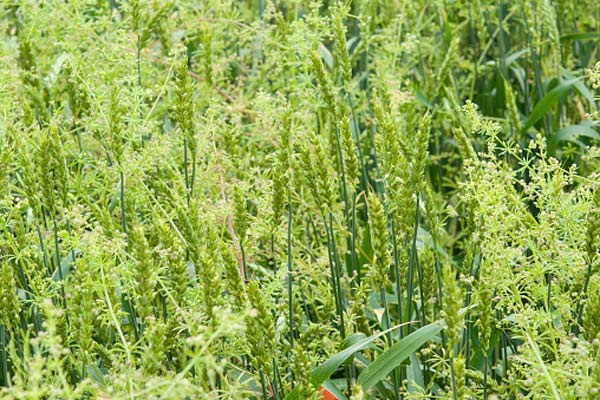
Cleavers – Annual early spring weed. In warmer regions it emerges in autumn (November), but mainly in spring (March–April). In mild winters it overwinters. The stems are four-angled and branched, with a height of up to 1 m. The leaves are sessile and arranged in whorls of 8–9. They have curved teeth with which they cling to cereal plants, restricting their growth. The fruit is spherical, grey to drab in colour. The cotyledons are ovoid and slightly indented at the tip, with a visible midrib. The first leaves are oval and slightly ovoid, evenly wavy-serrated, blunt at the tip. They have clearly expressed venation, are white-hairy and petiolate. The species withstands low winter temperatures and can therefore also be considered a wintering weed. It flowers and bears fruit from May to June, rarely July. In our country the seeds ripen simultaneously with winter cereals and enter mainly into the harvested crop. One plant forms from 200 to 1000 seeds which, after ripening, germinate with difficulty.
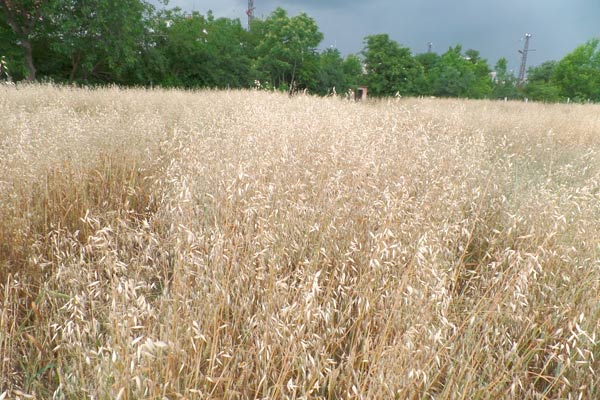
Massive infestation with wild oat in wheat (Department of Agriculture and Herbology at the Agricultural University – Plovdiv)
Wild oat – Annual early spring weed. It reproduces by seeds, part of which germinate in autumn (September–October) at a temperature of 15–180C, and another part – after overwintering (March–April) at a temperature of 6–10 0C. The stems are erect, slightly hairy at the nodes, with a height of 80 to 120 cm. From one plant 2–7 tillers develop. The leaves are lanceolate, pointed, with cilia along the margin. The sheath of the lower leaves is usually hairy and less often glabrous with a ligule. The inflorescence is a loose panicle. The spikelets are large, drooping, with 3 florets and awns, and the glumes are equal. The fruit is a grain enclosed in the lemma and palea, straw-yellow to dark brown in colour, with a thin longitudinal groove. The first leaf is light green, with hairs along the margin and clearly defined veins on the blade; the ligule is short and membranous, and the coleoptile is grey-green. The following leaves are almost glabrous. It overwinters successfully in milder winters. The seeds have a dormancy period of 3–4 months, and mass infestation occurs from the spring germination of the seeds. It flowers and bears fruit from June to July. First, the top seeds of the panicle ripen and, at harvest time, they fall to the soil; afterwards, with the help of their hygroscopic awn, which makes a rotary movement when moistened, and with the help of the hairs at the base, they penetrate into the soil. The lower seeds in the panicle ripen later and a large part of them enter the harvested crop. Three types of seeds are formed in the panicle, differing morphologically, anatomically and biologically. The upper seeds are early-ripening with a dormancy period of 22 months and prolonged germination; they develop later-ripening plants. The largest seeds are in the lower part of the panicle. Their dormancy period is 2–2.5 months, germination is uniform, and the plants developed from them are early-ripening. The seeds from the middle part of the panicle have intermediate properties. In the soil the seeds retain viability for more than 3 years. One plant forms from 200 to 300 (max. 3000) seeds. It develops on all soil types but predominates on their lighter variants.
Ivy-leaved speedwell – Annual wintering ephemeral. It overwinters successfully. On individual areas up to 2 million seeds per square metre have been recorded. It competes with cultivated plants in the early stages of their development, when they are most sensitive. The stems are branched from the base and prostrate on the soil surface. They are 5 to 30 cm long. The whole plant is hairy. The leaves are rounded kidney-shaped and slightly heart-shaped at the base. They are green to yellow-green, and often violet-red on the underside. The flowers are solitary, on stalks, in the axils of the stem leaves. The sepals are triangular-ovoid, and the corolla is pale blue to light grey. The fruit is a two-chambered capsule. The seed is spherical with a convex dorsal side and a concave ventral side, light brown in colour. The hypocotyl is violet. The cotyledons are ovoid, with a distinct midrib. The first leaves are three-lobed, hairy, often violet on the underside. It reproduces by seeds which germinate at a depth of 0.5–1.2 cm in autumn (October–November), in spring (March–April) and in warm winters (December–February). In mild winters the autumn plants flower from December to February and overwinter under the snow with flowers. In the absence of snow cover and a temperature drop to –15 0C they survive for 2–3 days. Flowering and fruiting are from February to June. There are on average 3 seeds in one capsule, and one plant forms from 75 to 210 (max. 1760) seeds. It predominates on the heavier variants of chernozems, vertisols and cinnamon forest soils.
Common chickweed – All-year-round ephemeral. It germinates mainly in October–November and March–April. The stems are branched, ascending and more rarely erect, with a clearly defined line of hairs along their entire length, 20 to 50 cm long. The main root is poorly developed, and the creeping stems often form additional roots at the nodes. The leaves have an ovoid, shortly pointed blade and are hairy at the base. They are arranged oppositely in pairs at the nodes, the upper ones being sessile and the lower ones with short petioles. The flower is solitary, on a stalk. It is located at the top of the stem or in the axils of the leaves. The fruit is an elongated, single-chambered capsule that splits in the middle. When ripe, the stalk droops and the seeds spill out. The seed is almost round, slightly flattened, with a convex dorsal side and a slightly indented hilum, matte and grey in colour. It is covered with blunt warts arranged in concentric circles parallel to the outer edge. The hypocotyl is pale green. The cotyledons are oblong-elliptical, slightly pointed at the tip and quickly passing into a petiole at the base. Their upper surface is covered with fine star-shaped hairs. The first leaves are opposite, broadly ovoid and almost round. The petioles are hairy, and lateral branches appear already in the axils of the cotyledons. It flowers and bears fruit in April–May in winter cereal crops. It develops several generations per year. It develops well in all seasons. It reproduces by seeds which germinate in the soil at a temperature of 5–7 0C at a depth of up to 3.5 cm and retain viability in the soil for 2–5 years. The seeds are formed 15–20 days after flowering, and one plant produces on average 2400 seeds.
Fumitory – All-year-round ephemeral. Under favourable conditions it germinates, flowers and bears fruit throughout the entire vegetation season. The stems are glabrous with a waxy coating, erect, bluish-green in colour, with a height of 10 to 30 cm. The leaves are simple to twice pinnately divided, grey-green to bluish-green in colour. The flowers are grouped towards the top of the stem in a racemose inflorescence. The sepals are violet, small and shorter than the corolla. Along the margin they are serrated and membranous. The petals are pale to dark pink. The fruit is a slightly wrinkled, globular nutlet with small warts and a small tip, straw-yellow to grey-brown in colour. The hypocotyl is reddish-violet with a waxy coating. The first and second leaves emerge on petioles from the axils of the cotyledons. They are twice pinnate, with linear lobes and also covered with a waxy coating. It reproduces by seeds which germinate in the soil from a depth of 0.5–4 cm. It flowers and bears fruit in April–May in winter cereals, and the seeds ripen 15–20 days after flowering. One plant forms from 150 to 500 (max. 6000) nutlets. It inhabits all soil types, but predominates on the lighter and sandy variants.
Henbit dead-nettle – Annual wintering ephemeral. It germinates at the end of October–November and in March–April, and flowers and bears fruit in April–May in winter cereals. The stems are branched from the base, erect or ascending, covered towards the top with soft hairs, dark green or violet in colour, with a height of 5 to 40 cm. The leaves are almost round, with petioles and a wavy margin. The upper leaves in the inflorescence are sessile and almost kidney-shaped. The corolla is pink, with a straight tube and lips, and the lateral lobes of the lower lip are small and pointed. The fruit is a flattened, three-sided nutlet with a finely rough surface covered with differently sized whitish warts, light chestnut in colour. The hypocotyl is short and cylindrical. The cotyledons are broadly oval and rounded at the tip, with petioles. At the sides at the base, where the petioles emerge, the blade is extended into small horns with an almost arched deep indentation. The first two pairs of leaves are rounded-ovoid with a slightly indented margin, with single hairs and petioles. The second pair of leaves is larger. Often, especially in autumn and early spring, the whole plant is violet-coloured. It reproduces by seeds. The seeds germinate in the soil at a depth of 0.5–2 cm already in autumn. Short stems develop with which the plant overwinters. In a mild winter it flowers in December–February, and in spring – immediately after snowmelt. The fruits ripen 20–30 days after flowering. One plant forms from 400 to 1800 (max. 8000) seeds. It predominates on vertisols, cinnamon and grey forest soils.
In some places in recent years, root-suckering weeds such as creeping thistle and field bindweed have multiplied massively. The increase in their density can be explained by the too early application of herbicides in spring, before the mass emergence of their shoots, and by their limited herbicidal effect on the organs of vegetative reproduction. Other agronomic reasons are delayed stubble cultivation, its single performance in wet years and, above all, shallow pre-sowing tillage of soils infested with root-suckering weeds, especially with disc harrows and rotary tillers, without the use of appropriate herbicides. Data from larger-scale and local surveys over different periods of time in our country show a clearly expressed tendency towards a reduction in species diversity in weed vegetation. This dynamics of weed associations is caused by the systematic use of effective herbicides against the predominant weeds in crops and by the application of more rational tillage systems. Simultaneously with this seemingly favourable tendency, compensatory processes are observed in the multiplication of annual grass weeds (wild oat, blackgrass, windgrass, annual ryegrass species, darnel, etc.) and of broadleaf weeds that are slightly sensitive and resistant to hormone-like herbicides – mayweed species, chamomile, cleavers, vetchling, common chickweed, chickweed, field pansy, etc.
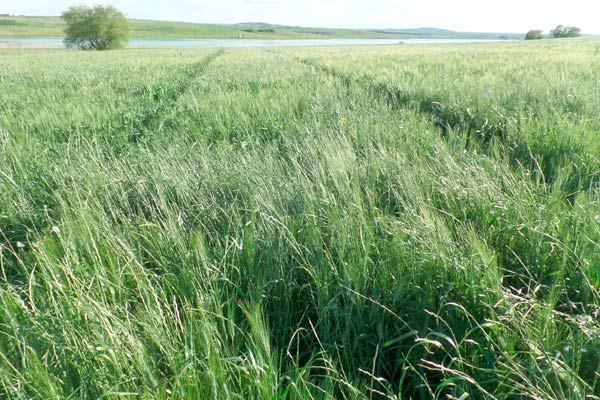
Severe infestation with resistant ryegrass (village of Ovchi kladenets, Yambol region)
In recent years, due to the ploughing up of virgin lands, so-called meadow grasses such as fescue species, brome grasses, perennial pasture ryegrass and others have multiplied massively in certain regions of Southeastern Bulgaria, and they are difficult to control with the herbicides registered in our country.
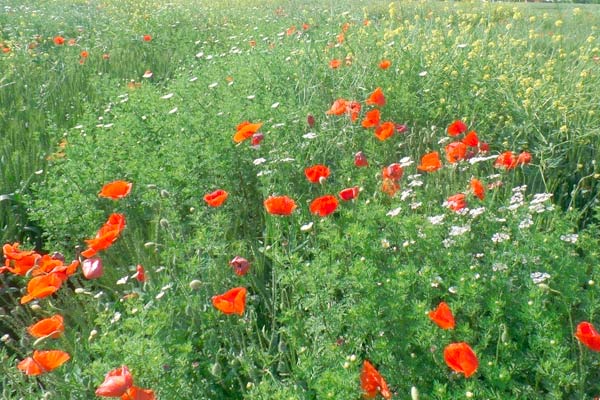
Mixed infestation with corn poppy, field mayweed, charlock mustard, volunteer coriander and Clearfield (Department of Agriculture and Herbology at the Agricultural University – Plovdiv)
An increasingly serious problem in field crop rotations is the infestation of cereal crops with volunteers from other crops (Clearfield volunteer oilseed rape, coriander, volunteers from technological sunflower hybrids – Express and Clearfield, etc.).