

![MultipartFile resource [file_data]](/assets/img/articles/onion_thrips_featured.jpg)
![MultipartFile resource [file_data]](/assets/img/articles/suillia-lurida-8d93fba1-86ac-476f-82f3-ecdddbdd9321.jpg)
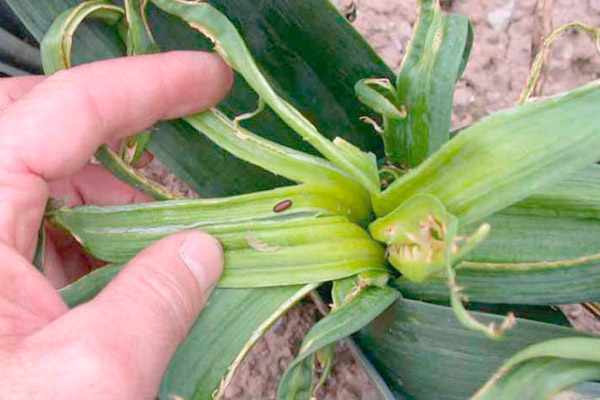
Garlic fly (Suillia lurida Melg.) attacks winter garlic and onions planted from sets in the autumn. It develops one generation per year and overwinters as an adult insect. Its flight in spring begins very early, as early as February–March. The flies lay their eggs singly at the base of the plant stems or on the soil in their vicinity. Damage is caused by the larvae. At first they gnaw a short stripe along the middle leaf, which widens downward. As a result of the damage, the upper part of the leaf wilts and later curls spirally. The larvae continue to destroy the youngest underdeveloped leaves and move towards the bulb, in which they make tunnels. Damaged plants lag in their development, turn yellow and wilt. Weaker plants die, while better developed ones remain with a hollow stem and a soft bulb. When the infested plants are pulled up, they break off. Only one larva develops in a single plant. The development of the larva lasts 28–35 days. Pupation takes place in April–May in the soil at a depth of 10–18 cm near the damaged plants.
Control
To reduce damage from the garlic fly, the areas intended for garlic should not be fertilised with farmyard manure, but only with mineral fertilisers. Garlic should be planted as early as possible in the autumn and high-level agronomic practices should be applied to ensure rapid growth of the plants so that they are able to overcome the damage caused by the fly larvae. Crop rotation, weed control – host plants, and ploughing after harvest contribute to reducing population density. Chemical control is applied against the flies before egg-laying at a density of 5 specimens/10 sweeps with an entomological net. Two to three treatments are carried out at 7-day intervals at the 3–4 leaf stage of the crop (February–March). There are no registered plant protection products against the garlic fly, but some broad-spectrum insecticides from the pyrethroid group can be used, such as Decis 100 EC 7.5–12.5 ml/ha, Meteor 60–70 ml/ha, Lambdex Extra 40–50 g/ha and Vaztak New 100 EC 10 ml/ha. When performing the treatments, an adjuvant must be added. Quarantine periods must be strictly observed.