

![MultipartFile resource [file_data]](/assets/img/articles/Diabrotica_virgifera_side.jpg)
Diabrotica is a widely distributed genus of beetles from the family Chrysomelidae. Members of this genus include some highly invasive species of great economic importance. The origin of the pests described below is North and Central America. Over long distances they are transported through international trade via soil and soil substrates, plants and plant parts.
For EU countries they are quarantine pests and are subject to official control.
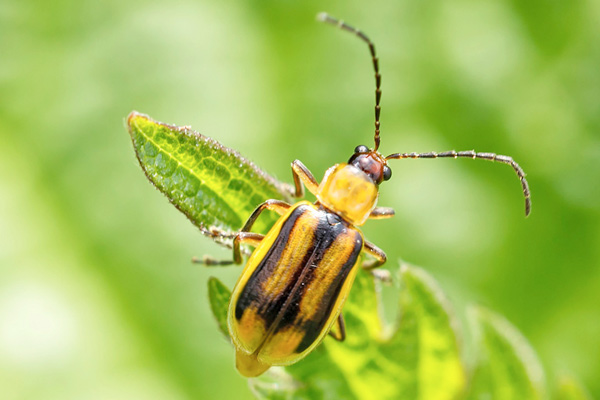
The western corn rootworm Diabrotica virgifera virgifera Leconte is widely distributed in Europe – Austria, Belarus, Bosnia and Herzegovina, Bulgaria, Croatia, the Czech Republic, France, Germany, Greece, Hungary, Italy, Montenegro, Poland, Romania, Russia, Slovakia, Slovenia and Ukraine. It is considered to originate from Central America. During the twentieth century the species was a major pest of maize in North America. Its long-term cultivation in monoculture has led to the expansion of the pest’s range and it has left the borders of the USA through international trade.
The western corn rootworm has accidentally entered Europe several times from North America in the period 1980–2000. The species became invasive and rapidly spread in Central Europe during the 1990s and the beginning of the 2000s. D. virgifera virgifera was detected for the first time in July 1992 in the Surčin area (Serbia), near the international airport in Belgrade.
Once it entered Europe, the pest began to spread rapidly in the Danube region. In Bulgaria it was recorded in 1998 in the north-western and central northern parts of the country. Each year the phytosanitary authorities carried out monitoring of the pest throughout the country by visual inspections and the placing of sticky traps with pheromone and synthetic food attractants.
In 2003 active training of growers started, aimed at familiarising them with the pest, the risks of its population increase and the methods of control; trials were conducted for testing resistant French and Bulgarian maize and sorghum hybrids and varieties.
In 2007 a programme was introduced to contain the further spread of Diabrotica virgifera virgifera, aligned with the programmes of the EU Member States. Despite the efforts, its distribution covers almost all maize production areas in the country. Population build-up of the pest has been established in small areas with maize grown in monoculture in the north-western region.
The economic impact of the occurrence of the pest in our country is relatively low. In 2015, by Decision of the EU, the monitoring was terminated.
Hosts
The main host of Diabrotica virgifera virgifera is maize (Zea mays). Adults are oligophagous – they feed not only on maize, but also on secondary host species – cereal, leguminous and cucurbit crops. The larva is monophagous, feeding only on maize roots, which it gnaws and tunnels.
Biology and morphology
In Bulgaria maize is a crop of great importance in many production regions. The favourable climate facilitates the spread and development of the pest. Beetles appear at the end of June and can be observed until mid-October; they start feeding and mating immediately. Larvae can be found from the beginning of May to the end of August. The pest overwinters in the egg stage in the areas around maize fields. It has one to two generations per year and both adults and larvae cause damage. Adults are yellow in colour with black stripes along the elytra, reaching 0.7 mm in size. The larvae are whitish with a dark head. They can be found in the soil at depths of up to 35 cm, but most often inhabit the layer up to 15 cm deep.
Symptoms
Newly emerged larvae feed mainly on root hairs. Subsequently they bore into the roots and tunnel them towards the base of the plant, which leads to root rot, stunted growth and development of the plants. The larvae can be found near the base of the growing point – a furrow is observed and later the plant lodges. Adult beetles cause damage by feeding mainly on pollen, tassels and young kernels.
Dispersal and control
Although larvae move over relatively short distances, adults fly to maize fields and migrate several kilometres per year. Yellow sticky traps and pheromone traps are successfully used to monitor its spread. The most suitable period for placing them is the beginning of June. Crop rotation is an effective method of control, with a mandatory alternation period of at least three years.
In recent years, the pest has been observed increasingly often in maize in our country, as reported by various growers. Therefore, adequate control of the pest is a guarantee of success in achieving optimal yields.
In Annex II, PART A to Commission Implementing Regulation (EU) 2019/2072 several species of the genus Diabrotica are included.
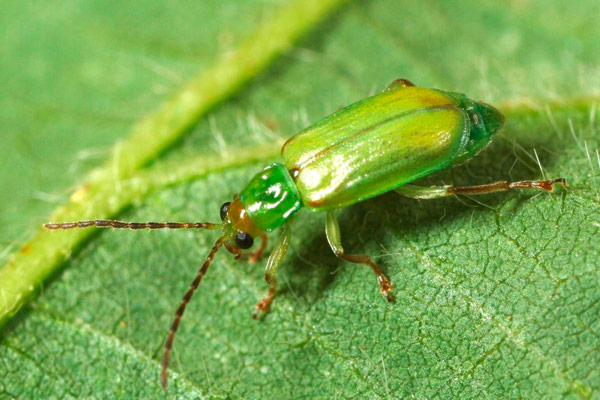
Diabrotica barberi Smith & Lawrence [DIABLO]
Geographical distribution
It originates from and is distributed only in North and Central America;
Hosts
Larvae of the northern corn rootworm have a limited number of hosts and develop only on plants of the family Gramineae. Maize (Zea mays) is the only crop regularly attacked by the larvae, which feed on its roots. To a lesser extent, millet (Panicum miliaceum), rice (Oryza sativa) and spelt (Triticum spelta) are attacked. Adults rarely feed on kernels and corn silk. They prefer the pollen of plants of the families Gramineae, Compositae, Leguminosae and Cucurbitaceae. List of hosts: Agropyron cristatum, Bouteloua curtipendula, Bouteloua dactyloides, Elymus canadensis, Elymus smithii, Elymus trachycaulus, Eragrostis curvula, Hordeum vulgare, Oryza sativa, Panicum miliaceum, Setaria helvola, Setaria viridis, Sorghastrum nutans, Spartina pectinata, Thinopyrum elongatum, Thinopyrum intermedium, Triticum aestivum, Triticum spelta, Zea mays.
Biology
Diabrotica barberi has one generation per year, overwintering in the egg stage, with part of the eggs capable of remaining in diapause for up to 2 years. On average, one female lays 25–30 eggs in clusters. They hatch in late spring and early summer. The larvae feed on the fine roots and gradually move to the main roots, penetrating them, feeding on their interior and then moving to the stem. Feeding starts shortly after plant emergence and early symptoms are expressed as wilting due to a lack of nutrients. External symptoms, such as gnawing, are observed on inflorescences and fruits. The sites of larval damage are often entry points for pathogen infection and lead to root rot.
Symptoms
Larvae of D. barberi feed on maize roots, which can reduce the plant’s ability to absorb water and nutrients from the soil; the damage leads to lodging and yield loss. High densities of adults further limit yield – they damage the corn silk and impede pollination. In maize-growing areas in the late season, beetles are easily seen on flowering plants near maize fields, where they feed on pollen, but the occurrence of specific symptoms on these other plants is not reported in the literature.
Morphology
Whitish eggs have a typical ovoid shape and are approximately 0.6 mm long. The larva is elongated and cylindrical, tapering towards the head. The body is white, while the head, thoracic and anal plates are yellowish-brown. The three pairs of legs are brownish with a single claw. The body length of adults is 4.8–5.6 mm. The main colour of the head is yellow. The body colour is amber yellow. The elytra are green in colour.
Means of spread
Adults are transported through trade in various plant products – fresh sweet corn (maize cobs) and forage (green maize), for which the pathways are not regulated in several European countries. In the event of the species entering a given region, larval stages have little chance of natural spread. The main means of natural spread of adults is by flight.
Control
Diabrotica spp. is a major problem in maize fields in North America and control of this pest is of essential importance. A widely used method is the application of soil insecticides at sowing in order to reduce larval feeding on roots. Another method is aerial application of insecticides, targeted at adults, to suppress their feeding and egg laying. Yellow sticky and pheromone traps are used to determine the exact time for insecticide treatments by attracting adults and establishing their flight. The most effective solution for suppressing pest populations is crop rotation.
Diabrotica undecimpunctata undecimpunctata Mannerheim [DIABUN] and
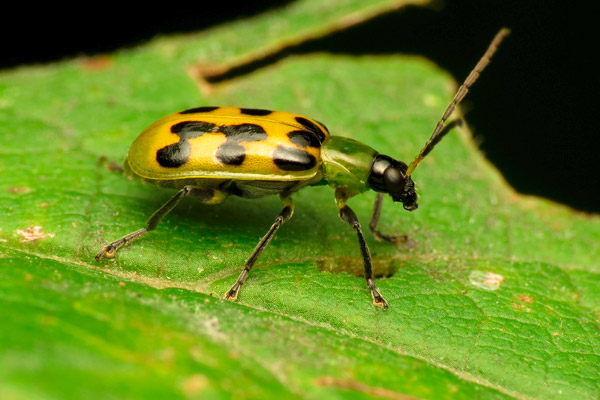
Diabrotica undecimpunctata howardi Barber [DIABUH]
Geographical distribution
Both species originate from North America and are distributed only in North and Central America.
Hosts
D. undecimpunctata howardi is polyphagous. Adults attack many cultivated plants, including the most typical ones from the family Cucurbitaceae – Cucumis sativus, Cucumis melo, Cucurbita pepo, Citrullus vulgaris, but also peanut (Arachis hypogaea), soybean (Glycine max), bean (Phaseolus vulgaris) and other legumes, maize (Zea mays), sweet potato (Ipomoea batata).
D. undecimpunctata undecimpunctata has a more limited host range, with adults feeding mainly on courgettes and larvae on maize roots.
Biology
The two subspecies have very similar biology. They overwinter as adults under plant residues in areas around host crops. Adult flight begins in spring. They feed on the flowers and leaves of many different plants, moving to species of the family Cucurbitaceae as soon as they become available. Females lay 200 to 1200 eggs individually in the soil near the bases of host plants. Soil moisture has a strong influence on the survival of newly laid eggs during the first 24 to 72 hours. Females prefer to lay eggs in moist, organic or clay soils. Larvae hatch after 7–10 days and pass through three developmental stages. In the third stage, larvae leave the host plants, burrow into the soil and enter an inactive or prepupal stage. Adults of the new generation often move from one host to another, starting with maize or peanuts and moving to species of the family Cucurbitaceae in mid-summer and finally to secondary hosts such as chrysanthemum in autumn.
Symptoms
Feeding by adults of D. undecimpunctata undecimpunctata does not cause particularly characteristic symptoms – these are injuries which reduce the market value of plants. Larvae tunnel plant roots, which then turn brown and dry. The plant suffers from nutrient deficiency and may die. Larval feeding increases the likelihood of fusarium root rot.
Both adults and larvae of D. undecimpunctata howardi cause damage; they feed on roots, young plants, flowers and stems and are vectors of the bacterium Pseudomonas lachrymans, which causes bacterial wilt and can survive in their bodies for a long period. Adult beetles cause the most noticeable damage by feeding on flowers, leaves, stems and fruits. Larvae attack young roots near the base of plants and tunnel the stems, which causes growth retardation or death. The pest is also a vector of some viruses such as Squash mosaic virus, Cucumber mosaic virus, Bean mosaic virus, and Maize chlorotic mottle virus.
Morphology
Eggs are usually oval, 0.7 x 0.5 mm, light yellow, with a surface covered with small hexagonal pits. Larvae have a yellowish-white, wrinkled body, 12–19 mm long, with six legs and a greyish-brown head. The pupa is about 6.3 mm long, white-yellow in colour. Beetles are 6–7.5 mm long. In D. u. undecimpunctata the abdomen is greenish-yellow with 11 black spots on the elytra, while in D. u. howardi it is yellow to yellowish-red with 12 large black spots. The head, antennae and legs are entirely black (howardi) or with greenish-yellow spots (undecimpunctata).
Means of spread
Adults are good fliers and move quickly from field to field during summer. They can be transported over long distances by air currents at heights of up to 800 km in 3–4 days. The main risk of spread is through the movement of soil in which infected courgettes, melons or maize have been grown.
Control
In the USA, an integrated management programme for D. undecimpunctata in courgettes, peanuts and beans has been established. It includes various control methods, such as monitoring adult flight by placing traps, destroying weeds around crops, applying soil insecticides, observing a three-year crop rotation and others.
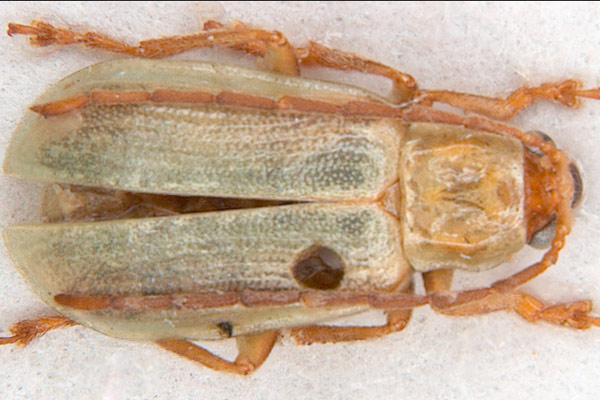
Diabrotica virgifera zeae Krysan & Smith [DIABVZ]
Geographical distribution
Diabrotica virgifera zeae originates from and is distributed in Central America, Mexico and the central southern parts of the USA. In the United States, the distribution of the pest is limited by the low annual rainfall, although artificial irrigation has extended its range westwards into New Mexico. Diabrotica virgifera zeae is not known to be present in the territory of the EU.
Hosts
Larvae of Diabrotica virgifera zeae are oligophagous – they prefer mainly maize roots (Zea mays), but can also feed on other plants of the family Poaceae, such as sorghum (Sorghum spp.) and some grass weeds. Adults are polyphagous – they attack mainly the leaves and silk of maize, but are also found on 63 genera from the families Poaceae, Asteraceae, Fabaceae and Solanaceae.
Biology
Diabrotica virgifera zeae has one generation per year, but in areas with continuous maize cultivation the pest develops two generations. It overwinters as an egg. Females lay eggs in autumn in the soil at a depth of 15–30 cm. Eggs hatch in late spring and young larvae feed on root hairs, while older larvae penetrate the core of the roots and destroy them. Pupation takes place in the soil. Beetles appear in spring but are most active in early summer. Adults feed on maize leaves, silk and pollen.
Morphology
The body length of adults reaches 4.8–5.4 mm. The head is yellow. In males the antennae are filiform and reach the end of the body. The wings are green, and the legs are bicoloured in yellow and black. Larvae are whitish with a dark head, covered with fine hairs. Eggs are oval, yellowish, shiny, up to 0.9 mm in size.
Symptoms
Larval feeding in maize roots causes reduced plant growth. Newly emerged larvae start feeding on fine root hairs. As the larvae grow, they tunnel the primary roots, which often leads to root rot. As a result of severe root damage, the conducting vessels become blocked, plant growth stops and plants lodge. Adult beetles cut the maize silk as if with scissors.
Means of spread
Most often the pest spreads through the movement of soil from maize fields, but also with maize cobs (sweet corn), green maize for fodder (maize stalks, maize leaves, other plant materials, waste, residues and by-products for animal feed). Adults can fly long distances.
Control
Adults are captured using pheromone traps. Control of Diabrotica virgifera zeae is carried out with approved plant protection products. Resistant and tolerant maize hybrids have been developed. It is very important to apply agronomic measures – crop rotation, soil tillage and others.