

![MultipartFile resource [file_data]](/assets/img/articles/devisil.jpg)
Lovage (Levisticum officinale Koch), also known as selim, leoshan, levushtyan, rusalin, is grown in the country as a culinary herb and medicinal plant. As a culinary crop it is widespread in Northern Bulgaria. All parts of the plant are used - leaves, stems, roots, seeds. The fresh leaves and petioles are rich in essential oils, vitamins, mineral salts and other components. For use as a spice, the leaves are dried and stored in paper bags or frozen in polyethylene bags. Frozen leaves retain the specific aroma of lovage for a longer time. The oil is extracted from the roots and the leaves of the plant.
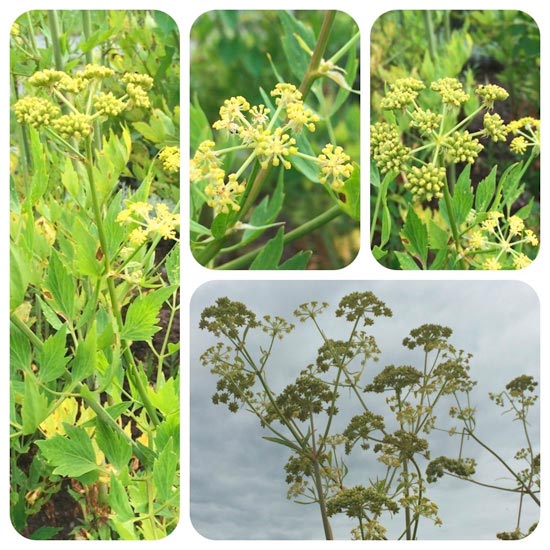
Lovage is a perennial herbaceous plant, which forms a leaf rosette at a height of 50-60 cm up to 1.50 m, with a rhizome 26-30 cm long and 1-2 cm thick. The leaves are large, dark green, glossy and similar to those of celery. In the first year a leaf rosette is formed, and in the second and subsequent years the leaf rosette expands and a flowering stem, flowers and seeds are formed. The weight of 1000 seeds is about 3 g, with 330,000-350,000 seeds contained in 1 kg. Their germination is 83-86% and is preserved for 3-4 years.
No varieties of this crop have been bred. Local populations are grown.
The crop is propagated in two ways: by seeds and vegetatively by dividing the rhizomes.
When using seeds to establish a new plantation, it is advisable to produce seedlings in advance. The crop responds best to cultivation in dense seedling trays with dimensions 51.5/32.5 cm. A suitable substrate is a mixture of peat and perlite in a ratio of 1:1 v/v. For one decare, 1.0-1.5 kg of seed are needed. Sowing of the seeds is carried out at the end of March, in unheated protected structures. The seeds germinate in 6 to 21 days depending on the temperature and moisture of the substrate. The plants require an optimal temperature of 18oC and substrate moisture at 80% of field capacity. They are ready for transplanting in the field at the beginning of June. The seedlings are about 14 cm high and have 3-4 true leaves.
The division of rhizomes is carried out at the beginning of vegetation in spring. The rhizome is lifted with a spade and divided into several parts which should have preserved growing points and small roots. The plants are used for filling gaps in the stand. A hole is dug, where the divided part of the rhizome is placed and the soil is well firmed. It is essential to provide irrigation for successful establishment.
Cultivation schemes
Suitable schemes for field cultivation of lovage on large areas are in rows, with spacing between rows of 80 cm and 30 cm between plants in the row (80/30 cm), or in two strips on a flat surface, with a distance of 120 cm, spacing between the two strips of 60 cm, and 50 cm between plants in the row (120+60/50 cm). In small areas or in the garden it is planted in a single row, with distances between plants in the row of 30-40 cm.
Lovage is not demanding with regard to soil, but prefers sandy-clay soils with a sunny exposure. It does not like shady places.
Crop management during vegetation
To obtain high yields of leaf mass, regular hoeing of the soil, removal of weeds, fertilization and irrigation of the plants are necessary.
Fertilization
In the first year after establishment of the plantation, it is advisable to top-dress the plants three times at 15-day intervals from mid-June to mid-July with mineral fertilizers (N:P:K), according to the following scheme: soil application I - 5:5:10; II - 5:5:10; III - 5:0:10; foliar – Kristalon 18:18:18, and at the end of vegetation, before winter, to apply Lumbrical (organic fertilizer, vermicompost) at a rate of 500 l/da. In the second year, good results for fertilizing the crop are obtained by using mineral fertilizers: Ammonium nitrate – 30 kg/da, Triple superphosphate – 40 kg/da, Potassium nitrate 25 kg/da and Lumbrical – 500 l/da. For fertilizing the crop in the third year, the use of the same fertilizers is recommended: Ammonium nitrate – 30 kg/da, Triple superphosphate – 80 kg/da, Potassium nitrate 50 kg/da, Lumbrical – 500 l/da.
Irrigation
The most appropriate method is to irrigate the plants by drip system, with a recommended irrigation rate of 30-40 m3/da.
During vegetation, it is necessary to periodically remove the yellowed leaves and flower stalks. The flower stalks are formed in the second year. They should be left when the plants are grown for seed production. The plants bloom in June - July, and the seeds ripen in July - August. The seed yield from a seed production stand is 30-40 kg/da.
Vegetation of the plants starts early in spring and ends at the end of October. Before vegetation, with the first hoeing of the plants for loosening the soil, nitrogen fertilizer is applied. At the beginning of November hoeing is carried out with application of potassium, phosphorus and organic fertilizers, thereby preparing the plants for overwintering. During winter the aboveground part dries up. In spring, when new leaves appear, the dried parts are removed.
Harvests and productivity of a single plant
In the first year after establishment of the lovage plantation, four harvests of leaf mass at commercial maturity are carried out. Harvesting of the leaves begins three months after transplanting the plants. The second harvest should be done one month after the first. In the first year after establishment of the plantation, one plant forms about 70 leaves at commercial maturity, with a mass of 0.80 kg. Vegetation in the second and third year starts from the beginning or middle of March, and the beginning of harvesting is from two weeks to one month later, depending on climatic conditions. In the second and third year, six to seven harvests are carried out. One plant forms about 122 leaves at commercial maturity, with a mass of 1.52 kg. Harvesting of the leaves is carried out at 15-20 day intervals, when the leaf petioles reach a length of 20-30 cm, and they are tied in bunches like parsley. With good crop management in lovage cultivation, 3-4 tons of fresh aboveground mass per decare are obtained, but higher yields can be achieved if the recommended fertilization schemes with appropriate fertilizers are followed.
Lovage has an intense, specific strong and distinctive aroma and is a suitable seasoning for many dishes. The plant has been used in folk medicine and for the preparation of love elixirs. Travellers in the Middle Ages had a more practical application for it. They filled their shoes with the leaves to mask unpleasant odours, and a decoction made from the rhizomes and leaves served as an effective body deodorant. The plant was probably more useful as a fragrance, given how rarely people bathed at that time. In medicine, lovage is widely used. An infusion from the roots of the plant has a tonic effect on the gastrointestinal tract, stimulates bile activity, reduces gas formation, eliminates stomach colic, and improves appetite. The plant exerts a positive tonic effect on the body, stimulating the functions of the nervous and cardiovascular systems. It is used in the treatment of chronic gastritis, colitis, biliary and renal colic, mild hypertension and for detoxification of the body.