

![MultipartFile resource [file_data]](/assets/img/articles/срамежлива-мимоза.jpg)
![MultipartFile resource [file_data]](/assets/img/articles/мимоза.jpg)
The sensitive mimosa (Mimosa pudica) is a plant of the genus Mimosa, family Fabaceae. Its country of origin is Brazil, but it has become naturalized in almost the entire world. In its natural environment in the subtropical forests of South America it reaches over 1 meter in height, but when grown in a pot it does not exceed 40 cm.

family Fabaceae
In Europe it is grown in pots, but is also often found as a shrub in gardens. It has characteristic fine, deeply cut leaves, thorny stems and its flowers resemble small coloured balls. The plant is known for its great sensitivity even to the lightest touch. The tiny leaves of the mimosa fold even at a gust of wind. This defensive reaction of the plant protects it from adverse weather conditions and from representatives of the animal kingdom that are herbivores. In addition to its reaction to physical stimuli, the leaves also droop in response to darkness and open again in daylight.
Under indoor conditions it is relatively easy to grow. It requires high air humidity and an optimal temperature between 16 and 24 °C; in winter it is advisable to bring it into a warm place, as it hardly tolerates temperatures below 10 °C. It is watered abundantly in summer and significantly less often in winter.
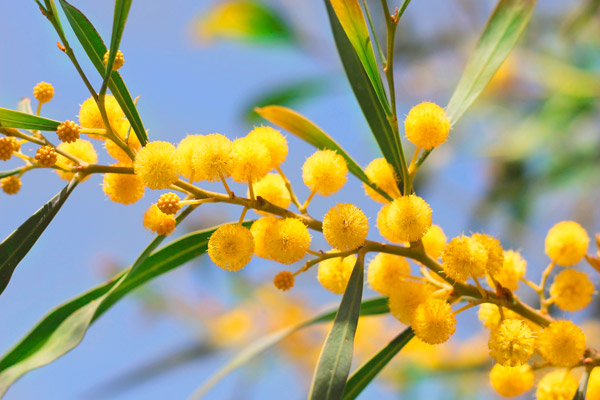
If you have travelled around the Mediterranean in March, you have surely noticed the beautiful small trees completely covered in yellow. This Acacia cannot be confused with any other tree. Its intense yellow colour makes it stand out from a great distance and attracts the eye.
The yellow mimosa (Acacia dealbata), or silver wattle, is a beautiful tree which also belongs to the family Fabaceae. Although a tree, it can develop excellently in a container under our climatic conditions.
Plants grown from seed have varying qualities and it is necessary for two to three years to pass for them to form and reveal their true beauty. The colour of the leaves varies from blue-green to silvery-grey. The leaves are bipinnate and the individual leaflets are very tiny, which gives the plant a particular elegance and an exotic silhouette. The flowers are bright yellow, gathered in large inflorescences.
Acacia has been awarded the Royal Horticultural Society’s Award of Garden Merit (RHS AGM).
In some countries its flowers are used in cut-flower arrangements and florists there call it mimosa. The fragrance extracted from the flowers is used in the perfumery industry.
It is interesting that in Italy the plant has gained great popularity and on International Women’s Day it is customary to give sprigs of mimosa as a gift. Initially chosen as a flower accessible to everyone for this holiday, because in the southern country in March there are many fields of flowering mimosa, over the years the extraordinary beauty of the plant has turned it into a symbol of women.
Happy holiday to all ladies!