

![MultipartFile resource [file_data]](/assets/img/articles/drone.jpg)
To address this challenge, a team of scientists from the Institute of Plant Genetic Resources (IPGR), Sadovo, and the Department of Computer Systems at Plovdiv University was formed. The leader of the task “Application of Smart Farming in Wheat Production“ under a project of the Agricultural Academy is Prof. Dr. Stanimir Stoyanov, who has nearly 30 years of experience in the field of information technologies. He graduated in Informatics and obtained his PhD at Humboldt University, Berlin.
In Bulgaria, up to now no scientific research has been carried out and no scientific publications have been identified regarding the application of smart farming. There are several companies that offer and apply precision agriculture, which is the first stage of the smart farming system. The Fourth Industrial Revolution, becoming an increasingly tangible reality, reveals previously unthinkable opportunities for improving people’s lives through the use of integrated technologies based on the achievements of artificial intelligence, the Internet of Things, and the integration of the physical and virtual worlds. We live in a constantly changing world, increasingly populated by autonomous entities such as unmanned aerial vehicles, robots and remotely controlled machines, where virtual environments and physical spaces are becoming ever more closely integrated. Modern integrated technologies are entering agriculture with growing intensity, offering solutions for the so‑called „smart farming“. Smart farming is an extremely broad field in which a wide range of tasks can be addressed. Despite the enormous scope, the tasks can be summarized into three major classes: Optimal use and saving of water resources; Protection of and minimal burden on the environment with harmful substances; Prevention and early detection of weeds in common winter wheat. During the first stage of the study, data will be collected and stored in the cloud from the ground sensor network; image material will be collected and stored in the cloud from a drone; an approach, model and software implementation of an analytical module for prevention and early detection of weeds will be developed; the correctness of the model will be verified through an experiment prepared under real conditions.
The smart farming system consists of four components Operative Center (Operative Center). The Operative Center supports system operators in the management, control and coordination of all stages of agricultural work. Each operator has a personal assistant who supports his or her work in the center, where the operators can prepare operative action plans depending on the specific conditions. By establishing the Operative Center, we demonstrate a new way of interacting with machines that will make our communication with them more efficient, easier and more seamless. At the same time, the communication must be sufficiently accessible, intuitive and easy to use by any person, depending on his or her qualifications and role in the smart farming system. For this purpose, we are building a user interface that will assist and guide users in real time and, if possible, in a sufficiently understandable way regarding the current state of the system and what needs to be done. The Operative Center works in close cooperation with the Local Data Center.
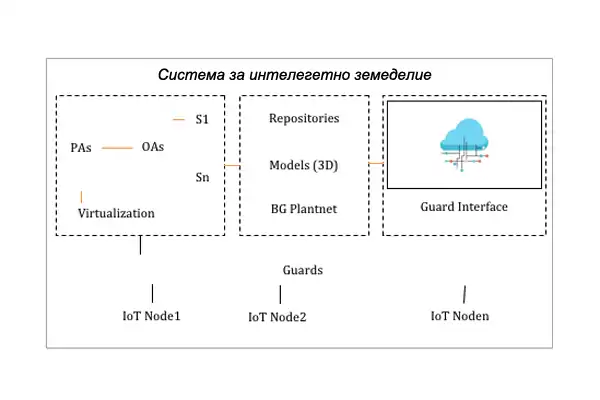
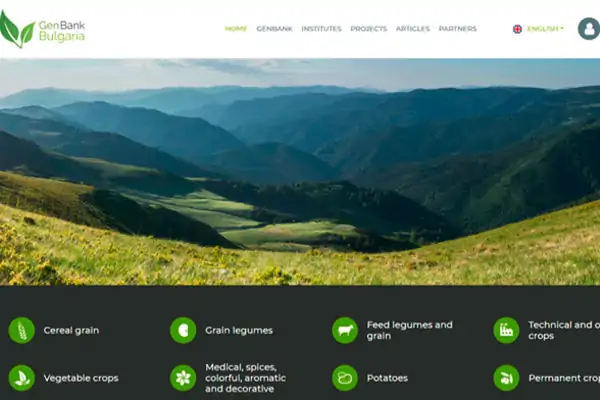
Local Center (Local Data Center). It is intended for the reception, storage and processing of large volumes of structured, semi‑structured and unstructured data, received from the stationary sensor network, drones and, in the future, specialized robotic devices. In addition, the repositories in the Local Center contain data specialized for agricultural crops and activities. The construction of 3D models of the physical world is envisaged. The information system of the National Gene Bank, developed within the framework of the BG PlantNet project, is integrated in the Local Center. The project is partially funded by the national Research Fund.
Global Center (Global Data Center). The Global Center provides the communication infrastructure of the overall system and the cloud infrastructure for storage and processing of big data. The data in the center, supplied by the Local Center, provide models for global analyses and statistics. This component is being developed within the framework of the project „Center of Excellence“ of the Faculty of Mathematics and Informatics at Plovdiv University „Paisii Hilendarski“ (BG05M2OP001-1.001-0003).
Guards (Guards). The purpose of the system of Guards is to ensure integration between the virtual and physical worlds. The core of this component includes devices for receiving sensor information from the physical world (open agricultural fields, greenhouses), transforming and transferring this information to the virtual world, where operative decisions are made. The Guards include the stationary sensor network and drones. In the future, the Guards will be expanded with specialized agricultural robots.
During the one‑year joint work with Plovdiv University, the step‑by‑step development of the presented infrastructure began at IPGR.