

![MultipartFile resource [file_data]](/assets/img/articles/Svalbard-global-seed-vault-00-1000x562.jpg)
Spitsbergen, or Svalbard, as it is called in Norway, is the Arctic archipelago consisting of three large and numerous small islands. Most expeditions to the North Pole start from here. Although it is part of Norway, the archipelago has a special international status that allows a number of countries to carry out economic activities there.
The largest tourist town in the archipelago is the Norwegian Longyearbyen, and the second is the Russian village of Barentsburg. The average monthly temperature ranges from +4.4 degrees in July to -20.7 degrees in February. Most of the territory is covered by glaciers, which in recent years have been actively melting due to global warming.
All sights in Longyearbyen are designated as the northernmost. Here is also located the Global Seed Vault – an enormous collection of seeds, established by Norway under the auspices of the UN in 2006.
For euphony it is called the new "Noah's Ark". The strategic objective is to prevent the destruction of plant diversity in the event of a global planetary catastrophe, such as nuclear war, an asteroid impact, drastic changes in the climatic and phytosanitary environment. In a facility located at a depth of 120 m, protected by armoured doors, about 4.5 million accessions are stored, with a special area allocated for each country. Spitsbergen was not chosen by chance – due to the cold weather here, the accessions will not be damaged even in the event of a failure of the refrigeration units.
What is Bulgaria's participation in this large-scale project?
We quote the opinion of Assoc. Prof. Dr. Gergana Desheva, Head of the National Genebank at the Institute of Plant Genetic Resources in Sadovo:
"The conservation of plant diversity is a complex interdisciplinary process, which is the subject of various national and international initiatives. The European Community is joining efforts in this direction by organizing the European Cooperative Programme for Plant Genetic Resources (ECPGR). One of the priorities of the programme is the introduction of harmonized mechanisms for conservation, evaluation and documentation of accessions. The Institute of Plant Genetic Resources (IPGR) in Sadovo is the National Coordinator for the conservation of the diversity of crop plants and their wild relatives within the framework of ECPGR. The national ex situ collection in the genebank at IPGR is part of the European electronic catalogue for plant genetic resources EURISCO (http://eurisco.ecpgr.org/). The database (BGR National Inventory) includes passport data for 69,435 accessions, described according to the FAO/Bioversity descriptor (2017). Since 2009 the Bulgarian collection has been part of the European integrated genebank system – AEGIS (http://aegis.cgiar.org). A condition for the inclusion of plant genetic resources in the AEGIS database is the safety duplication of the accessions in the Global Seed Vault. In 2014 IPGR sent the first 933 accessions of typical Bulgarian varieties and local populations for conservation in Svalbard under a signed agreement with the Ministry of Agriculture and Food of Norway. The national collection includes accessions of cereal, grain legume and vegetable crops. Bulgaria ranked among the first European countries (after Germany, Norway, Ireland and the Czech Republic) to deposit original plant accessions for future generations in the new "Noah's Ark". The intention of our institute is to enrich the collection, bearing in mind the fact that the genebank in Sadovo maintains one of the richest collections in Europe, but unfortunately we are constrained by the lack of targeted funding for the regeneration of accessions and the coverage of high transport costs."
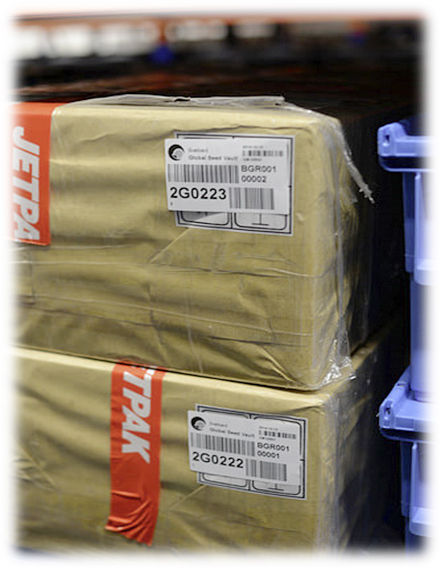
The consignment with Bulgarian plant genetic resource accessions submitted for responsible safekeeping in the Global Seed Vault in Svalbard, Norway