

Smuts are among the most widespread and harmful diseases of cereal crops. They attack various organs of the host plants, including vegetative and flower buds, leaves, stems, petals, sepals, stamens, pistil, fruits, seeds. They less frequently attack the roots. The affected organs look charred and covered with soot, from which the name of the disease – smut – is derived. The formed sooty mass consists of teliospores (chlamydospores). Smuts are highly specialized parasites – the different species attack a strictly defined plant species. If the seeds are not treated with fungicides, losses can range from 5 to 40%.
The main representatives of smuts in wheat are common bunt (common, stinking) of wheat – Tilletia caries Kuehn (syn. Tilletia tritici (Bjerk)Wint ) and Tilletia levis Kuehn (syn. Tilletia foetida(Wallr.) Liro) and loose smut – Ustilago tritici (Pers) Jens.
The typical symptoms of common bunt of wheat (Tilletia caries Kuehn/ Tilletia levis Kuehn) are best expressed after heading and even more clearly visible during grain filling and milk ripeness. Initially the ears of diseased plants are darker and dark green. After grain filling the ears appear thicker and with more widely opened glumes, the awns are more spread out, and the number of kernels in each spikelet is higher than in healthy plants. The kernels are somewhat smaller, rounded, without the characteristic longitudinal groove on one side. The seed coat is preserved. At first it is greenish, and later becomes green-brown to grey-brown. At maturity the seed coat becomes brittle and easily cracks. The kernels transformed into sori burst under pressure and release a black powdery mass of chlamydospores, greasy to the touch, with an unpleasant smell of rotten fish due to the substance contained in them – trimethylamine. These are the spores of the fungal pathogens causing the disease, which during harvest become dispersed as dust and adhere to the surface of healthy kernels or fall into the soil, from where, later, upon seed germination they infect the young seedlings.
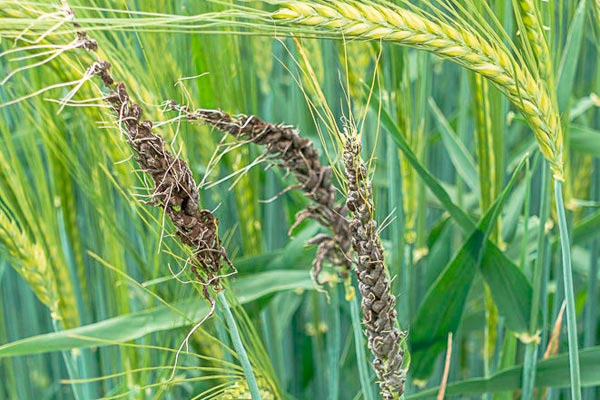
In the case of loose smut of wheat (Ustilago tritici(Pers) Jens) after heading, instead of a normal ear, from the sheath of the uppermost leaf an ear appears that is completely destroyed and transformed into a black powdery mass, covered with a thin, transparent membrane, which soon tears and disappears. Only the rachis remains intact. After 3–4 days the chlamydospores are blown away by the wind, and only the bare bases of the ears and the rachis remain protruding on the plants. The pathogen is preserved as mycelium inside the kernel (in the embryo), infected during flowering. During vegetation the infection from teliospores spreads from diseased to healthy plants by air.
In barley, brown loose smut of barley – Ustilago nuda (Jensen) Rostrup in certain years causes severe damage. Until heading, smutted plants do not differ in any way from healthy ones. At heading, from the sheath of the last leaf an ear appears, completely transformed into a black smutted mass. The ear is covered with a thin transparent membrane, which after drying tears and releases the teliospores of the pathogen. Mass infections occur during flowering. After the spores are dispersed, only the rachis of the ear remains protruding. The smutted mass consists of numerous small, spherical or elongated teliospores of the fungus, with spines on the outer wall. Infection of plants with the pathogen takes place during flowering, when the dusty spore mass lands on the ovary (pistil) and germinates, forming a mycelium that becomes localized inside the kernel. The infected kernel does not differ from a healthy one. The mycelium retains its viability in the kernel for more than 11 years. When infected seed is sown, the mycelium is activated simultaneously with its germination, grows and reaches the vegetative apex. Thus it overwinters, and in spring develops diffusely along the stem. When the ear is formed, the mycelium completely encompasses it, grows intensively and totally destroys it, leaving undamaged only the ear rachis and sometimes a small part of the awns. It has been established that infection with loose smut is often associated with open flowering of the plants in the preceding year.
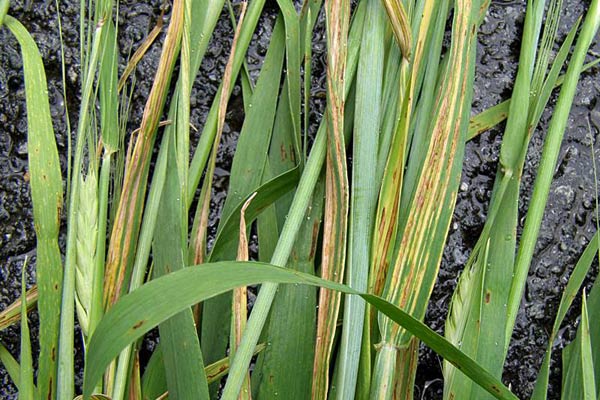
Stripe disease of barley (Drechslera graminea Ito (syn. Helminthosporium gramineum Rabenh.) is widespread and highly harmful. It occurs everywhere this crop is grown and causes premature death of diseased plants and complete destruction of their productivity. The first manifestations of stripe disease are observed on individual plants already at emergence in the autumn, but the symptoms are most evident at the beginning of stem elongation. Long chlorotic, and later brown spots (lines) appear on the leaves, located between the veins. They dry out and crack into strips. In humid weather the diseased tissues are covered with a sooty sporulating layer. The affected plants do not form ears, and those that do usually do not form seeds, or their seeds are weak and shrivelled. The infection is transmitted on the surface or inside the seed as a spore or mycelium. When an infected seed germinates, the mycelium also develops and reaches the coleoptile, from where it successively passes into the vegetative apex, which may die.
In humid weather, brown tufts of conidiophores with spores are formed. During flowering the spores are spread by wind and, landing on the flowers, germinate and from each cell an infective hypha is formed, which develops into mycelium. The mycelium penetrates under the glumes to the seed coat and disintegrates into gemmae. The gemmae are resistant to unfavourable conditions and retain viability for up to 5 years. Ascospores, which are formed in perithecia on plant residues and cause local infections, are also a source of infection. Stripe disease develops only on barley (in wild and cultivated forms). Several physiological races have been identified. Barley varieties differ in their resistance to this disease. Stands showing stripe disease are not suitable for seed production purposes.
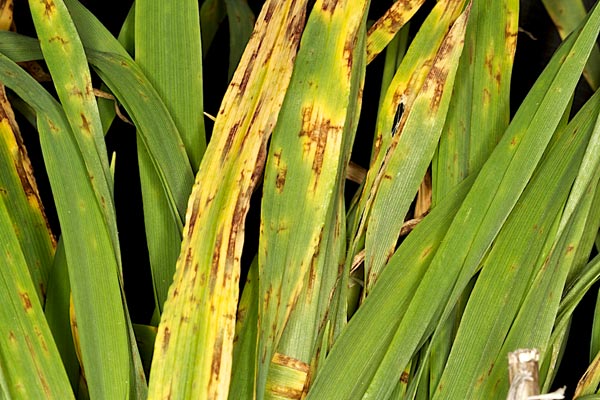
In recent years, the occurrence of net blotch (Pyrenophora teres (Sacc.) has been more widely observed in a number of regions of the country. The typical symptoms are necrotic spots of various size and shape, most often net-like. They may be observed as early as autumn on the lowest leaves, but most severely – after heading. A dark grey coating is formed on the lesions. No merging of the spots and no cracking of the leaves is observed. The fungus P. teres exists in two forms: P. teres f. teres, causing the typical net-like spots, and P. teres f. maculate, causing round spots – the spot type form. Spot type symptoms are characterized by dark brown rounded to elliptical spots, bordered by a chlorotic halo. In addition to the leaves, the fungus also attacks the leaf sheaths, stems and the ear of the plants. Conidiophores usually emerge singly or in groups of 2–3 from the stomata or from intercellular epidermal cells. They are thickened at the base, almost colourless at first, then turning brown. The conidia are cylindrical, colourless to slightly pigmented, with 1–14 septa. The pathogen is preserved as mycelium in the seeds and on plant residues, which cause infections in the following year. The development of the disease is of a local character.
In a number of regions, serious problems in monoculture cultivation of wheat and barley are caused by root and basal rots of cereals. Their causal agents are widely distributed fungi occurring on the surface and inside the seeds, in the soil and on plant residues. They are caused by a complex of soil-borne pathogens that lead to death and destruction of the root and crown part of the plants and cause damage to the conducting system. As a result, suppressed plant growth, yellowing and drying of leaves, bleaching of stems, whiteheads, delayed heading, shrivelling of grains and empty ears, and loss of productive stems are observed. Infection with root rots accumulates in the soil, especially under continuous cereal cropping, on plant residues. Transmission of infection by seeds is also possible.
Fusarium root rot (Fusarium sp.) occurs on all cereal plants. Under favourable conditions it causes significant losses in the quantity and quality of production. The fungus is preserved in the form of mycelium, chlamydospores, sclerotia on plant residues, in the soil, on the surface and inside the seeds.
The causal agent attacks the roots, the tillering node and the bases of the stems. The infected plant parts turn brown, become destroyed, with the formation of a dry rot. In humid weather, mycelium and sporulation of the fungus are formed, and a pink coating or light red discolouration of the tissues may be observed. The disease causes death of seedlings, reduction of total and productive tillering. Fusarium root rot is caused by fungi of the genus Fusarium: F. culmorum (W.G.Sm.), F. avenaceum (Er) Sacc., F. gramineum Schw., F. gibbosum App., F. sambucinum Fuck, etc. The conidia of fungi of the genus Fusarium are sickle-shaped or fusiform-sickle-shaped, with septa. In some species of this genus microconidia are found – one-celled or with a single septum, with an oval, elliptical or ovoid shape.
Take-all (black root rot) – Gaeumannomyces graminis (syn. Ophiobolus graminis (Saccardo) primarily attacks wheat, but also occurs on barley, rye and oats. It has been established in many places in our country in stands grown in monoculture, on light soils and under low agricultural technology. Some grass cereals are also hosts. In Gaeumannomyces graminis two forms have been identified: f. sp. graminis, which occurs on wheat, barley and the genera Bromus, Agropyron, and f. sp. avenae on oats, Agrostis gigantea, rice, rye and various grass cereals. During vegetation the ascospores are spread by air and by rain splash. In the soil this pathogen often spreads in the form of mycelium at different depths. The fungus is preserved as mycelium, sclerotia, chlamydospores. The symptoms of the disease appear throughout the vegetation period. Infected plants develop more weakly, their leaves turn yellow and dry. The attacked plants continue to grow, but have reduced vigour. They form smaller and more erect ears, which dry prematurely, whiten and remain empty or form shrivelled grains. Take-all most often occurs in patches, where it affects all plants. Their roots and the lowest 1–2 internodes are blackened and covered with a dark coating of the fungal mycelium, on which numerous black pseudothecia are formed. The causal agent of take-all of cereals overwinters in plant residues and in the soil as pseudothecia, chlamydospores, mycelium and conidia. The fungus Trichoderma viride parasitizes on the pathogen.
Basal rot and eyespot of cereals – Pseudocercosporella herpotrichoides is a disease that occurs in more northern regions with humid and cool climate. Symptoms may be detected as early as the earliest stages of cereal crop development. The symptoms appear as blackening of the roots and the coleoptile. The yellow-brown spots that appear on the coleoptile enlarge towards the root and cause the death of individual plants and tillers.
The symptoms typical of the disease are observed on the stems and leaf sheaths after heading, in the form of elliptical spots with a dark brown periphery, most often on the 1st–2nd internode. In the central part of the spots a dark coating develops, resembling a “bird’s eye”. Beneath the spots the cavity of the stem is filled with a grey coating, which gradually darkens. Small black microsclerotia are formed on the spots. Diseased plants turn yellow, their grains remain poorly filled, smaller and lighter. The spotted tissues at the base of the stems soften, lose mechanical strength and this causes lodging of the plant.
The causal agent of this disease overwinters on plant residues in the soil. It is spread by conidia, by air and splashing water.
Helminthosporium root rot – Cochliobolus sativus, Kuribayashi (Drechslera sorokiniana; Drechslera bondarcevi, Dr. tetramera, Dr. biseptata, Dr. lunata). The most widespread in our country is Drechslera sorokiniana. The disease occurs on wheat, barley, rye, oats, perennial grass species and weeds – smooth brome, millet, meadow timothy. The causal agent is preserved in the soil on infected plant residues, on the surface and inside the seeds.
It spreads during vegetation by air and splashing water. The development of the disease is of a local character. The disease appears already during seed germination and seedling emergence. On the young seedlings brown spots are observed, which expand rapidly. The attacked sprouts often have a single root instead of three. In adult plants, rotting, darkening and blackening of primary and secondary roots, the tillering node and the lower parts of the stems are observed, as a result of which the plants lag in development, the stems become pale, do not form ears or form small, often empty ears, which dry before ripening. Sometimes grains are formed, but they are small, shrivelled and light. The causal agent is one of the reasons for “black embryo” in seeds.
In a cool and humid autumn in cereal stands, leaf blotch (Rhynchosporium graminicola Heinsen (syn. Rhynchosporium secalis) Rhynchosporium graminicola Heinsen (syn. Rhynchosporium secalis), powdery mildew (Erysiphe graminis De Candolle), septorioses (Septoria sp.), as well as leaf rusts may appear.
The spread and harmfulness of diseases are not the same in the different regions where cereal crops are grown. Plant protection depends on the time of occurrence and the degree of disease infestation. Both premature and delayed plant protection measures are undesirable. Proper combination and application of different methods leads to success in controlling diseases and reducing the damage they cause. The quantity and quality of the yield from cereal crops depend on timely diagnosis, the degree of infestation and the implementation of various measures for their limitation and reduction of losses. Carrying out observations of the stands, in accordance with the varietal characteristics of the crops, leads to a reduced risk of diseases. For a correct assessment of the phytopathological status of the stands, it is necessary to know the distribution and degree of infestation.
Distribution is recorded for all diseases of cereal crops and is established by the number of affected plants (organs) per unit area.
Degree of infestation characterizes the intensity of infestation and is directly related to the damage caused. It is determined by the percentage coverage of the plant organs with sori, coatings, spots.
Records of occurrence and degree of infestation by diseases are made visually, through route surveys of the fields, along a diagonal, 3–4 times during vegetation. The degree of infestation is recorded as a percentage, according to scales for the respective causal agents. Chemical protection is carried out with plant protection products registered for the respective diseases.
Proper combination and application of different methods ensure reliable protection in the control of diseases of cereal crops and reduction of the damage they cause.
Control of seed-borne diseases is a mandatory element of the technology for growing cereal crops. It is important to note that it is impossible to determine from the external appearance of the seeds whether they are infected with seed-borne pathogens. The most reliable means of detecting pathogen infection in seeds is phytopathological analysis.
Seeds for seed-production stands must be treated with fungicides regardless of the result. It is necessary to provide and use for sowing non-infected seeds through strict control of seed production fields. The application of proper cultivation practices creates the most favourable conditions for the development of cultivated plants and less favourable conditions for the causal agents of smuts; seed treatment before sowing with systemic fungicides.
Most measures for controlling rusts are of a preventive nature, with the aim of creating more favourable conditions for plant development and eliminating the preconditions for rust infection.
Agrotechnical measures for limiting the occurrence of diseases include: cultivation of resistant varieties; ploughing under plant residues at greater depth; inclusion of cereal crops in crop rotations with row or legume crops; use of healthy, high-quality seed; balanced mineral fertilization; sowing at optimal dates; compliance with seeding rates and prevention of stand thickening; weed control as sources of infection; timely harvesting of the crop, without allowing losses and grain spillage, in order to limit the amount of volunteers and plant residues.