

Temperatures in September decrease and usually the maximum values do not exceed 25℃, although in recent years summer temperatures have been observed throughout the month. The foliage of the trees continues to photosynthesize actively and ensures the nutrition of the fruits (in autumn and winter cultivars), the differentiation of the fruit buds and the accumulation of reserve nutrients. During this month, for most fruit species, treatments are not necessary.
In apple orchards, spraying is carried out against late infections of scab and the causal agents of fruit rots during ripening and storage caused by fungi of the genera Monilinia, Penicillium, Botritis, Alternaria, Botryosphaeria, etc. and against the second generation of codling moth.
For control of fungal diseases, the most effective fungicides are Luna Experience – 20 – 75 ml/da, Chorus 50WG – 30-50 g/da, Scab 80WG Capetan – 188 g/da, Score 250 EC – 15-20 ml/da.
For control of the codling moth, the following approved insecticides are included in the list: Avant 150 EC – 33.3 ml/da, Affirm 095 SG – 300 g/da plus 0.02% adjuvant Break-Thru, Aficar 100 EC – 30 ml/da, Affirm Opti – 200 g/da, Voliam Targo 063 SC – 75 ml/da, Delegate 250 WG – 30 g/da, Deka EC – 30 ml/da, Dukat 25 EC – 30 ml/da, EfcyMetrin 10 EC – 30 ml/da, Imidan 50 WP – 150 g/da, Calypso 480 SC – 20-25 ml/da, Coragen 20 SC – 16-30 ml/da, Meteor – 0.06%, Proteus O-TEC – 0.05-0.06%, Sineis 480 SC – 30-43.7 ml/da, Sumi Alpha 5 EC – 0.02%, Harpun – 100 ml/da, Cyclone 10 EC – 30 ml/da. Apple cultivars whose fruits will be harvested in the second half of September should be sprayed with insecticides with a short pre-harvest interval.
In late-ripening pear cultivars control against fruit moths (codling, oriental and pear moths) and the causal agents of fruit rots must be continued. The insecticides and fungicides indicated for apple are used.
In case of high infestation density of the common pear psylla (4-6% shoots with colonies), pear orchards are sprayed with one of the insecticides: Bermectin – 37.5 – 120 ml/da, Vaztak New 100 EC – 20 ml/da, Valmec – 37.5 – 120 ml/da, Deka EC – 75 ml/da, Delegate 250 WG – 30 g/da, Laota – 37.5-120 ml/da, Meteor – 90 ml/da, Movento 100 SC – 0.12 - 0.15%, Naturalis – 100-200 ml/da, Sineis 480 SC – 30-43.7 ml/da, Sumi Alpha – 0.03%, Harpun – 100 ml/da.
In pear orchards where regular pest control has not been carried out, the pear bud weevil usually multiplies and its density often exceeds the economic threshold of harmfulness – 5-8 specimens per tree, which necessitates spraying against the adults before egg laying with one of the insecticides: Deka EC (Desha EC, Dena EC) – 30-50 ml/da, Meteor – 90 ml/da.
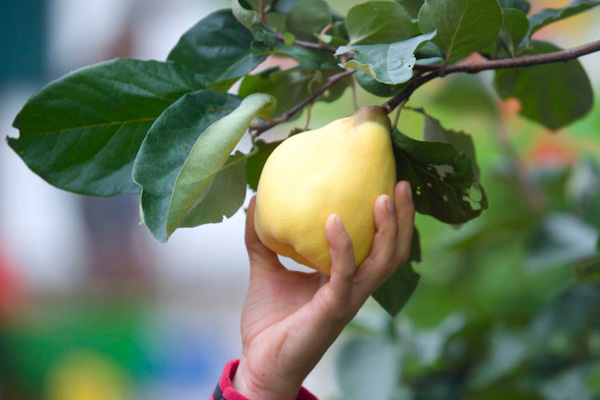
The fruits of the quince cultivars grown in our country are highly susceptible to late brown rot, grey rot and soft rot, which are particularly harmful in periods of frequent rainfall during fruit ripening and later during storage. This necessitates spraying with one of the fungicides: Luna Experience – 20 – 75 ml/da, Chorus 50 WG – 30-50 g/da, Scab 80 WG Capetan – 188 g/da, Score 250 EC – 15-20 ml/da.
To protect the fruits from infestation by codling moth and oriental fruit moth, one of the insecticides indicated for control of the codling moth is added to the fungicide solution.
The adopted economic thresholds of harmfulness for the individual pests are as follows:
Codling moth – 0.8 – 1% fresh entries;
Pear psylla – 4-6% shoots with colonies;
In organic production the use of synthetic pesticides is not permitted. For control of fungal diseases, copper-based and sulphur-based fungicides are used. For pest control, the following bioinsecticides are approved:
Madex Twin and Madex Top against codling moth and oriental fruit moth.
Naturalis against common pear psylla.
Sineis against codling moth and pear psylla.
Pheromones (attractants) are also approved:
Ginko for codling moth
Isomate OFM TT for oriental fruit moth
Isomate C for codling moth
Isomate CRL for codling moth and leafrollers.