

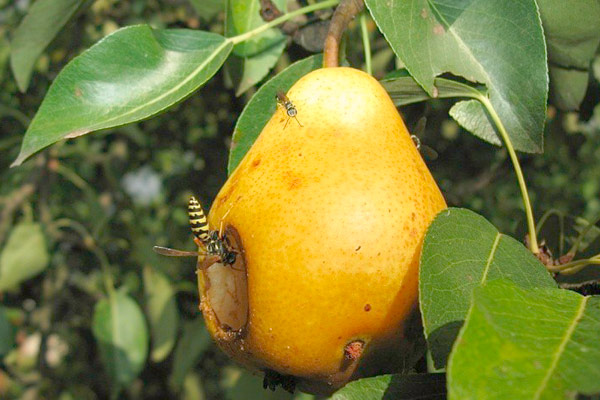
The average monthly temperature for most of the country in August is between 23-27℃. Precipitation during this month is short-lived and very often scarce.
Shoot growth in August has finished, and the fruits of the autumn varieties of apples, pears and peaches are enlarging intensively. During this month the process of differentiation of the fruit buds takes place. Along with these processes, the fruit trees are also being supplied with reserve nutrients.
The measures for protection of the fruit crop and the trees from pests continue.
In the calendar for July we recommended that in apple orchards where scab infection has not been allowed, sprays against this disease should not be carried out. This recommendation is also valid for August. In the presence of infection on the leaves and fruits and in case of frequent showers, in August as well the risk of late infections continues and may lead to an increase in the degree of fruit damage, which necessitates spraying.
In apple varieties that are susceptible to powdery mildew, control against this disease also continues. For simultaneous control of both diseases, it is best to use fungicides that are effective against both pathogens, such as Embrelia – 150 ml/da, Quimera - 20 g/da, Kumulus DF – 600-900 g/da, Luna Care – 300 g/da, Score 250 EC – 15-20 ml/da, Sulgram – 750 g/da, Thiovit Jet 80 WG – 600 g/da, Flint Max 75 WG – 0.02%, Heliosulfur C – 150-500 ml/da, Shavit F 72 WDG – 0.2%. At high temperatures do not spray with sulfur-containing fungicides, which may cause scorching in some varieties.
In apple varieties that are resistant or very slightly susceptible to powdery mildew, for stand‑alone control of scab one of the following fungicides may be used: Delan 700 WP - 50 g/da, Delan PRO - 250 ml/da, Decibel Max - 30 g/da, Dithane DG - 200 g/da, Dithane M45 - 200 g/da, Difcor 250 EC - 15 ml/da, Indar 5 EW – 100 ml/da, Karamat – 200 ml/da, Luna Experience – 20–75 ml/da, Luna Care – 300 g/da, Password 25 WG – 50 g/da, Polyram DF – 0.2%, Sankozeb 80 WP – 200 g/da, Syllit 40 SC – 160 ml/da, Syllit 544 SC – 125 ml/da, Scab 80 WG Captan – 188 g/da, Sugoby – 20 g/da, Faban – 120 ml/da, Folpan 80 WDG – 0.15%, Fontelis SC – 75 ml/da, Chorus 50 WG – 30–50 g/da, Shardif 25 EC – 20 ml/da, Difenzon 25 EC – 20 ml/da, Dishon 25 EC – 20 ml/da.
To prevent the development of resistance of the fungus causing scab (Venturia inaequalis), it is best to alternate fungicides with different modes of action on the pathogen or to use fungicide mixtures. For example, fungicides with the active substance difenoconazole (Score 250 EC, Difcor 250 EC, Shardif 25 EC, Dishon 25 EC) should be alternated with fungicides based on kresoxim‑methyl (Sugoby) or cyprodinil (Chorus 50 WG), as well as with fungicides based on dodine (Syllit 40 SC) or captan (Scab).
Varieties resistant to scab – Prima, COOP‑10, Frolina, Liberty, Jonafree, Jonathan, Pioneer, McFree, Pilot, Topaz, Novamak, Sava, Rubinola, etc., are sprayed only against powdery mildew and for them one of the following fungicides may be used: Bayfidan 250 EC – 15 ml/da, Bellis – 80 g/da, Embrelia – 150 ml/da, Kozavet DF – 750 g/da, Quimera – 20 g/da, Kumulus DF – 600-900 g/da, Luna Care – 300 g/da, Systane 20 EW – 28-42 ml/da, Systane Ecozon EW – 60-185 ml/da, Score 250 EC – 15-20 ml/da, Solfo 80 WG – 750 g/da, Sulgram – 750 g/da, Thiovit Jet 80 WG – 600 g/da, Topaz 100 EC – 25-50 ml/da, Topsin M 70 WDG – 0.12%, Flint Max 75 WG – 0.02%, Heliosulfur C – 150-500 ml/da, Shavit F 72 WDG – 0.2%.
In August, spraying is also carried out against bitter pit (spots) in apple. Damage from this non‑infectious disorder on the fruits is observed during the ripening period and later during storage. The affected fruits are dotted with numerous dark sunken spots, most often concentrated in the lower part of the fruit. Later the spots become more intensely coloured; in red‑coloured fruits they turn dark red, while in yellow‑ and green‑coloured fruits they become light green to green. Sometimes affected fruits have no external symptoms and do not differ from healthy ones, but when cut, brown pits scattered among the healthy fruit flesh are visible. Bitter pits represent dark brown spongy tissue with a bitter taste. To prevent this disorder, spray two or three times with CaCl2 – 0.6%. The first spraying is carried out about one month before harvest, and the following ones at intervals of 10-12 days. The foliar fertilizer Wuxal Calcium – 300-600 ml/da is also recommended. A minimum of 6 sprays are carried out with it, the first after fruit set, and the following at intervals of 12-15 days. It is necessary to avoid water stress in the trees and to carry out harvesting at the most favourable dates for each variety.
In the first half of August, the first spraying against the second generation of the codling moth is carried out. After 10–12 days the second spraying is performed, which is also directed against San José scale. For control of the codling moth, the following insecticides are included in the list of approved products: Avant 150 EC - 33.3 ml/da, Affirm 095 SG - 300 g/da plus 0.02% Break‑Thru adjuvant, Aficar 100 EC - 30 ml/da, Affirm Opti - 200 g/da, Voliam Targo 063 SC - 75 ml/da, Delegate 250 WG - 30 g/da, Deca EC - 30 ml/da, Dukat 25 EC – 30 ml/da, Efcymertrin 10 EC – 30 ml/da, Imidan 50 WP – 150 g/da, Calypso 480 SC – 20-25 ml/da, Coragen 20 SC – 16-30 ml/da, Meteor – 0.06%, Proteus O‑TEC – 0.05-0.06%, Sineis 480 SC – 30-43.7 ml/da, Sumi Alpha 5 EC – 0.02%, Harpoon – 100 ml/da, Cyclone 10 EC – 30 ml/da. Of the listed insecticides, Affirm 095 SG - 300 g/da plus 0.02% Break‑Thru adjuvant, Aficar 100 EC - 30 ml/da, Affirm Opti - 200 g/da, Voliam Targo 063 SC - 75 ml/da, Delegate 250 WG - 30 g/da, Dukat 25 EC – 30 ml/da, Efcymertrin 10 EC – 30 ml/da, Calypso 480 SC – 20-25 ml/da, Coragen 20 SC – 16-30 ml/da, Sineis 480 SC – 30-43.7 ml/da, Sumi Alpha 5 EC – 0.02%, Cyclone 10 EC – 30 ml/da are also effective against leaf‑mining moths.
For control of San José scale, the following insecticides are registered: Brai - 28-50 ml/da, 0.03%, Deca EC – 50-75 ml/da, Dursban 4 EC – 150-187 ml/da, Closer 120 SC – 40 ml/da, Meteor - 90 ml/da, Mulligan – 30-50 ml/da, Proximo – 28-70 ml/da, Harpoon – 30 ml/da.
Apple varieties that ripen in August and whose crop is harvested in the second half of this month are sprayed once against the second generation of the codling moth with insecticides with a short pre‑harvest interval.
Insecticides for control of the codling moth and San José scale are added to the indicated fungicides for simultaneous control of pests on apple during this period.
For the pear, as for the apple, where scab infection has not been allowed, sprays against this disease are not carried out in August. In pear orchards where infection has occurred, treatments against scab must continue. For control of this disease, one of the fungicides listed for apple scab is used. Against the common pear psylla, one of the following insecticides is added to the fungicide solution: Bermectin – 37.5–120 ml/da, Vaztak New 100 EC – 20 ml/da, Valmec – 37.5–120 ml/da, Deca EC – 75 ml/da, Delegate 250 WG – 30 g/da, Laota – 37.5-120 ml/da, Meteor – 90 ml/da, Movento 100 SC – 0.12-0.15%, Naturalis - 100-200 ml/da, Sineis 480 SC – 30-43.7 ml/da, Sumi Alpha – 0.03%, Harpoon – 100 ml/da. Of the listed insecticides, Deca EC – 75 ml/da, Delegate 250 WG – 30 g/da, Meteor – 90 ml/da, Sineis 480 SC – 30-43.7 ml/da, Sumi Alpha – 0.03%, Harpoon – 100 ml/da are approved for codling moth and can successfully be used for simultaneous control of pear psylla and fruit moths in pear.
Fungicide sprays in quince are against brown rot and brown leaf spots, for which one of the following fungicides is used: Karamat 2.5 EW – 200 ml/da, Scab 80 WG Captan – 188 g/da, Chorus 50 WG – 45-50 g/da. For control of fruit moths, one of the insecticides listed for control of the codling moth is added to the fungicide solution.
In sweet and sour cherries, after harvest one treatment is carried out against cherry leaf spot (cylindrosporiosis) with: Karamat 2.5 EW – 300 ml/da, Signum - 30 g/da, Score 250 EC – 30 ml/da, Syllit 40 SC – 150 ml/da, Syllit 544 SC – 125 ml/da, Delan 700 WG – 0.05% and Flint Max 75 WG – 30 g/da. This spraying is carried out only in orchards where infection has occurred and where the meteorological conditions (temperature and humidity) in August are favourable for the development of the disease.
Immediately after harvest, when damage from bacterial canker (blight) caused by Pseudomonas syringae, is established in sweet and sour cherries, pruning is carried out to remove the infected branches and twigs. This period is the most suitable for sanitary pruning because the trees are in active vegetation and the plants’ defence capacity is higher, while the bacterium is weakly active and does not cause new infections during this month. After pruning, the wounds are covered with oil‑based paint.
To reduce the overwintering inoculum of brown rot and cherry fruit fly, it is necessary to pick all fruits and collect and destroy the mummified ones.
In young non‑bearing sweet and sour cherry orchards, when the black cherry aphid and cherry slug sawfly increase in number, spraying with Calypso 480 SC – 0.02% must be carried out.
In plum, in August control is directed against late brown rot, rust, larvae of the plum scale and the second generation of the plum fruit moth. Against brown rot, spray with one of the following fungicides: Difcor 250 EC – 20 ml/da, Indar 5 EW – 150 ml/da, Captan 80 WG - 150-180 g/da, Karamat 2.5 EW – 300 ml/da, Luna Experience – 50 ml/da, Password 25 WG – 50 g/da, Signum – 30 g/da, Systane 20 EW - 12.5–30 ml/da, Chorus 50 WG – 0.045%. Of the listed fungicides, Signum is effective also against rust. For simultaneous control of rust and red leaf spots in plum, Indar 5 EW – 150 ml/da and Karamat 2.5 EW – 300 ml/da are approved. Effective insecticides against plum fruit moth are: Delegate 250 WG – 100-120 ml/da and Coragen 20 SC – 16-30 ml/da. For control of the common plum scale, Movento 100 SC – 0.075-0.1% or Proximo – 28-70 ml/da is recommended. Early‑ripening plum varieties are sprayed with fungicides and insecticides with a short pre‑harvest interval.
Most of the peach varieties distributed in our country ripen between 10-30 August, and in those harvested by mid‑August, sprays are not carried out. In varieties that ripen at the end of August – beginning of September, treatment is necessary against brown rot, oriental fruit moth and peach twig borer. Of the approved fungicides against brown rot, the most suitable are: Indar 5 EW – 150 ml/da (with a pre‑harvest interval of 3 days), Embrelia – 150 ml/da, Luna Experience – 50 ml/da, Signum – 30 g/da, Systane 20 EW – 30 ml/da, Chorus 50 WG – 45–50 g/da, which have a 7‑day pre‑harvest interval. For simultaneous control of oriental fruit moth and Anarsia, one of the following insecticides is used: Avant 150 EC – 33.3 ml/da, Affirm Opti – 200-225 g/da, Voliam Targo 063 SC – 75 ml/da, Delegate 250 WG – 30 g/da, Imidan 50 WG – 150 g/da, Coragen 20 SC – 16-30 ml/da, Lamadex Extra - 70 g/da, Meteor - 90 ml/da, Sumi Alpha 5 EC - 0.02%.
Strawberry plantations in August are treated against the strawberry mite. One of the approved acaricides in strawberry is used : Apollo 50 SC - 30-40 ml/da, Zoom 11 SC – 40-50 ml/da, Malbeknok EC – 100-150 ml/da, Nissorun – 50-75 g/da, Thiovit Jet 80 WG – 500 g/da.
In August, in some peach and plum plantations, it may be necessary to spray against spotted‑wing drosophila (Drosophila suzukii). For its control one of the approved insecticides may be used: Affirm Opti – 200 g/da, Calypso 480 SC – 20-30 ml/da, Imidan 50 WP – 150 g/da, Coragen 20 SC – 16-30 ml/da, Lamadex Extra – 60–100 g/da, Neem Azal T/S – 0.4 g/da.
Temperatures in August are high, which requires that spraying during this period be carried out early in the morning or late in the evening.
The accepted economic injury thresholds for individual pests are:
Codling moth – 0.8–1% fresh entries;
Oriental fruit moth – 1.5% damaged fruits;
Plum fruit moth – 1–1.5% fresh entries;
Anarsia – 3% damaged shoots;
Aphids – 10–15% infested shoots;
Common plum scale – 5-7 individuals per leaf;
Leaf‑mining moths – 1-2 fresh mines per leaf;
Pear psylla – 4-6% shoots with colonies;
In organic production the use of synthetic pesticides is not permitted. For control of fungal diseases, copper‑containing and sulfur‑containing fungicides are used. For pest control the following bio‑insecticides are approved:
Carpovirusine against codling moth and oriental fruit moth, Chrysant EC against peach aphid.
Madex Twin and Madex Top against codling moth and oriental fruit moth.
Naturalis against whitefly and spider mite in strawberry, cherry fruit fly, common pear psylla, European red mite; Neem Azal T/S against leaf‑mining moths in apple.
Oikos against aphids, leafhoppers and leaf‑mining moths in apple.
Pyretro Natura against peach aphid.
Rapax against oriental fruit moth, Anarsia in peach and apricot, and leafrollers in pome fruits.
Sineis against codling moth, apple blotch leafminer, Anarsia and pear psylla.
The following pheromones (attractants) are also approved:
Ginko for codling moth
Isomate OFM TT for oriental fruit moth
Isomate C for codling moth
Isomate CRB for codling moth and leafrollers.
For cherry fruit fly the visual trap Ferocon AM is approved.