

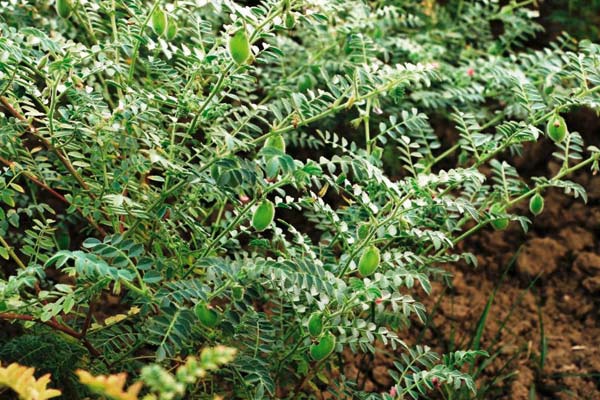
In recent decades, there has been increased interest in chickpea and its role in a healthy diet. Its grains are a food of high biological value for humans, as they are rich in proteins, carbohydrates, fats, mineral substances and vitamins. For Bulgaria, chickpea is a traditional crop, used mainly for human consumption and to a lesser extent for feed. The seeds of bitter vetch are a protein-rich food, and before animals began to be kept under domestic conditions it was used as food for humans. Now it is grown mainly as a good forage grass and for grain, especially for sheep. In our country, bitter vetch as a cultivated plant occupies relatively small areas, and only in the southern parts of the country.
Poor weed control is one of the most important limiting factors in chickpea stands. The initial 60‑day period is considered critical for weed competition with chickpea. According to studies, about 40%–45% yield reduction in chickpea is due to the damage caused by weeds. A 75% reduction in yields has been reported due to severe competition of chickpea stands with weeds.
In chickpea and bitter vetch, weeds from different weed groups (annual and perennial grasses and broadleaved weeds, as well as ephemeral weeds) emerge and grow intensively in the initial stages of crop development, which is why the application of a single herbicide is ineffective. For this reason, it is advisable to control the weed spectrum by mixed application of two or more herbicides in order to establish an appropriate and effective practice for weed management in chickpea.
The action of eleven herbicides and herbicide combinations in different concentrations has been studied, as follows – Beflex 50 ml/da; Corum 100 ml/da; Sirtaki SC 30 ml/da; Sirtaki SC 15 ml/da; Bismarck 200 ml/da; Bismarck 100 ml/da; Beflex 50 ml/da + Dual Gold 120 ml/da; Sirtaki SC 30 ml/da + Dual Gold 60 ml/da; Sirtaki SC 15 ml/da + Dual Gold 120 ml/da; Sirtaki SC 30 ml/da + Stomp Aqua 180 ml/da; Sirtaki SC 15 ml/da + Stomp Aqua 350 ml/da (Table 1). The herbicides and herbicide combinations were applied immediately after sowing in both crops. One plot of chickpea and bitter vetch was left as control and was not treated with herbicides (Fig. 1, 2).
In our study, in the weed association in chickpea, field bindweed (Convolvulus arvensis) and redroot pigweed (Amaranthus caudatus L.) predominated. They were present in large numbers with the application of Sirtaki SC at both tested doses. The weed count results show poor control of Sirtaki SC on redroot pigweed (Amaranthus caudatus L.). Bismarck, at both application rates (200 ml/da and 100 ml/da), also has a weak effect against this weed. The combinations of Sirtaki SC 15 ml/da + Stomp Aqua 350 ml/da and Sirtaki SC 15 ml/da + Dual Gold 120 ml/da have good efficacy against redroot pigweed (Amaranthus caudatus L.). All tested herbicide combinations provide good control over the mixed weed flora.
Compared to the control, the grain yield in chickpea is significantly higher when Sirtaki SC 30 ml/da, Sirtaki SC 15 ml/da, as well as all studied herbicide combinations are applied. On chickpea grain yield, the complementary effect of the two herbicides Sirtaki SC + Dual Gold is clearly manifested at both studied rates (30 ml/da + 60 ml/da; 15 ml/da + 120 ml/da). Most of the tested herbicides and herbicide combinations are tolerant and do not suppress the crop, and a high positive effect on grain yield was observed.
From all that has been said so far, it can be summarized that the best weed control in chickpea is achieved with the following herbicide combinations – Sirtaki SC 30 ml/da + Dual Gold 60 ml/da; Sirtaki SC 15 ml/da + Dual Gold 120 ml/da; Sirtaki SC 30 ml/da + Stomp Aqua 180 ml/da and Sirtaki SC 15 ml/da + Stomp Aqua 350 ml/da. Good control is also provided by the solo application of Sirtaki SC at both tested rates – 15 ml/da and 30 ml/da. When these herbicides are applied, chickpea yield is high.
In bitter vetch, as in chickpea, the largest proportion of the total number of weeds is field bindweed (Convolvulus arvensis) and redroot pigweed (Amaranthus caudatus L.). Besides the control, the variants treated with Beflex and Corum have the highest weed numbers. Sirtaki SC at both application rates (30 ml/da and 15 ml/da) is effective against redroot pigweed (Amaranthus caudatus L.). The herbicide combinations – Sirtaki SC 15 ml/da + Dual Gold 120 ml/da; Sirtaki SC 30 ml/da + Stomp Aqua 180 ml/da and Sirtaki SC 15 ml/da + Stomp Aqua 350 ml/da have good efficacy against the mixed weed flora.
With the application of Corum 100 ml/da, Sirtaki SC 30 ml/da, Bismarck 200 ml/da, Beflex 50 ml/da + Dual Gold 120 ml/da, Sirtaki SC 30 ml/da + Dual Gold 60 ml/da, the grain yield in bitter vetch is significantly higher. With the application of all other herbicides and herbicide combinations, weeds have a clearly expressed suppressive effect on the crop, which affects its yield.
The reduction of grain yield in chickpea and bitter vetch is the result of overall weed infestation. Most of the studied herbicides in both crops are tolerant and have a strong positive effect on grain yield. Those herbicides with low weed control have a negative effect on grain yield.
Finding a suitable herbicide for effective control in mixed weed flora is necessary for better adaptation of these two crops. The use of herbicides makes it possible to control a wide spectrum of weeds as an effective means of reducing costs.
For more details, read issue 7/2020 of the journal "Plant Protection"