

Geographical distribution of Drosophila suzukii
Drosophila suzukii was registered for the first time in the USA in the autumn of 2008 in the state of California, where the losses for 2010 in the states on the Pacific coast (California, Oregon and Washington) amounted to about 500 million dollars, mainly due to attacks in strawberry, raspberry, blackberry, blueberry and cherry plantations. The pest has managed to spread from the Pacific coast in the west to the states on the Atlantic coast in the east, to the state of Florida in the south and the province of British Columbia in Canada in the north, i.e. up to the 49th parallel. In 2010-2011 it was reported in Central and South America, including Mexico, Costa Rica and Ecuador.
In Europe the pest was first detected in Spain and Italy in 2008, after which it was established in other European countries in the period up to 2011 – France, Austria, Switzerland, Slovenia, Germany, Croatia, and in 2012 – in the United Kingdom and Portugal, or, for the indicated period, it spread from the 40th to the 47th parallel in Western Europe. Losses in Southern France reached up to 80% in the affected crops, and in Northern Italy in the Trentino region between 30–40% of berries and cherries. So far it has not been clarified how this drosophila entered Europe from America – probably with fruit or planting material, or the penetration of the species into European countries is connected with its introduction into the USA. The proximity of the dates when the species was introduced into North America and Europe, as well as the haplotypes of the populations, provide grounds to assume that the two invasions are probably related. In 2010 the fly D. suzukii moved from Spain and Southern France in Europe about 1400 km to the north and east, which indicates its high mobility and adaptability, i.e. from the Mediterranean region in the south to the cool mountainous areas of the Alps, and over the following two years – throughout Western Europe. It has been established that one generation can move up to 45 km in distance, with migration also being assisted by winds.
For the first time D. suzukii was described in 1916 in Japan, detected on cherries, where its study was carried out by Matsumura (1931), who also recorded its synonym – Leucophenga suzukii (Matsumura, 1931).
Since 2011 D. suzukii has been included in the A2 LIST of the European and Mediterranean Plant Protection Organization (EPPO) (List of quarantine pests recommended for official control, occurring in the EPPO region).
The species belongs to the phylum Anthropoda, class Insecta, order Diptera, suborder Brachycera, family Drosophilidae, Drosophila suzukii (Matsumura). In the genus Drosophila more than 1500 species have been described worldwide. Apart from Japan, D. suzukii occurs in North and South Korea, China, in the easternmost part of Russia – Primorsky Krai, India, Burma, Pakistan, Mexico and Costa Rica. In the Hawaiian Islands it has been known since 1980. It is considered that D. suzukii was distributed in the wild in Japan or was introduced from outside, but when and how is still unknown.
Morphology and life cycle
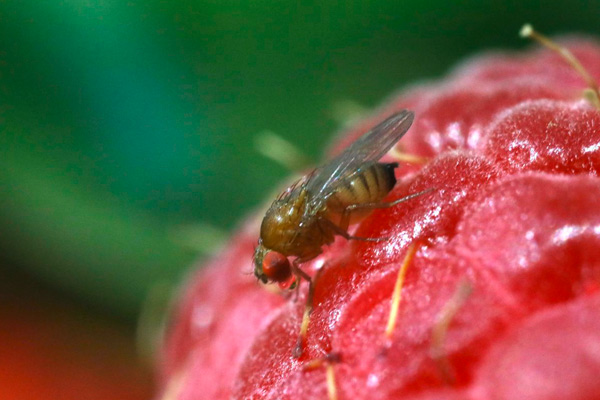
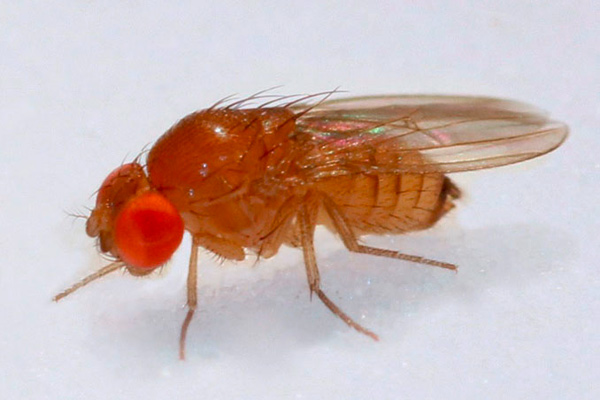
The studies carried out so far in Japan, the USA, Italy, France, Austria, Switzerland and others have established that Drosophila suzukii is a small fly with a body length of 2–3 mm, and with spread wings reaching 6–8 mm, with red eyes. The male individuals have a dark spot at the tip of their wings, from which its name in the USA derives – spotted wing drosophila (SWD). The female specimens possess a well-developed telescopic ovipositor.
The larva is milky white. The pupa is brownish.
D. suzukii overwinters as an adult insect. Under suitable conditions it can also develop throughout the year. In one season this species develops from 7 to 15 generations depending on the climatic conditions of the region – in Japan there are about 13 generations, and in California – up to 10. For its normal development, temperatures between 10–32 °C are necessary, with optimal activity between 20–25 °C, and below 5 °C they enter winter diapause. Considering that this drosophila has reached the northern island of Hokkaido in Japan, as well as the Far East of Russia, and from the warm regions of Spain has established itself in countries in the Alpine region, we can understand its high adaptability to the climatic conditions of a given region. The female individuals lay their eggs on the ripe fruits of the host plants. One female can lay up to 400 eggs or an average of about 300. The eggs hatch within up to 72 hours depending on climatic conditions. Several larvae can be found in a single fruit. They must be sought only in the fruits, because they never develop outside them. The pupa can develop inside the fruit flesh of the fruit itself or outside it. The attacked fruits soften and at the site of attack secondary pathogens may enter and diseases caused by fungi and bacteria may develop, and the fruits may rot and fall, i.e. such fruits completely lose their commercial value.
Host plants
Drosophila suzukii has a wide range of host plants, encompassing over 95 species belonging to 23 botanical families. Preferred hosts of the species are the fruits of wild and cultivated species, with the greatest economic importance for cherries, strawberries, raspberries, blackberries, blueberries, peaches, plums, grapes, apricots.
Among the berry species it prefers strawberries, raspberries, blackberries, blueberries; among the stone fruit species – cherries, peaches, apricots, plums; vines – table and wine grapes. It also attacks persimmon, figs, mulberries, cornelian cherry, as well as a large number of wild and ornamental plants such as Lonicera spp., Sambucus nigra, Rosa spp. and others. In traps in France it has been detected on tomatoes. All this shows that this drosophila is polyphagous and will be a very dangerous pest for our fruit production in the coming years.
Methods for monitoring D. suzukii and phytosanitary control in Bulgaria
In every agro-ecological region it is urgently necessary to organize monitoring to determine the boundaries of distribution of this new dangerous quarantine pest. Restrictive and sanitary measures should then be applied, as well as measures against reinfection of the area. In parallel, studies should begin on the biology of development of Drosophila suzukii together with the phenological development of the individual host plants.
The next step should be a strategy to start integrated pest management against the pest, including investigation of possibilities for finding its natural enemies and parasites of the eggs and larvae. The approach should be aimed at integrated control with a view to moving towards biological control against D. suzukii, taking into account its particular specificity as a pest and the information on the results obtained in other countries.
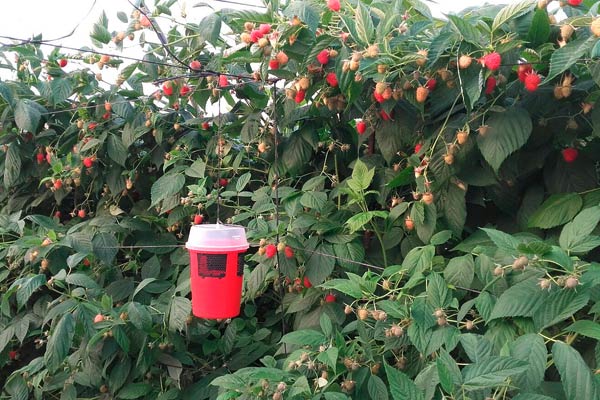
The monitoring programme of the Bulgarian Food Safety Agency for surveillance of D. suzukii started in 2012 with the aim of clarifying the pest status in Bulgaria. Monitoring is carried out by the plant protection departments in the following regions of the country: Blagoevgrad, Burgas, Veliko Tarnovo, Vidin, Vratsa, Varna, Dobrich, Kardzhali, Kyustendil, Pazardzhik, Plovdiv, Pernik, Ruse, Silistra, Sliven, Sofia city, Stara Zagora and Haskovo. Visual inspections of the fruits are carried out and traps for the adults of the fly are set in risk points such as commodity exchanges, wholesale markets, warehouses, markets, enterprises and places for repackaging of fruits. Fruiting permanent plantations of cherries, peaches, plums, strawberries, vineyards, raspberries, blackberries and other host plants are also monitored. Rest areas along motorways, especially near border crossing points, where damaged fruits are discarded, from which the emerged adult pests can later find suitable hosts, are also taken into consideration.
National programme for phytosanitary control and control of Drosophila suzukii Matsumura in Bulgaria
To date, under the National programme for phytosanitary control and control of Drosophila suzukii Matsumura in Bulgaria, the following observations have been made:
In 2014 and 2015 a total of 670 adults were recorded, with the share of captured male flies being 3.5 times higher than that of females. The largest number of adult individuals of D. suzukii were found in Tephri-trap type traps, followed by specialized Riga traps. In the Plovdiv region the captured flies are significantly more than in Blagoevgrad and Kyustendil, with the highest number of D. suzukii found in the village of Kalekovets on traps in apple orchards. Apples are not a preferred host of the pest and the flies can be found on them only when the fruits are damaged. In the village of Tsalapitsa the fly was found in Riga traps in raspberries, which are a preferred host of the pest.
Methods for control of Drosophila suzukii
The most important factor for conducting successful control of the pest is monitoring.
Fruits are most susceptible to attack at the beginning of ripening, after their colouring and the formation of a certain amount of fruit sugar. If monitoring indicates the presence of the pest at this moment, insecticides must be applied to protect the fruits. Often the presence of D. suzukii is not noticed until the fruits have been harvested. Treatments with plant protection products (PPPs) are directed mainly against the adult individuals in order to prevent oviposition.
Prophylactic and agrotechnical measures
The transfer and spread of D. suzukii occurs mainly through infested fruits, therefore all fruits that remain in the field or in the orchard can be a primary source of infestation. Therefore, infested fruits must be collected and destroyed by burying them in the soil or by insecticidal treatment.
Exposure of fruits to low temperatures
Placing the fruits after harvest at low temperatures leads to cessation of the development of D. suzukii. An experiment was carried out in the USA in which blueberry fruits with eggs laid in them were placed at a temperature of 1.5 to 2 °C for 3 days and out of 434 eggs none survived. The same
temperature and exposure time also stop the development of the fly larvae.
Kaolin suspension
The kaolin “film” used against sunburn on fruits in some fruit crops has a repellent effect against adult individuals of
D. suzukii.
Physical isolation with netting with mesh size (1 x 1 mm)
This method is applied in Japan and for some valuable crops in Canada and Italy. It provides complete protection of plants from infestation with D. suzukii. This approach, however, is successful for relatively smaller areas and in organic production of strawberries, raspberries and blueberries.
Chemical control
The insecticides used so far worldwide have not shown good efficacy against the pest. The large number of generations and the use of chemical treatments at the fruit ripening stage may increase the risk of pesticide residues in fruits, lead to the development of resistant populations and affect pollinating insects and other beneficial species. The wide range of host plants, on the other hand, requires a specific approach when conducting chemical control in each particular crop. The larvae of D. suzukii develop inside the fruits and for this reason there are no sufficiently effective insecticides with larvicidal action. Control is directed mainly against the adult individuals. Laboratory and field studies, both in the southern zone of the EU and in the USA, show that three groups of insecticides have the best effect on adult flies – organophosphates, pyrethroids and spinosyns.
For control of this pest, the following insecticides are included in the list of plant protection products authorized for use: for raspberry – Exalt – 240 ml/da, Neem Azal T/S – 0.4 g/da; for stone fruits – Affirm Opti – 200 g/da, Imidan 50 WP – 150 g/da, Coragen 20 SC – 16–30 ml/da, Lamadex Extra – 60–100 g/da, Neem Azal T/S – 0.4 g/da.
Biological control
The most probable reason for the rapid spread of the invasive species D. suzukii in Europe is the absence in its new habitats of the complex of natural enemies. An increase in the number of local species of entomophages and entomopathogens that can control pest populations can be expected. There are still no bioagents that can be indicated for use in practice, but as promising at present are several species of predators – the earwig Labidura riparia (Dermaptera: Labiduridae), 3 species of bugs from the genus Orius (Hemiptera: Anthocoridae); the rove beetle Dalotia coriaria (Coleoptera: Staphylinidae) and the predatory mite – Hypoaspis miles (Laelapidae). Studies on four species of parasitoids have shown the development of a strong immune response and interruption of the development of the bioagent. Research related to the efficacy of microbial preparations based on entomopathogenic fungi and nematodes is at an early stage of testing and they cannot yet be recommended in practice.
Among the natural enemies and potential bioagents of D. suzukii, the following species, reported in the literature, are also included in the List of bioagents that may be applied in the Republic of Bulgaria, approved in 2015 by the Minister of Agriculture and Food and the Minister of Environment and Water:
Anthocoris nemoralis (Hemiptera: Anthocoridae)
Orius laevigatus (Hemiptera: Anthocoridae)
Orius majusculus (Hemiptera: Anthocoridae)
Dalotia coriaria (= Atheta coriaria) (Coleoptera: Staphylinidae)
Hypoaspis miles (Acari: Laelapidae)
Food baits
Various fruits or fruit derivatives have been tested as baits for the fly, including: a mixture of brown sugar, alcohol, vinegar and water, ripe bananas, strawberry purée, apple cider or baker’s yeast, sugar and water; apple cider vinegar (ACV). As the cheapest and easiest to apply attractant, apple cider vinegar can be used (but it must not contain preservatives).
Other authors have established that the combination of apple cider vinegar and white table wine leads to a synergistic effect and attracts more D. suzukii than the separate use of the two components. Changing the proportions of the two components in the baits – acetic acid and ethanol – leads to interesting results. Lower levels of acetic acid attract more flies than higher levels (from 2% to 6%), while for ethanol no differences in attraction were found when the ethanol concentration varied between 5 and 25%.
Baker’s yeast has also been studied as an attractant. Comparative studies of baits of baker’s yeast and apple cider vinegar have been carried out and it has been established that apple cider vinegar is more effective overall. On the other hand, baits with baker’s yeast capture a larger number of D. suzukii and in them the first captures of flies are more often detected compared to apple cider vinegar. Studies have established that baits with baker’s yeast attract more flies in the months when the flies are at higher population levels.
When alternating baits with apple cider vinegar and with baker’s yeast in a blueberry plantation, it has been established that D. suzukii prefers yeasts from June to October, while in November, when temperatures decrease, the efficacy of apple cider vinegar is higher. This suggests that the attractiveness of baker’s yeast depends on temperature and requires relatively high temperatures in order to be activated.