

Diseases
Late blight of tomato
Pathogen – Phytophthora infestans
Symptoms
It attacks all above-ground parts of tomato plants.
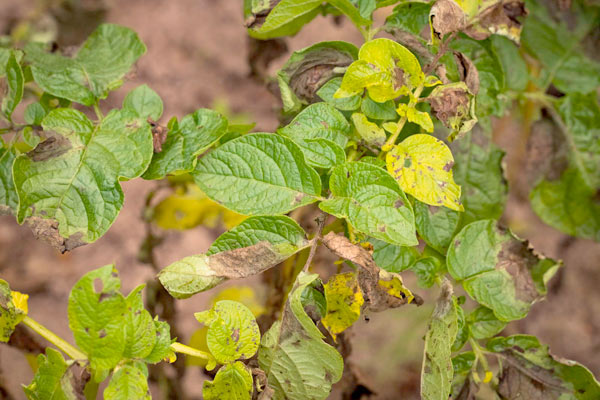
The first symptoms are observed on the oldest leaves – watery spots with irregular shape, covered on the underside with a sparse whitish mould.
Later the spots enlarge, scorch and turn brown.
The spots on petioles and fruit stalks are dry, dark brown, while on the stems they are large, watery and encircle them entirely.
The spots on the fruits are brown, rough, with a radiating structure and they enlarge rapidly. In humid weather they are covered with a sparse whitish mould.
Life cycle
The pathogen is preserved in the soil on plant residues and fruits.
Favourable conditions for infection are the presence of “critical periods”.
Rainfall over two consecutive days with a total amount of at least 10 l/ha.
Minimum temperature in the range of 10-120C, maximum – 18-250C.
Relative air humidity above 80%.
Retention of water droplets on the plants.
Control
- Keeping seedlings free from late blight;
- After transplanting, in the presence of favourable conditions (critical periods), preventive treatments with contact PPP shall be carried out;
- At detection of the first symptoms of late blight, PPP with local-systemic and systemic action shall be used
- Authorised PPP: Azaka 80 ml/ha; Acrobat Plus WG 200 g/ha; Golbex WG 250 g/ha; Kilate WG 250 g/ha; Keefol WG 250 g/ha; Valbon 180-200 g/ha; Vinker WG 200 g/ha; Dithane DG 200 g/ha; Dithane M-45 200 g/ha; Zoxis 250 SC 70-80 ml/ha; Captan 80 WG 150-190 g/ha; Karyal Star 60 ml/ha; Corsate 60 WG 20-30 g/ha; Manfil 75 WG 210 g/ha; Pencozeb 80 WP 200 g/ha; Revus 250 SC 50 ml/ha; Ridomil Gold MZ 68 WG 0.25%; Sancozeb 80 WP 200 g/ha; Simbal Flow 50 ml/ha; Sinstar 70-80 ml/ha; Taegro 18.5-37 g/ha; Tazer 250 SC 80-100 ml/ha.
Early blight of tomato and pepper
Pathogen – Alternaria solani
Symptoms
Small watery spots appear on the leaves, reaching 5-7 mm in diameter. Later they dry out, become dark brown to black with a concentric structure, coalesce and the leaf scorches. In pepper the spots are lighter in colour.
The spots on the stem, petioles and pedicels are similar, with the characteristic concentric structure. Attack on the pedicels may cause flower drop.
On fruits they start from the stem end and also have a concentric structure.
At high relative air humidity the affected areas are covered with a black mould of the fungal sporulation.
Life cycle
The pathogen is preserved as mycelium with plant residues in the soil.
Development of the pathogen is favoured at temperatures of 26-280C and the presence of heavy dews or frequent showers.
Control
- Keeping seedlings free from the disease;
- Preventive treatments with contact PPP shall be carried out in the presence of favourable conditions for development;
- At occurrence of the first spots, treat with PPP with local-systemic and systemic action;
- Authorised PPP: Azaka 80 ml/ha; Acrobat Plus WG 200 g/ha; Dagonis 100 ml/ha; Dithane DG 200 g/ha; Dithane M-45 200 g/ha; Difcor 250 SC 50 ml/ha; Zoxis 250 SC 70-80 ml/ha; Captan 80 WG 150-190 g/ha; Karyal Star 60 ml/ha; Cuproset Gold New 300 g/ha; Ortiva Top SC 100 ml/ha; Pencozeb 80 WP 200 g/ha; Pencozeb 75 WG 210 g/ha; Reflect 125 EC 100 ml/ha; Ridomil Gold MZ 68 WG 0.25%; Sancozeb 80 WP 200 g/ha; Sinstar 70-80 ml/ha; Taegro 18.5-37 g/ha; Tazer 250 SC 80-100 ml/ha; Cidely Top 100 ml/ha.
Bacterial leaf spot of tomato and pepper
Pathogen – Pseudomonas syringae pv. tomato, Xanthomonas vesicatoria, X. euvesicatoria, X. gardneri
Symptoms
Small black spots with a chlorotic halo around them appear on the leaves, stems, petioles and pedicels of tomatoes. In case of severe attack the leaf scorches and dies;
On fruits the spots are initially watery, later they become black, slightly raised, resembling small scabs;
In pepper the spots on the leaves are round, watery and rapidly necrotise. Later they turn yellow and fall off;
The spots on the fruits are brown, slightly raised, similar to warts, and long narrow lesions can develop on the stems.
Life cycle
The bacteria are preserved in the seed coat, in plant residues and in the soil;
Optimum temperature for development is 25-270C.
Control
- Sowing of disinfected seed;
- Planting of healthy seedlings;
- Treatment with PPP at occurrence;
- Authorised PPP: Serenade ASO SC 400-800 ml/ha; Taegro 18.5-37 g/ha.
Downy mildew (Cuban) of cucumber, melon, watermelon
Pathogen – Pseudoperonospora cubensis
Symptoms
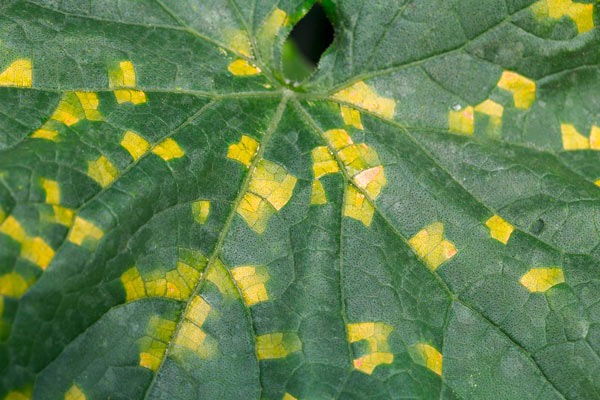
Small watery, yellowish spots with irregular shape, limited by the venation, appear on the leaves;
In humid weather small cloudy droplets of bacterial exudate appear on their underside;
Later the centre of the spots scorches and falls out. Angular, perforated spots remain on the leaves;
On fruits small watery spots of irregular shape are formed, covered with cloudy bacterial exudate. During ripening, the bacterium penetrates deep into the tissues and reaches the seeds, infecting them.
Life cycle
It is preserved in plant residues in the soil and in the seeds;
It is spread by raindrops.
Control
- Regular monitoring of crops;
- Preventive treatments with PPP in the presence of favourable conditions;
- Authorised PPP: Golbex WG 250 g/ha; Kilate WG 250 g/ha; Keefol WG 250 g/ha; Bordeaux Mix 20 WP 375-500 g/ha; Zoxis 250 SC 70-80 ml/ha; Infinito SC 120-160 ml/ha; Corsate 60 WG 20-30 g/ha; Ridomil Gold MZ 68 WG 0.25%; Taegro 18.5-37.0 g/ha.
Angular leaf spot of cucumber
Pathogen – Pseudomonas syringae pv. lachrymans
Symptoms
Small watery, yellowish spots with irregular shape, limited by the venation, appear on the leaves;
In humid weather small cloudy droplets of bacterial exudate appear on their underside;
Later the centre of the spots scorches and falls out. Angular, perforated spots remain on the leaves;
On fruits small watery spots of irregular shape are formed, covered with cloudy bacterial exudate. During ripening, the bacterium penetrates deep into the tissues and reaches the seeds, infecting them.
Life cycle
It is preserved in plant residues in the soil and in the seeds;
It is spread by raindrops.
Control
- Sowing of disinfected seed;
- Regular monitoring of crops;
- Preventive treatments with PPP in the presence of favourable conditions for development of the pathogen;
- Authorised PPP: Bordeaux Mix 20 WP – 375-500 g/ha.
Downy mildew of onion
Pathogen – Peronospora destructor
Symptoms
Plants obtained from infected bulbs lag behind in growth, become chlorotic, with curved leaves;
At high relative humidity their leaves are covered with a violet mould of fungal spores;
With later infection, yellowish, slightly sunken spots appear on the leaves, which in humid weather are covered with a violet mould;
Through the pseudostem the pathogen moves down into the bulbs and infects them.
Life cycle
The pathogen is preserved as mycelium in infected bulbs, in overwintering plants of annual and perennial onions and as oospores in the soil;
The fungus is spread by air currents;
Cool and humid weather favours mass development of the disease;
Optimum temperature for spore germination is 7-160C.
Control
- Regular monitoring of crops for early detection of the disease;
- Preventive treatments with contact PPP in the presence of favourable conditions for development of the pathogen;
- Treatment of crops at occurrence of the first spots with systemic PPP;
- Due to the presence of a waxy coating, for better adhesion, adjuvants are added to the spray solutions – Silwet L 77 20-30 ml/ha; Silwet 408 5-10 ml/ha and a spray volume reduced by up to 40%/ha; Spur 0.025-0.05% for contact PPP and 0.1% for systemic ones; Silwet adjuvants shall not be mixed with copper-containing PPP.
- Treatment with PPP containing metalaxyl prolongs the vegetation of onions;
- Authorised PPP: Acrobat Plus WG 200 g/ha; Bordeaux Mix 20 WP 375-500 g/ha; Zoxis 250 SC 80-100 ml/ha; Corsate 60 WG 30-40 g/ha; Pencozeb 80 WP 200-250 g/ha; Pencozeb 75 WG 210-260 g/ha; Ridomil Gold MZ 68 WG 250 g/ha; Signum 150 g/ha; Tazer 250 SC 80-100 ml/ha.